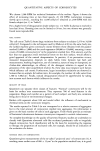
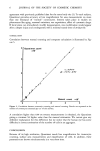
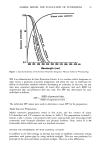
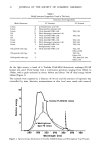
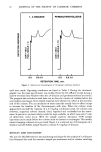
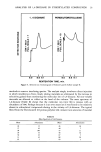
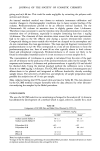
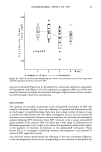
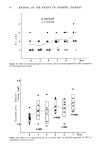
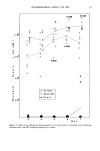
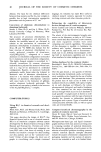
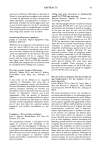
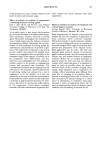
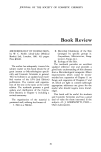
22 JOURNAL OF THE SOCIETY OF COSMETIC CHEMISTS 1,4 DIOXANE I I I 8.0 8.6 9.1 PERDEUTEROTOLUENE I I I 8.0 8.6 9.1 RETENTION TIME, min. Figure 2. Selected ion chromatogram of 1.0 mg/kg 1,4-dioxane standard. each were made. Operating conditions are listed in Table I. During the chromato- graphic run, the mass spectrometer was isolated from the GC effluent except during a narrow retention-time window when the 1,4-dioxane and perdeuterotoluene are eluted. The program also included a brief bake-out to clear the column of volatiles before the next analysis was begun. Non-volatile materials were allowed to collect at the injection end of the column. The accumulation of these materials usually had no effect except to increase the baseline of the chromatogram with time. When the column noise approached one-half the response of a 0.5 mg/kg 1,4-dioxane peak, the column was removed, unpacked, solvent cleaned, dried, repacked and re-installed on the instru- ment. In practice a second column would be kept available, in which case only 15 min of down-time could occur. With the sample matrices discussed, 75-80 sample injections can be made before the column must be cleaned or exchanged. This usually means changing columns once per week. Figure 3 is a selected ion chromatogram of a Sodium Laureth Sulfate sample found to contain 9.3 mg/kg 1,4-dioxane. RESULTS AND DISCUSSION The use of a GC/MS selective ion monitoring technique for the analysis of 1,4-dioxane has eliminated the need for extensive sample pre-treatments and/or column switching

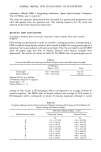
ANALYSIS OF 1,4-DIOXANE IN ETHOXYLATED COMPOUNDS 23 1,4 DIOXANE I I I 8.0 8.6 9.1 PERDEUTOROTOLUENE , I I I 8.0 8.6 9.1 RENTENTION TIME, min. Figure 3. Selected ion chromatogram of Sodium Laureth Sulfate sample B. methods to remove interfering species. The analysis simply involves a direct injection in which interferences from closely eluting materials are eliminated by the increase in selectivity gained from monitoring the molecular ion of 1,4-dioxane. All non-volatile materials are allowed to collect at the head of the column. The mass spectrum of 1,4-dioxane (Table II) shows that the molecular ion (m/e 88) is intense with an abundance of 59%. Perhaps because it is an even mass ion it was found to be relatively absent in ethoxylated compounds eluting in the vicinity of 1,4-dioxane. The typical bleed from the Chromosorb 103 porous polymer did contain trace amounts of material Table II Mass Spectrum of 1,4-Dioxane. Mass Abundance Mass Abundance 26 15 43 20 27 26 44 7 28 100 57 11 29 53 58 36 30 18 87 5 31 16 88 59 42 5 89 3
Purchased for the exclusive use of nofirst nolast (unknown)
From: SCC Media Library & Resource Center (library.scconline.org)