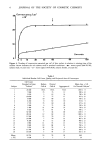
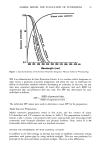
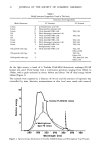
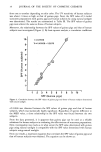
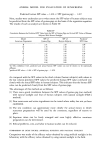
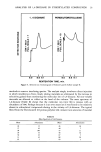
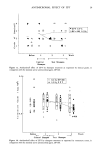
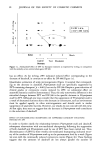
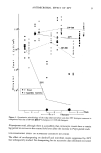
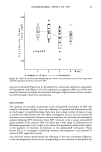
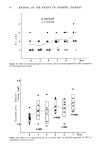
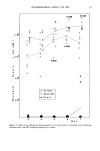
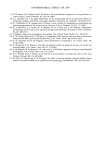
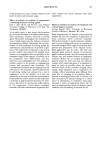
ANTIMICROBIAL EFFECT OF ZPT 35 I 0 6 •1 05 I 0 4 3 P• 0.01 P• 0.01 • O oo 0 P•O.01 o o o P•0•5 o Aerobe 0 Anaerobe ß Yeast 3 4 $ 6 7 Day Figure 5. Effect of no subsequent shampooing for six successive days on microbial count, following treatments with 1.0% ZPT-containing shampoo for 3 weeks.

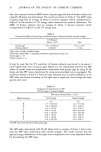
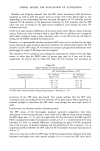
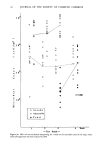
36 JOURNAL OF THE SOCIETY OF COSMETIC CHEMISTS specific decrease in Pityrosporum ovale 2) aerobic and anaerobic bacteria are not influenced by the use of ZPT even under the suppressed dandruff situation 3) no shampooing after suppression of dandruff and Pityrosporum ovale induces recovery of dandruff up to control level, but does not increase the number of Pityrosporum ovale in 6 days. From these findings, it is clear that the presence of ZPT molecules on scalp in concentrations capable of maintaining the continuous suppression of Pityrosporum ovale does not always result in reduction of dandruff. This suggests that there may be great differences between the effective concentrations of ZPT required to suppress dandruff and Pityrosporum ovale. Our microbial studies from some viewpoints fail to reveal direct evidence that the decreased number of Pityrosporum ovale contribute to the reduction of dandruff induced by the use of ZPT. It is very likely that ZPT may have an influence on other sites of the skin in a different manner from the way it suppresses Pityrosporum ovale and reduces the amounts of dandruff. Leyden et al (1) demonstrated similar suppression of Pityrosporum ovale without a decrease in the amounts of dandruff by use of Amphotericin B and emphasized significance of antimetabolic action by antidandruff agents in improvement of dandruff. Kligman et al (2) hypothesized that the mode of antidandruff action by both ZPT and SeS is cytostatic, although no data were given regarding ZPT's effect in decreasing epidermal proliferation. SeS does decrease the corneocyte count, with a corresponding decline in the labeling index. Concerning the mode of antidandruff action of ZPT, little is known about the possible biological function of ZPT-dependent reduction of dandruff except for a few actions associated with its highly antimicrobial effect. Priestly (16) speculated, based on acute toxicity of ZPT to cultured cells, that ZPT's action against dandruff is a result of non-specific toxicity for epidermal cells. Gloor et al (17) also have reported antimitotic effect of omadine MDS, which is chemically similar to zinc pyrithione. Since pyrithione is a general inhibitor of membrane transport process in fungi (7), it is possible that the suppression in dandruff by ZPT is due to a marked decrease in the activities of a variety of independently regulated transport systems in epidermal cells. In conclusion, the question of whether the mode of antidandruff action of ZPT is involved with antimetabolic effect on epidermis or not may require further analysis, especially of its cellular effects. REFERENCES (1) J. J. Leyden, K.J. McGinley and A.M. Kligman, Role of microorganisms in dandruff, Arch Dermatol., 112, 333-338 (1976). (2) A.M. Kligman, K.J. McGinley andJ. J. Leyden, The nature of dandruff, J. Soc. Cosmet. Chem., 27, 111-139 (1976). (3) E. Shaw, Analogs of aspergillic acid. I. The tautomerism of the hydroxypyridine N-oxide, J. Am. Chem. Soc., 71, 67-70 (1949). (4) E. Shaw, J. Bernstein, K. Losee and W. Lott, Analogs of aspergillic acid. IV. Substituted 2-bromopyridine-N-oxides and their conversion to cyclic thiohydroxamic acid,J. Am. Chem. Soc., 72, 4362-4364 (1950). (5) F. E. Pansy, H. Slander, W. L. Koerber and R. Donovich, In vitro studies with 1-hydroxy-2(1H) pyridinethione, Proc. Soc. Exp. Bid. Med., 82, 122-124 (1953). (6) H. Yale, Sulfur and selenium compounds of pyridine, Part IV, in Pyridine and its derivatives, E. Klingsberg, Ed., (Interscience, New York, 1964), p. 345-437.
Purchased for the exclusive use of nofirst nolast (unknown)
From: SCC Media Library & Resource Center (library.scconline.org)