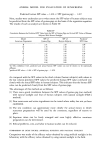
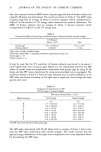
16 JOURNAL OF THE SOCIETY OF COSMETIC CHEMISTS First, the untreated (control) MED value of guinea pigs and that of human subjects by using FL-SE lamps was determined. The results are shown in Table V. The MED value of guinea pigs had an average of about 6 minutes exposure which corresponded to 0.6J/cm 2 as the amount of UV energy when measured by research radiometer. The MED of human subjects had an average of about 4 minutes exposure which corresponded to 0.4J/cm 2 as the UV energy dose. Table V Untreated Site MED of Guinea Pigs and Human Subjects Determined With Artificial Sunlight' UV-Monitor 2 (Mean _+ S.D.) Time Guinea pigs 3 0.63 _+ 0.13J/cm 2 6.0 _ 1.2 min Human subjects 4 0.38J/cm 2 3.7 min 'Light source: Toshiba FL40SE30 lamps. 2Thermopile. Model RM 1-1 integrating radiometer (Japan Spectroscopic Co.). 3Guinea pigs n = 50. 4Human subjects n = 3. It may be seen that the UV sensitivity of human subjects was found to be about 2 times higher than that of guinea pigs. Moreover, the relationship between the SPF values of model sunscreen preparations determined with guinea pigs by using FL-SE lamps and the SPF values determined by using natural sunlight were investigated. The results are shown in Table VI. From the data obtained here, a marked difference in the SPF value was found according to the light source employed, even though the same species were used. Table VI Comparison of Light Sources on SPF (FL-SE Lamps vs. Natural Sunlight) SPF values obtained (Mean _+ S.D.) • Model Sunscreen FL-SE Lamps Natural Sunlight (n) (n) B 2.77 _+ 0.67 (10) 2.21 + 0.73 (14) D 2.50 + 0.80 (14) 1.76 + 0.30 (5) F 3.14 + 0.47 (5) 2.10 + 0.70 (7) G 4.60 + 1.34 (5) 2.68 _+ 0.41 (10) H 15.01 _+ 4.36 (15) 3.19 -+ 0.87 (16) J 8.00 + 1.90 (5) 2.70 + 0.40 (5) K 27.93 - 3.40 (8) 7.68 + 0.69 (7) L 4.07 + 0.93 (15) 4.14 _+ 0.94 (7) 'The SPF values were determined with guinea pigs. The SPF value determined with FL-SE lamps had an average of about 3 times more than the SPF value determined with natural sunlight. The results indicate that the spectral energy distribution of the light source employed is the most important factor for determining the SPF value.

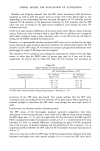
ANIMAL MODEL FOR EVALUATION OF SUNSCREENS 17 Kaidbey and Kligman showed that the SPF values determined with fluorescent suniamps as well as with hot quartz mercury lamps were either falsely high or low depending on the relationship between the peak absorption of UV absorber and the maximal UV-B emission of the fluorescent suniamp (5). This indicates that the SPF value may vary according to the light source employed, even though the same UV absorber was used. LeVee et al. also reported differences of the same nature when efficacy values obtained using a Xenon arc solar simulator with a 2mm WG-305 cut off filter were compared with values obtained using a solar simulator with a lmm WG-320 cut off filter in testing the 4% PABA standard formulations (6). However, it is questionable whether consistent SPF value can be obtained by the light source having the same emission spectrum therefore, the relationship between the UV intensity and the SPF values of 4 commercial sunscreen preparations determined with guinea pigs by using FL-SE lamps was investigated. The intensity of UV irradiation was changed by adjusting the distance from the light source in order that the MED value of guinea pigs may be 6 min and 30 min, respectively. As will be seen in Table VII, when the UV intensity was increased, an Table VII Relation Between UV Intensity and SPF SPF Values Obtained (Mean _+ S.D.) • Commercial Sunscreen FL ß SE-lamps FL ß SE-lamps Preparation Tested Med--6 min. MED--30 min. X 19.5 _+ 5.0 9.9 -+ 1.6 Y 15.0 _+ 4.4 6.7 + 1.2 Z 5.5 + 1.5 2.0 _+ 1.0 U 2.5 _+ 0.8 2.3 _+ 0.7 •The SPF values were determined with guinea pigs using FL ß SE-lamps. (n = 10) increment of the SPF value was found. The results indicate that the SPF value commonly varies according to the UV intensity of the light source when employing an artificial sunlight to determine the SPF value, even though the same light source is used. Furthermore, we obtained another interesting result. The SPF values of 8% homosalate standard sunscreen preparation have been determined 3 times during the past 3 years (1978, 1979, 1980) by using natural sunlight the SPF values were 2.2, 2.3, and 2.0, respectively. On the other hand, the SPF value for FDA's standard homosalate formulation is listed as 4.24 ___ 1.14 determined with solar simulator (1). This is a marked difference. Considering the spirit of FDA's proposed rule in the accuracy of product labeling and the protection of the consumer, it is an important problem whether the SPF value for 8% homosalate standard formulation is 4.24 or 2.1. Sayre et al. also found that the SPF value of 8% homosalate lotion obtained with solar simulator was higher than with natural sunlight (3.6 vs 2.4) and the SPF value had a
Purchased for the exclusive use of nofirst nolast (unknown)
From: SCC Media Library & Resource Center (library.scconline.org)