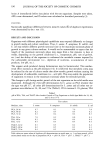
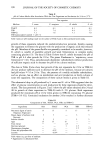
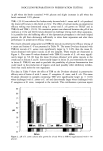
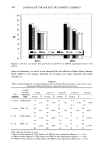
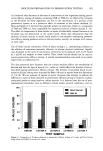
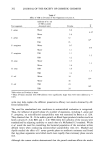
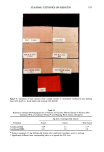
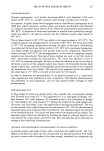
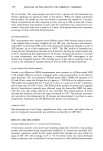
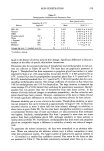
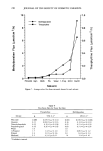
202 JOURNAL OF THE SOCIETY OF COSMETIC CHEMISTS Table V Effect of TSB on D-values of Test Organisms in Lotion A Addition of 0.1 ml of TSB or sterile -- Test organism deionized water D-value X S. aureus Water S. algrelg$ P. aeruginosa Water TSB TSB Water 6.8 5.6 12 15 0.7 1.1 1.1 14' 6.2* 0.9 Water P. aeruginosa TSB TSB 1.2 B. ereus Water 1.5 1.3 Water 1.0 B. ereus TSB 1.6 1.5 TSB 1.4 E. coli Water 14 15' Water 16 E. coli TSB 24 24* TSB 24 1.2 Table values are D-values in hours. * Mean D-values obtained with TSB addition were significantly larger than with water addition (p = 0.05). ocula may help explain the different preservative efficacy test results obtained by dif- ferent laboratories. The need for standardized test conditions in antimicrobial evaluation is recognized. Thus, the influence of growth phase of a number of organisms, including S. aureus and P. aeruginosa, on microdilution susceptibility tests was examined by Barry et al. (20). They observed that 18-24-hr surface growth on Blood Agar produced similar results as broth cultures (5-6-hr BHI and 2-4-hr TSB) when the turbidity of the inocula were standardized by adjusting turbidity to match that of a McFarland 0.5 standard. Wicks et al. noted the need for controlling the bacterial population of the inoculum within defined limits when conducting antimicrobial susceptibility tests (21). Mayhall and Apollo studied the effect of S. aureus growth phase on antibiotic resistance and found that log phase organisms were killed much more rapidly than stationary phase inocula (22). Although the current studies demonstrated that the growth medium affects the results

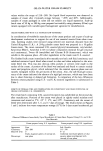
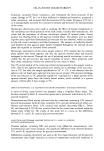
INOCULUM PREPARATION IN PRESERVATION TESTING 203 of preservative efficacy testing, the rate of inactivation of test organisms is independent of the concentration of organisms introduced in the sample (up to the point at which the preservative system is overwhelmed by the inoculum). This was substantiated by demonstrating that different concentrations ofS. aureus (from 1.5 x 10³ to 1.8 X 10⁶ S. aureus/mL) gave similar rates of inactivation in preservative efficacy tests of lotion (3). Thus, use of inocula adjusted to a standard turbidity is not needed for preservative efficacy testing performed by the linear regression method. Although the studies on the effects of incubation of cultures up to 72 hr used emul- sions, it is believed that similar results would be observed with different test organisms in preservative efficacy tests of different samples. Nevertheless, the suitability of using cultures incubated for extended periods should be determined using cosmetic and/or pharmaceutical products of interest in each laboratory. The effect of extended incubation of yeasts and molds was not studied because these organisms typically have slower growth rates than the test bacteria used in this work and because preservative testing generally is performed with cultures that have been incubated for 2-7 days at 20-25øC (1). The quantitative data on the kinetics of bacterial inactivation obtained by use of the linear regression method often provide investigators with a better understanding of preservative testing than is possible by use of non-quantitative methods. This work demonstrated that culture conditions and the type of inoculum affect the kinetics of bacterial death during preservative efficacy testing. It is evident that the acceptance criteria used in determining the suitability of preservative systems are dependent on the results of test methods used (1-3,8) and that changing methods may necessitate reeval- uation of acceptance criteria. It is recommended that test methods be modified to use saline suspensions of test organisms grown on solid agar media rather than broth ino- cula. ACKNOWLEDGMENTS We thank Mr. Mark Entrup of Hill Top Bioresearch Laboratories for furnishing the culture of B. subtilis. REFERENCES (1) Anon, "Microbiological Tests, Antimicrobial Preservatives--Effectiveness," in United States Pharma- copeia XXI (The United States Pharmacopeial Convention, Rockford, MD, 1985), pp. 1151-1152. (2) Preservation Subcommittee of the CTFA Microbiological Committee, A guideline for the determina- tion of adequacy of preservation of cosmetics and toiletry formulations, TGA Cosmet. J., 2, 20-23 (1970). (3) D. S. Orth, Linear regression method for rapid determination of cosmetic preservative efficacy,J. Soc. Cosmet. Chem., 30, 320-332 (1979). (4) E. J. Scibienski, J. J. O'Neill, and C. A. Mead, An accelerated preservation test. Presentation at the Annual Scientific Meeting of the Society of Cosmetic Chemists, Dec. 11, 1981. (5) M. Chan and H. N. Bruce, A rapid screening test for ranking preservative efficacy, Drug & Cosmet. Ind., 129, 34-37, 80-81 (1981). (6) G. K. Mulberry, M. R. Entrup, and J. R. Agin, Rapid screening methods for preservative efficacy evaluations, Cosmet. Toilet., 102, 47-50, 52-54 (1987).
Purchased for the exclusive use of nofirst nolast (unknown)
From: SCC Media Library & Resource Center (library.scconline.org)