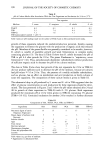
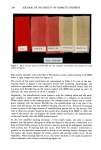
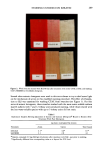
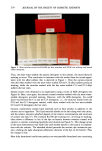
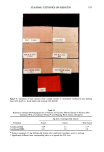
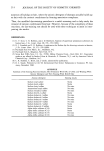
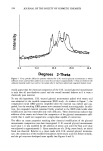
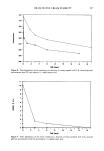
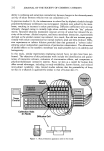
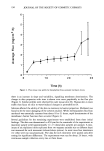
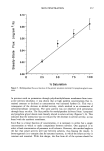
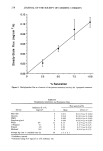
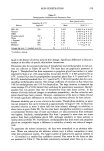
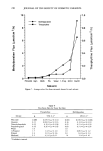
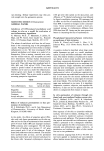
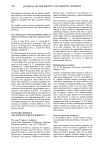
210 JOURNAL OF THE SOCIETY OF COSMETIC CHEMISTS bOllll'M I)½}1)1.'( 'E'I !1 •! I,FATFS ('TAC ( I•( II•-I.'l' ('1•( I1-1"( ('1'•('/.'4-1.() ('IACIS-I':O C1'•C/7-1"O Ci'M'/12.1,'(} Figure 3. Wool swatches stained with Red-80 dye after treatment with CTAC and washing with laureth sulfate detergents. Thus, the more water-soluble the anionic detergent in this scheme, the more likely for staining to occur. This conclusion is consistent with the results from the initial experi- ment with the alkyl sulfates that is depicted in Figure 1. Here the cationic-treated swatches when washed with the more water-soluble C8 and C 10 alkyl sulfates produced staining, while the swatches washed with the less water-soluble C12 and C14 alkyl sulfates did not stain. Similar results were obtained in an experiment using a series of AOS detergents (see Figure 4). Here, once again, the cationic-treated swatches washed with the more water- soluble detergents provided staining. However, with the AOS detergents, the cutoff point was between the C12 and the C14 detergents, i.e., the swatches washed with the C10 and the C12 detergents stained, while those washed with the less water-soluble C 14 and C 16 detergents did not stain. Cationic conditioners contain lipid materials such as fatty alcohol in addition to the cationic active ingredient. This lipid material adsorbs to the hair along with the cation, and the relative amounts adsorbed depend on the relative concentrations and structures of cationic and lipid (7). The standard Red-80 dye-staining test, involving no washing, often shows a difference in hue of the dye on keratin between swatches treated with cationic vs cationic containing lipid-like cetyl alcohol (see Figure 5). This change in hue of the stain demonstrates that lipids like cetyl alcohol adsorb to the keratin in combina- tion with the cationic. The adsorbed alcohol perturbs the cationic dye interaction pro- duct, shifting the light absorption-reflectance character of the dye on the keratin. Thus the change in hue. Most fully formulated conditioner products or even partially formulated ones containing

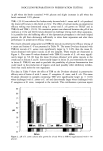
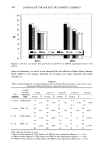
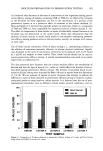
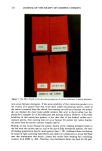
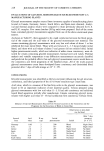
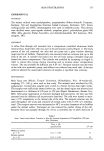
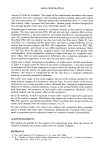
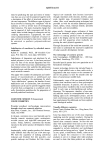
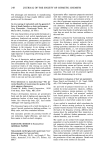
STAINING CATIONICS ON KERATIN 211 CTAC CTAC/CoI0 CTAC/C-12 CTAC/C-14 CTAC/C-16 AOS SURFACTANTS Figure 4. Wool swatches stained with Red-80 dye after treatment w•th CTAC and washing with AOS detergents. just cationic and fatty alcohol compare favorably to either pure SAC or CTAC in the modified dye-staining procedure. Figure 6 compares swatches treated with SAC, a partially formulated conditioner con- taining SAC and cetyl alcohol, and a commercial conditioner based on SAC and ceteth- 2 after washing with both sodium deceth-2 sulfate and SLS. All swatches washed with the deceth-2 sulfate show a light stain, in contrast to those washed with SLS, which do not stain. This suggests that the cationic adsorption, binding, and washing from ker- atin is similar whether it is used pure in solution or formulated into a conditioner. Nevertheless, we decided to test this hypothesis by radiotracer experiments. Table IT summarizes the results of an experiment in which a formulated conditioner containing radiolabeled SAC and ceteth-2 was washed from wool fabric by solutions of radiolabeled SDES and ALS. The binding of the anionic detergent is similar to the case where pure cationics are washed (compare the results of Tables T and TT). Here roughly two times the amount of ALSvs SDES binds to the keratin-containing cationic. Fur- thermore, in the dye-staining test, the SDES species can be displaced by the anionic dye, but the lauryl sulfate moiety cannot. In contrast to the case of washing pure cationic from keratin, these results with a fully formulated product show that both of these anionic detergents, ALS and SDES, remove a similar amount of cationic from the swatch, but a large difference exists in the amount of anion that is left behind, with nearly two times the amount of lauryl sulfate vs deceth sulfate being left behind on the keratin. From all of these staining and radiotracer results, we conclude the following: Swatches of keratin fibers when treated with cationic detergents bind those detergents by electro- static and Van der Waals attractive forces. When one attempts to remove the cationic detergent from the hair by washing with an anionic detergent, an electrostatic interac-
Purchased for the exclusive use of nofirst nolast (unknown)
From: SCC Media Library & Resource Center (library.scconline.org)