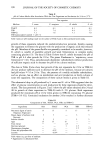
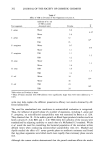
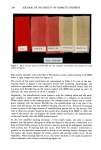
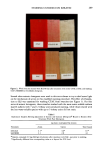
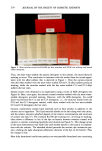
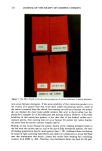
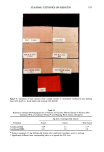
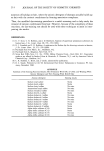
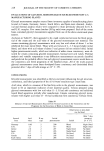
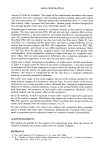
214 JOURNAL OF THE SOCIETY OF COSMETIC CHEMISTS nomenon of buildup on hair, where the anionic detergent of shampoo actually builds up on hair with the cationic conditioner by forming association complexes. Thus, the modified dye-staining procedure is a useful screening tool to help study the removal of cationic conditioners from hair. However, because of the complexity of these reactions, the dye-staining test should be used with other techniques to assist in inter- preting the results.. REFERENCES (1) G. V. Scott, C. R. Robbins, and J. D. Barnhurst, Sorption of quaternary ammonium surfactants by human hair, J. Soc. Cosmet. Chem. 20, 135-152 (1969). (2) R. J. Crawford and C. R. Robbins, A replacement for Rubine dye for detecting cationics on keratin, J. Soc. Cosmet. Chem., 31, 273-278 (1980). (3) Purchased from Test Fabric, Inc., Middlesex, N.J. (4) Purchased from A. Klugman, New York, N.Y. (5) Sirius Red F3BA New, C.I. No. 35780, Mobay Chemical Corp., Rock Hill, S.C. Equivalent products are offered by Sandoz Colors & Chemicals, E. Hanover, N.J., and by American Color & Chemical Corp., Charlotte, N.C. (6) C. R. Robbins, C. Reich, and J. Clarke, submitted for publication. (7) R. L. Sneath. Presented at the 5th International Hair Science Symposium in Constance, W. Ger- many, November 1986. APPENDIX Summary of the Staining Reaction Results After Treatment With SAC or CTAC and Washing With Anionic Detergent and Then Staining With Red-80 Dye Anionic detergent Staining results Sodium octyl sulfate Sodium decyl sulfate Sodium lauryl sulfate Ammonium lauryl sulfate Sodium tetradecyl sulfate Sodium deceth-2 sulfate Sodium dodeceth-1 sulfate Sodium dodeceth-2 sulfate Sodium dodeceth-3 sulfate Sodium dodeceth-5 sulfate Sodium dodeceth-7 sulfate Sodium dodeceth-12 sulfate Alpha olefin sulfonate (C10) Alpha olefin sulfonate (C12) Alpha olefin sulfonate (C 14) Alpha olefin sulfonate (C16) Stains Stains No stain No stain No stain Stains No stain No stain No stain No stain Stains Stains Stains Stains No stain No stain

j. Soc. Cosmet. Chem., 40, 215-229 (July/August 1989) Effects of variations in physicochemical properties of glyceryl monostearate on the stability of an oil-in- water cream R. O'LAUGHLIN, C. SACHS, H. BRITTAIN, E. COHEN, P. TIMMINS, and S. VARIA,* The Squibb Institute for Medical Research, New Brunswick, NJ 08903-0191 (R.O., C.S., H.B., E.C., S. V. ), and International Development Labs, E. R. Squibb & Sons, Reeds Lane, Moreton, Merseyside, U.K. (P.T.). * To whom correspondence should be addressed. Received March 22, 1989. Synopsis During the development of an oil-in-water cream formulation, syneresis of the aqueous phase was observed. A quantitative syneresis test was devised to study the separation of the aqueous phase. Variations in the physical and chemical characteristics of glyceryl monostearate obtained from various sources were identified as the principal factors influencing syneresis of the formulation. A group of diagnostic tests, including variable temperature x-ray diffraction analysis developed for screening various lots of glyceryl monostearate, was used to successfully predict the possibility of the occurrence of syneresis in a cream batch. The acid value of the various lots of glyceryl monostearates correlated well with the propensity of the cream to produce syneresis. Increasing the acid value of the glyceryl monostearate by the addition of small amounts of fatty acids eliminated the observed syneresis. Further, the storage temperature had a profound effect on the syneresis and consistency. INTRODUCTION Pharmaceutical cream bases are essentially semisolid emulsion systems that appear "creamy white" due to reflection of light by the internal dispersed phase. The most common creams are oil-in-water emulsion systems, whose structure or semisolid char- acter is dependent upon emulsified liquid droplets or particles that comprise the in- ternal phase. Creams are usually prepared at high temperature (fusion method) using internal-phase materials such as mineral or vegetable oils, liquid emollient esters, solid long-chain fatty acids, alcohols, and esters. Upon cooling, these ingredients exist as dispersed or emulsified microscopic droplets, liquid crystals, solid particles, or spheres, creating a three-dimensional gel structure or matrix that entraps the aqueous external phase (1,2). In many formulations the gel structure may be metastable. Creams are dynamic compositions that are influenced by temperature storage and shear forces. The gel structure may stiffen, contract, and shrink at cold temperatures, or soften, expand, and fluidize at warm temperatures. Gel structure may be broken down due to shear thinning by mechanical mixing, pumping, or rubbing. Many creams possess thixo- tropic properties that allow recovery of gel structure upon storage after exposure to shear thinning. 215
Purchased for the exclusive use of nofirst nolast (unknown)
From: SCC Media Library & Resource Center (library.scconline.org)