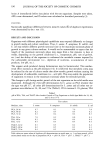
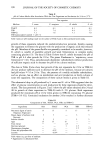
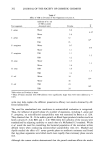
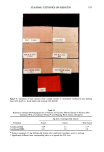
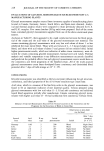
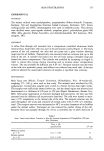
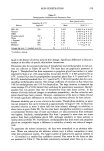
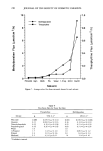
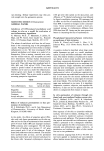
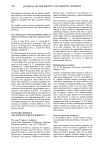
196 JOURNAL OF THE SOCIETY OF COSMETIC CHEMISTS lotion A immediately before inoculation with the test organisms. Samples were taken, APCs were determined, and D-values were calculated as described previously (3). STATISTICS -- Statistically significant differences between mean D-values (X) of duplicate experiments were determined by the t test (13). RESULTS AND DISCUSSION Organisms with different physiological capabilities may respond differently to changes in growth media and culture conditions. Thus, S. aurem, P. aeruginosa, B. subtilis, and E. coli may exhibit different growth rates and time in the maximum stationary phase of growth in any given culture medium. It would not be unreasonable to expect that the length of the maximum stationary phase may range from a few minutes to days or weeks, depending on the growth conditions (i.e., temperature, pH, rate of growth, etc.) and the ability of the organism to withstand the metabolic stresses imposed by the unfavorable environment (i.e., depletion of nutrients, accumulation of toxic products, low pH, etc.). The organic acids produced during fermentation may be bacteriocidal. This antibac- terial effect increases as the pH decreases (14). It is believed that metabolic stress may be reduced by the use of culture media that allow aerobic growth without causing the development of unfavorable conditions (i. e., acid pH). This may enable the population of organisms to remain in the maximum stationary phase for extended periods. The changes in pH during aerobic growth of the test organisms on the solid media were monitored. Although the 24-hr pH determination for S. aureus on PCA revealed that the agar was pH 6.7, all other pH determinations for S. aureus and all other test or- ganisms were alkaline at 24, 48, and 72 hr (Table I). PCA contains 0.1% glucose TSA Table I pH of PCA, TSA, and TSALT After Aerobic Growth of Test Organisms on Solid Agar Media for 24, 48, and 72 hr at 37øC Test culture Medium, time S. aureus P. aeruginosa B. subtilis E. coli PCA, 24 hr 6.7 8.1 7.9 7.8 PCA, 48 hr 8.2 8.4 8.4 8.2 PCA, 72 hr 8.3 8.4 8.4 8.3 TSA, 24 hr 7.8 8.2 8.0 8.3 TSA, 48 hr 8.3 8.4 8.4 8.4 TSA, 72 hr 8.4 8.5 8.4 8.4 TSALT, 24 hr 8.3 8.5 8.2 8.2 TSALT, 48 hr 8.2 8.5 8.2 8.3 TSALT, 72 hr 8.4 8.5 8.4 8.4 Table values are mean values of duplicate pH determinations on sterile agar, ca. 1 cm from growth. pH of uninoculated media on the day of preparation: PCA -- pH 6.8, TSA = pH 7.1, TSALT = pH 7.1.

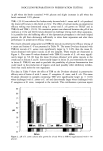
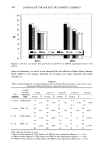
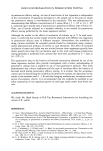
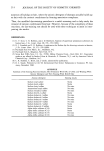
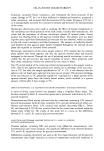
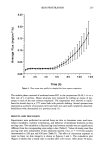
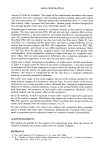
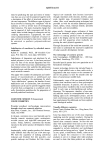
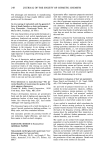
INOCULUM PREPARATION IN PRESERVATION TESTING 197 contains no added glucose. The pH values for uninoculated PCA, TSA, and TSALT were pH 6.8, 7.1, and 7.1, respectively. These pH determinations suggested that extended incubation on solid agar media did not cause these bacteria to produce acid that could cause metabolic stress consequently, the effect of incubating the test organisms on TSALT for 24, 48, and 72 hr on preser- vative efficacy testing was studied. Excellent reproducibility of test data was obtained when these cultures were used in preservative efficacy testing of lotion A. Thus, D- values obtained with 24-, 48-, and 72-hr cultures were within 0.1 hr for S. aureus, O. 5 hr for P. aeruginosa, 0.3 hr for B. subtills (ATCC 6633), and 0.3 hr for E. coli (Figure 1). These differences of 0.5 hr for repetitive analyses of lotion A samples using the same test organism are considered to be within the precision limits of the linear regression method (7). This study was repeated two times with essentially the same results. Sim- ilar results were obtained when this experiment was repeated, in triplicate, with lotion B. This demonstrates that saline inocula from surface growth from 24-, 48-, or 72-hr TSALT cultures provide essentially the same D-values in preservative efficacy testing of these lotions with these test organisms. Although surface growth of the test organisms on solid media produced negligible acidity during the 72-hr incubation period, growth in TSB, which contains 0.25% glucose, caused an appreciable drop in pH of some of the test cultures after growth for 24 hr (Table II). The data illustrate that S. aureus and E. coli reduced the pH of TSB from the initial pH of 7.2 to pH 5.3 and 5.7, respectively. These organisms are facul- tative aerobes, which means that they can grow either aerobically or anaerobically. Although the static broth tubes were incubated aerobically, it is believed that rapid ,..,4 UJ 2 • 24 HRSIIIIHRS • 48 •:• 7'2 HI:iS S. aureus P. aeruginosa Bacillus E.coli 3.9 0.5 1.2 1.3 3.9 0.9 1.5 4 1 1.5 1.1 Figure 1. D-values obtained in lotion A using saline suspensions from 24-, 48-, and 72-hr TSALT cul- tures of S. aureus and E. coli.
Purchased for the exclusive use of nofirst nolast (unknown)
From: SCC Media Library & Resource Center (library.scconline.org)