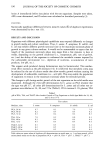
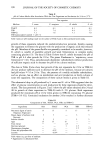
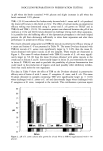
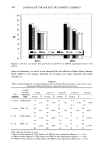
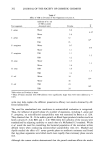
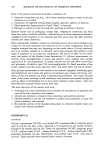
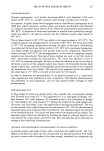
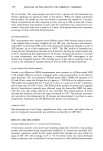
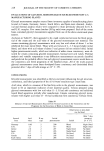
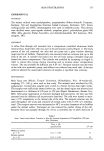
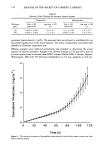
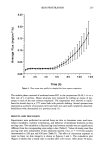
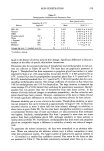
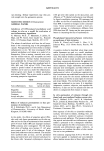
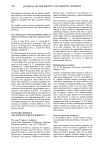
198 JOURNAL OF THE SOCIETY OF COSMETIC CHEMISTS Table II pH of Culture Media After Inoculation With the Test Organisms and Incubation for 24 hr at 37øC Test organism Medium S. aureus P. aeruginosa B. subtills E. coli TSALT 8.2 8.1 8.1 8.3 TSB 5.3 7.4 6.4 5.7 TSB(-G) 7.1 7.6 7.1 7.0 TSB (uninoculated control) = pH 7.2 Table values are pH readings made on the surface of TSALT and in filter-sterilized broth media. growth of these organisms reduced the oxidation/reduction potential, thereby causing the organisms to ferment the glucose with the production of organic acids that reduced the pH. Members of the genus Bacillus are generally considered to be aerobic however, B. subtills is capable of anaerobic growth and weak fermentation in complex media containing glucose (15). The data in Table II show that B, subtills decreased the pH of TSB to pH 6.4 after growth for 24 hr. The genus Pseudomonas is "respiratory, never fermentative" (16). Thus, pseudomonads dissimilate carbohydrates without production of sufficient organic acids to decrease the pH of the culture medium. The data in Table II also show that growth of the test organisms for 24 hr in TSB(-G) did not produce sufficient acid to decrease the pH of the medium, because all cultures had pH values •7.0 at 24 hr. Thus, the presence of a readily utilizable carbohydrate, such as glucose, has an effect on metabolism and acid production in broth cultures of some test organisms. The composition of these culture media is given in Table III. The substantial drop in pH produced by S. aureus and E. coli in TSB suggested that the effect of glucose concentration on acid production by these organisms should be deter- mined. The data presented in Figures 2 and 3 show the pH values obtained after 24 and 48 hr growth of these organisms in TSB(-G) with 0-5% glucose. Both organisms produced the minimum pH at 24 hr when grown in TSB(-G) containing 3% glucose [TSB( + 3% G)]. Continued incubation for another 24 hr resulted in further decreases Table III Composition of TSA, TSALT, PCA, TSB, and TSB(-G) Ingredients TSA TSALT PCA TSB TSB(-G) Pancreatic digest of casein 15 15 5 17 17 (Tryptone Trypticase) Papaic digest of soybean meal 5 5 -- 3 3 (Soytone) Sodium chloride 5 5 -- 5 5 Agar 15 15 15 -- -- Yeast extract -- -- 2.5 -- -- Dextrose (glucose) -- -- 1 2.5 -- Dipotassium phosphate -- -- -- 2.5 2.5 Tween 80 (polysorbate 80) -- 0.5* -- -- -- Lecithin -- 0.07' -- -- -- Table values in g per liter of medium. * Supplements to dehydrated TSA.

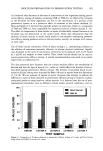
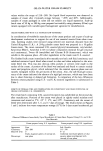
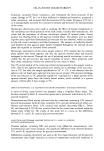
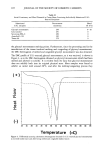
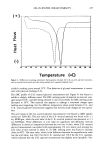
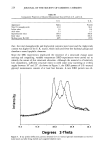
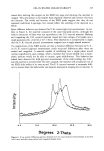
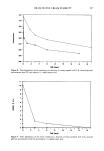
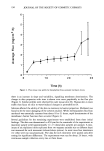
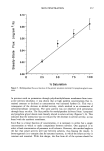
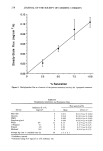
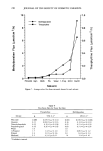
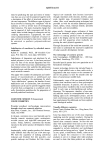
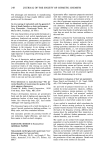
INOCULUM PREPARATION IN PRESERVATION TESTING 199 in pH when the broth contained •4% glucose and slight increases in pH when the broth contained 42% glucose. TSB( + 3% G) was selected for further study because both S. aureus and E. coli produced the lowest pH values in this broth at 24 hr. The effect of culture media on preservative efficacy testing was determined using S. aureus and E. coli grown on TSALT and in TSB(-G) and TSB(+ 3% G). No consistent pattern was observed between the pH of the medium at 24 hr and the D-values obtained in challenge testing with these organisms. It is possible that the buffering effect of the dipotassium phosphate in the broth helped prevent the pH from decreasing sufficiently to stress these organisms and alter their performance in preservative efficacy testing. The results obtained using saline and TSB(-G) inocula in preservative efficacy testing of a cream and lotions C-F are presented in Table IV. The mean D-values obtained with TSB(-G) inocula of S. aureus were significantly larger (p 4 0.05) than the mean D- values obtained with saline inocula in all test samples. These results are illustrated in Figure 4. The mean D-values obtained with TSB(-G) inocula of E. coli were signifi- cantly larger (p 40.10) than the mean D-values obtained with saline inocula in the cream and in lotions C and F, directionally larger in lotion D, and essentially the same in lotion E. TSB(-G) was used to preclude the possibility of glucose fermentation that could result in the production of organic acids (and possibly other inhibitory metabo- lites) that could stress the test organisms. The data in Table V show the effect of TSB on the D-values obtained in preservative efficacy tests of lotion A with S. aureus, P. aeruginosa, B. cereus, and E. coli. The mean D-values obtained in samples containing TSB were significantly larger (p = 0.05) when challenged with S. aureus or E. coli and directionally larger when challenged with P. aeruginosa or B. cereus, compared to the controls. This corroborates a previous report _ 8 7 6 5 4 3 2 1 24hrs 48hrs Figure 2. pH of S. aureus cultures after growth for 24 and 48 hr in TSB(-G) supplemented with 0-5% glucose.
Purchased for the exclusive use of nofirst nolast (unknown)
From: SCC Media Library & Resource Center (library.scconline.org)