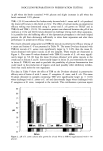
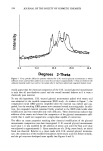
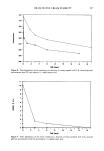
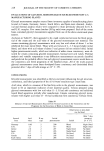
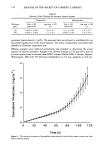
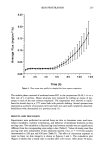
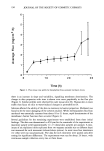
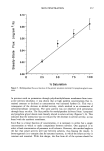
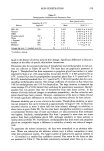
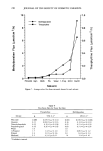
SKIN PENETRATION 235 0.25 0.20 0.15 0.10 0.05 0.00 ß ' I i 1 ß ' I ' ' I I 0 20 40 60 80 100 120 Time (h) Figure 3. Flux versus time profile for theophylline from aqueous suspension. The mobile phase consisted of methanol:water:HCl in the proportions 60:40:1 v/v at a flow rate of 1.0 ml/min. Donor solutions were prepared by adding an excess of per- meant to each of the neat solvents employed. The suspensions were allowed to equili- brate for several days in a 37øC water bath with periodic shaking. Several systems were examined as a percent of saturation (w/w) and were not used until completely dissolved. Solubilities were determined in a previous study (5). RESULTS AND DISCUSSION Experiments were performed on excised fuzzy rat skin to determine inter- and intra- subject variability, stability to hydration, and influence of membrane thickness on flux and lag time. The variability in flux and lag time between animals was not significantly different from the corresponding inter-subject data (Table I). Values of steady-state flux and lag time were independent of skin thickness (pooled t-test, ot = 0.05) for samples dermatomed to 320 !.•m and 450 !.•m (Table II). The effect of continuous exposure to water on fuzzy rat skin integrity is shown in Figures 2 and 3. The cumulative plot (Figure 2) shows that a steady state is reached after a few hours. After about 50 hours,

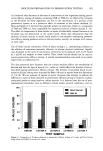
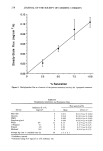
236 JOURNAL OF THE SOCIETY OF COSMETIC CHEMISTS ß ' ' ' I ' ' ' ' ! ' ' 0 10 20 30 Time (h) Figure 4. Flux versus time profile for theophylline from saturated methanol donors. there is an increase in slope and variability, signalling membrane deterioration. The change in skin properties with time is shown even more graphically in the flux plot (Figure 3). Similar profiles were observed for nude mouse skin (8). Human skin is more stable than fuzzy rat skin to water-induced changes in permeability (9). Solvents affected the ability of the skin to maintain its barrier properties. Methanol was found to be the most damaging of the solvents studied. While methylparaben flux from methanol was essentially constant from about 10 to 23 hours, rapid deterioration of the membrane's barrier function then occurred (Figure 4). Several guidelines for the remaining experiments were established from these initial findings. The skin was dermatomed to 450 I•m for the remainder of the experiments to maximize sample yield (approximately 12-15 dorsal skin samples per animal). A min- imum of six replicates (three replicates from two separate animals run on different days) was measured for each treatment (solvent/solute system). In most cases four treatments (12 cells) were run simultaneously. The data for each treatment were pooled only after testing for significant differences. The experiments were run for about 24 hours, with continuous sample collection every two or three hours.
Purchased for the exclusive use of nofirst nolast (unknown)
From: SCC Media Library & Resource Center (library.scconline.org)