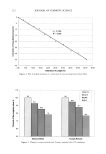
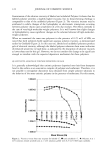
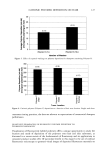
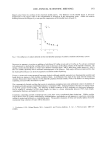
110 JOURNAL OF COSMETIC SCIENCE 12 10 6 i .............. 10.9 •: i r•DL EIDb BIDE •DYI ..... -3.69 9.34 # 3, OMC 1 •33 ---- f i o.61 o• -0.42 # 2, CATC 4,42 # 4, SLS Gray Hair Sample Figure 2. Change in color index values of gray hair tresses after UV irradiation. color. This demonstrates that CATC is a very good UV absorber and protects hair from color fading. CHANGE IN CROSS-SECTIONAL AREA WITH EXTENSION As a solid fiber, it is known that the cross-sectional area of a hair fiber decreases with an increase in its length during the extension process. Since human hair consists mainly of ot-keratin, a biological polymer, it is expected that the hair fibers exhibit viscoelastic properties. Therefore, the contraction in the cross-sectional area of a hair fiber during its extension process would not exactly be inversely proportional to the amount of its extension. In order to find and establish the exact correlation between the length extension and the contraction of the cross-sectional area during the elongation process, we measured the center cross-sectional areas at different extensions for 100 single brown and gray hair fibers. The plot of the length extension rs. average contraction of the central cross- sectional area is presented in Figure 4. It was found that the correlation between the length extension and the average contraction of the center cross-sectional area is a statistically linear function. The determined ratio of extension to contraction is 1 to 0.758, which indicates that as a hair fiber is extended by 10%, its cross-sectional area only contracts about 7.58%. This coefficient was very useful, and used in calculations of the revised cross-sectional area at the strain-to-break.

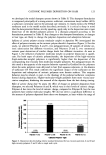
UV DAMAGE ON GRAY HAIR 111 4.5 3.5 2.5 2 1.5 0.5 [3DL EIDb I•IDE 1 0.71 0.72 # 2, CATC 3,89 2.94 . # 3, OMC Brown Hair Sample 4.45 3.58 . # 4, SLS Figure 3. Change in color index values of brown hair tresses after UV irradiation. CHANGE IN TENSILE STRENGTH The changes in both the average Young's modulus and stress-to-break of gray hair samples after 15 days of UV irradiation are presented in Figure 5. It is readily seen that after 15 days of UV irradiation, hair fibers from gray hair tresses 2, 3, and 4 retained 94.6%, 87.7%, and 76.6% of their initial Young's modulus, and 92.7%, 85.4%, and 78% of their initial stress-to-break values, respectively. All of these reductions in tensile strength indicated that the cortex of the hair fiber was damaged and that some portion of the disulfide bonds, hydrogen bonds, and salt bridges were likely modified. The above results clearly demonstrated that CATC helped to maintain the tensile strength of hair. CHANGES IN DYNAMIC CONTACT ANGLE Changes in the average dyanmic advancing contact angles of gray hair fibers after UV irradiation are presented in Figure 6. It is readily seen that the average advancing contact angles of hair fibers from tresses 3 and 4 decreased dramatically, which indicates that the characteristics of the hair surface were changed from hydrophobic to hydrophilic because of the surface damage. This increase in the hydrophilicity and wettability of the hair surface may be partially attributed to the loss of 18-MEA and other fatty acids on the hair surface (10). In contrast, only the hair fibers treated with CATC maintained their
Purchased for the exclusive use of nofirst nolast (unknown)
From: SCC Media Library & Resource Center (library.scconline.org)