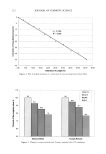
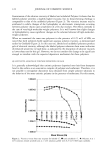
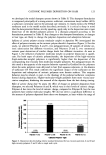
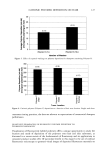
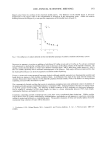
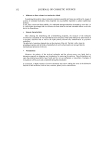
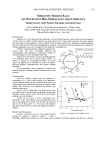
114 JOURNAL OF COSMETIC SCIENCE 300 250 200 •5o- 100 50 [] NO UV [] CATC ß OMC I i [] SLS lOO ::::::ii!!!i :' :' :' :' :' :' 21.5 252 241 :•.:,•:: .... ===================== ß ... :-: -.-....:. ß :...-.:.:.:. • ß :: .: ...:......: ß ::.! •, ...::!i-:3-i::!ii:: ß ii:: ':• :": :'":'::: ' :" ' ' '! i• :.' :' '. :-:---:'.:: ß :•: ::'::.':!:i..:i.:'..' •.• .:.:..,:...: :.:..... .:.:• •:. ,...::: :¾:,:.::. . 1oo Peak Load Total Work Figure 7. Changes in wet combing force after UV irradiation. part to the oxidation of cystine to cysteic acid. As a result of the increased surface hydrophilicity (wettability), the wet combing force of these hair tresses increased dra- matically. In contrast, the peak load and the total work for the hair tress treated with CATC were reduced 78.5% and 72.2%, respectively. This reduction in the wet combing forces for tress 2 clearly indicates that CATC provides a conditioning benefit in addition to its U¾ protective function. SWELLING TEST Radnapandian et aL (1) determined the extent of transverse swelling in a 0.1 N NaOH solution of Piedmont hair that had been irradiated for 300 hours at various RH levels. In a similar fashion, we determined the average increases in the center cross-sectional area of hair fibers after 15 days of U¾ irradiation. The data are summarized in Figure 8. It is seen that the hair fibers treated with CATC showed almost the same amount of transverse swelling as the hair fibers without U¾ exposure. Hair fibers treated with 10% SLS exhibited the highest amount of swelling. Swelling increases with the loss of crosslinks inside the hair fiber (13). Hence, our experimental results suggest that hair treated with CATC retains a larger number of crosslinks compared to hair treated with either SLS/OMC or SLS. This interpretation is consistent with our test results of tensile strength. Alternatively, as suggested by Ratnapandian et •1. (1), the degradation of protein in the hair fiber may cause swelling. Hair tresses treated with SLS or OMC had less U¾ protection, and the proteins may have been extensively degraded. Protein residues possessing molecular weights small enough to let them diffuse out of the fiber during immersion in 0.1 N NaOH solution may have left holes in the cortex allowing the NaOH solution to swell the hair. Hair treated with CATC experienced less protein

UV DAMAGE ON GRAY HAIR 115 16 lO 13.7 11.3 :.:.:. .:.:. . NO UV 11.7 ........ ...... :... :...:. C^TC OMC Hair Sample and Treatment Figure 8. Transverse swelling of hair fibers after UV irradiation. 15.5 .:.:.'.:: - ::::.'. ........ ::::::::::::::::::::::::: ........... : :7::'?:.: . .:...: :... ::..:.:..:.. ß .: ...:.:.-::-:.:... ß ::::::::::::::::::::: ..' '.' :-: .'.':'::: ß SLS degradation, and the protein residues were large enough to be retained. This only leads to osmotic swelling of fiber, which is smaller in magnitude than the diffusion swelling caused by the loss of protein fragments. TRYPTOPHAN DAMAGE In order to compare the tryptophan damage on the surface of hair, we measured fluo- rescence intensities of four test gray hair tresses using a Fluorolog-3 spectrophotometer from Spex with a solid-sample accessory. The excitation wavelength was set at 295 nm and the tryptophan emission intensity was measured at 340 nm. The percent tryptophan damage (Trp damage) was calculated as [(I o - Ia)/I o] x 100, where I a and I o represent, respectively, the tryptophan emission intensities from damaged hair and non-damaged hair (5). The emission intensity has been assumed to be directly proportional to the surface tryptophan concentration. The percent photoprotection was calculated as 1-Trp damage. The calculated Trp damage and percent photoprotection are presented in Figure 9. After 15 consecutive days of UV irradiation, the unprotected natural gray hair (tress 4) lost about 85% of its surface tryptophan content. Gonzenbach et al. (9) reported 26.4% to 37.6% decreases in tryptophan content of untreated blond hair after 180 hours of exposure to simulated sunlight. Cegarra and Gacen (14) reported that the tryptophan content in wool decreased about 61% after 100 exposure hours in a Fade-Ometer. Jachowicz et al. (5) have indicated that the fluorescence technique probes only the surface layers of hair and detects tryptophan damage related to the residues of this amino acid located in the cuticles and/or outermost layers of the cortex. They reported 45% tryp- tophan loss for Piedmont hair under outdoor solar irradiation for only 65 hours. Our
Purchased for the exclusive use of nofirst nolast (unknown)
From: SCC Media Library & Resource Center (library.scconline.org)