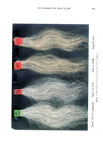
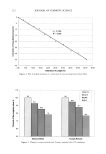
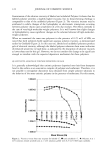
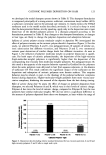
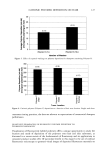
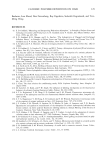
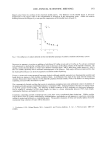
116 JOURNAL OF COSMETIC SCIENCE • •oo-t 13., 80 ½ 40 o i•1 Photoptotection, % i 95,83 4..17 ..... f111111lllllll # 2, CATC 85,42 19,1 ? # 3, OMS # 4, SLS Hair Sample Figure 9. Tryptophan damage and photoprotection of different hair tresses. experimental results are consistent with their studies. From. Figure 9, it is clear that CATC provides very effective protection from. tryptophan photodamage. CUTICLE ABRASION After UV irradiation, hair fibers from the four test gray hair tresses were taken and examined under SEM. No visible damage on the hair surface (cuticle appearance) was observed. In order to detect the structural damages in hair cuticles, we combed all these four test gray hair tresses with 1000 strokes using a combing wheel (one combing per second). After combing, we randomly collected hair fibers from these hair tresses and inspected them. under SEM to determine the extent of cuticle abrasion. Four typical SEM pictures are presented in Figure It is seen that hair fibers from. tresses 3 and 4 underwent more cuticle abrasion compared with those from tresses 1 and 2. These results indicated that more cuticle structural damages were taking place in tresses 3 and 4 than in tresses 1 and 2 during UV irradiation. This clearly demonstrates that the hair surface (cuticles) in tress 2 was protected by CATC from. a combination of mechanical and UV damage. COMPARISON OF UV DAMAGE IN GRAY VS. DARK BROWN HAIR Some of the UV damage data for gray and dark brown hair tresses are summarized in Table II to demonstrate the effects of pigmentation on UV damage.

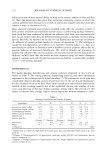
UV DAMAGE ON GRAY HAIR 117 Fig. 10-a Tress 1 (No UV) Fig. 10-b Tress 2 (CATC) Fig. 10-c Tress 3 (OMC) Fig. 10-d Tress 4 (SLS) Figure 10. SEM pictures of hair fibers after 1000 combing strokes. Table II UV Damage on Gray and Dark Brown Hair* Gray hair Dark brown hair Tress Tress Tress Tress Tress Tress 2 3 4 2 3 4 Hair treatment CATC OMC SLS CATC OMC SLS Stress-to-break retention (%) 92.1 82.1 75.7 96.6 88.6 81.1 Tryptophan damage (%) 4.17 79.17 85.42 4.5 80.2 85.2 Difference in color (AE) 0.74 5.56 7.42 0.72 3.89 4.45 * Data collected for gray hair after 15 days of UV irradiation and for dark brown hair after 20 days of UV irradiation. From the data in Table II it can be concluded that gray hair is more sensitive to UV irradiation and undergoes more severe damage than dark brown hair. These results clearly demonstrate that gray hair needs additional protection from UV exposure. CONCLUSIONS It has been shown that there are no statistically significant differences in the center maximum diameter, center cross-sectional area, center ellipticity, extent of swelling, stress-to-break, and strain-to-break between gray and black hair from the same heads
Purchased for the exclusive use of nofirst nolast (unknown)
From: SCC Media Library & Resource Center (library.scconline.org)