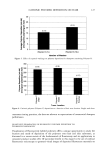
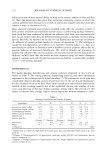
118 JOURNAL OF COSMETIC SCIENCE (Table I). However, UV irradiation causes more severe damage on natural gray hair than on natural dark brown hair (Table II). The extent of UV damage can be assessed by the following measurements: a change in hair color (color fading or yellowing), a decrease in tensile strength (Young's modulus and stress-to-break), a decrease in dynamic advancing contact angle, a loss of tryptophan at the hair surface, and an increase in hair swelling in 0.1 N NaOH solution. It has been found that the quaternized UV absorber, cinna- midopropyltrimonium chloride (CATC), delivered from a simple rinse-off shampoo system, is more substantive on hair and more effective in protecting hair from UV damage than a conventional UV filter. CATC not only provides excellent UV protection for hair, but provides conditioning benefits as well. ACKNOWLEDGEMENTS The authors acknowledge Kevin Gallagher's encouragement and Dr. Rob Comber's invaluable help and discussions during the whole study. REFERENCES (1) S. Ramapandian, S. B. Warner, and Y. K. Kamath, Photodegradation of human hair,J. Cosmet. Sd., 49, 309-320 (1998). (2) E. Hoting, M. Zimmermann, and S. Hilterhaus-Bong, Photochemical alterations in human hair, I. Artificial irradiation and investigations of hair proteins,J. Soc. Cosmet. Chem., 46, 85-99 (1995). (3) E. Hoting and M. Zimmermann, Sunlight-induced modifications in bleached, permed, or dyed human hair, J. Soc Cosmet. Chem., 48, 79-91 (1997). (4) E. Hoting, M. Zimmermann, and S. Hilterhaus-Bong, Photochemical alterations in human hair. II. Analysis of melanin, J. Soc Cosmet. Chem., 46, 181-190 (1995). (5) J. Jachowicz, M. Helioff, and C. Rocafort, Photodegradation of hair and its photoprotection by a substantive photofilter, DCI, 28-44 (December 1995). (6) C. Pande and J. Jachowicz, Hair photodamage--Measurement and prevention, J. Soc. Cosmet. Chem., 44, 109-122 (1993). (7) A. Deftandre, J. Garson, and E. Leroy, Photoaging and photoprotection of natural hair, 16th IFSCC Congress, New York, October 8-11, 1990, pp. 197-208. (8) Giesen et al., UV filter for hair protection, 16th IFSCC Congress, New York, October 8-11, 1990, pp. 294-314. (9) H. Gonzenbach, W. Lohncock, K.-F. De Polo, V. G. Givaudan, G. Blankenburg, J. FiShles, H. HiScker, and K. Schiifer, UV damage on human hair: A comparative study with 10 UV-filters, 19th IFSCC Congress, Sydney, 1996, pp. 41-52. (10) A. Korner, H. Schmidt, Th. Merten, St. Peters, H. Thomas, and H. H/Scker, Changes in the content of 18-methylicosanoic acid in wool after UV-irradiation and corona treatment, 9th International Wool Textile Research ConJ•rence, pp. 414-419. B. Hollfelder, G. Blankenberg, L. Wolfran, and H. Hocker, Chemical and physical properties of pigmented and non-pigmented hair ("grey hair"), Int. J. Cosmet. Sci., 17, 87-89 (1995). K. Roper and E. Finnimore, Chemical structure of chromophores formed during photoyellowing of wool, Int. Wool Text. Res. Conf, Tokyo, 1985, Vol. 4, pp. 21-31. E. Leroy, A. Deftandre, and J. Gatson, Photoaging of human hair, 7th International Hair Science Symposium, Bad-Vevenahr, 1990. J. Cegarra and J. Gacen, A method of determining the amount of tryptophan in wool by hydrolysis with sulphuric acid for short periods,JSDC, 215-220 (April 1968). (11) (12) (13) (14)

j. Cosmet. Sci., 52, 119-129 (March/April 2001) Examining cationic polysaccharide deposition onto keratin surfaces through biopolymer fluorescent labeling JAMES V. GRUBER, FRANCOISE M. WINNIK, ANDRE LAPIERRE, NEELA D. KHALOO, NIRAJ JOSHI, and PETER N. KONISH, Amerchol Corporation, 136 Talmadge Rd., Edison, NJ 08818-4051 O.V.G., N.J., P.N.K), and Department of Chemistry, McMaster University, 1280 Main Street West, Hamilton, Ontario, Canada L8S 4M1 (F.M.W., A.L., N.D.K.). Accepted for publication February 28, 2001. Synopsis Fluorescein-labeled polyquaternium-10 and guar hydroxypropyltrimonium chloride were employed to study the deposition behavior of these cationic polymers onto hair from a surfactant system. The influence of the covalently attached fluorescein dye on labeled polyquaternium-10 was examined through rheological studies and comparative studies against data previously obtained from radiolabeled polyquaternium-10. A quan- titative method for analyzing the amount of cationic polymer that deposits onto hair during a standard shampooing process has been developed using the labeled cationic polymers. The technique requires digestion of the hair and analysis of the resulting solutions against known standardization curves. It has been found that the molecular weight of the cationic polymers plays the most significant role in influencing the deposition of the polymers from surfactant, a far greater role than either cationic charge or washing cycles. The technique also allows for determination of polymer deposition at various tress locations, allowing for the study of the influence of tress age (i.e., damage) on polymer deposition. The use of fluorescein-labeled polyquaternium-10 also provides a unique opportunity to visualize the deposited polymers on individual hair fibers via fluorescent or confocal microscopy. INTRODUCTION It is now widely accepted that cationic polymers form deposits onto keratin surfaces treated with polymer/surfactant systems. This was not always the case. It was only through the painstaking application of various analytical methodologies that this fact of great importance to the cosmetic industry was established beyond doubt. Qualitative indication of cationic polymer deposition was gathered, for example, from streaming potential and ESCA analysis of treated hair (1). There are still only a few methods to James v. Gruber's present address is Arch Personal Care, 70 Tyler Place, South Plainfield, NJ 07080. Francoise M. Winnik's present address is Faculte de Pharmacie, Universit6 de Montreal, C.P. 6128 Suc- cursale Centre Ville, Montreal, Quebec, Canada H3C 3J. 119
Purchased for the exclusive use of nofirst nolast (unknown)
From: SCC Media Library & Resource Center (library.scconline.org)