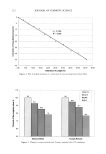
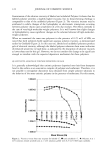
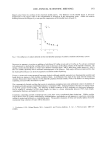
124 JOURNAL OF COSMETIC SCIENCE Examination of the solution viscosity of labeled and unlabeled Polymer A shows that the labeled polymer provides a slightly higher viscosity, but its shear-thinning rheology is comparable to that of the unlabeled polymer (Figure 2). The viscosity increase may be attributed to subtle changes of the hydrophobic or electrostatic interactions occurring between polymer chains upon attachment of a few dye residues. The effects intensify in the case of very-high-molecular-weight polymers. It is well known that slight changes in hydrophobicity cause significant changes in the solution behavior of high-molecular- weight polymers. When we examined the same two polymers in the presence of 0.25 wt% of SDS, we noted that both polymers build significant aqueous solution viscosity, as demonstrated earlier by Goddard (Figure 2). In this case too, labeled and unlabeled polymers produce gels of identical viscosity, although the labeled polymer solutions show some indication of enhanced sensitivity to high shear, as indicated by the disruption of solution viscosity at lower shear rate for this gel. However, we do not consider this change to be significant enough to interfere with the expected deposition mechanism for these polymers. QUANTITATIVE ANALYSIS OF POLYMER DEPOSITION ON HAIR It is generally acknowledged that cationic polymers deposited onto hair from shampoos bind to the surface as an associative complex of polymer and surfactant. Therefore, it is not possible to extrapolate deposition data obtained from simple polymer solutions to the behavior of the same cationic polymer in the presence of surfactants. For this reason, •' 1.00E+01 1.00E-01 Shear Stress (Pa) Figure 2. Viscosity versus shear rate response for labeled (¸, O) and unlabeled (0, ß) Polymer A as 1 wt% solutions (closed symbols) and as 1 wt% solutions gelled with 0.25 wt% SDS (open symbols).

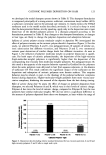
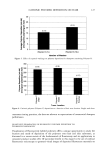
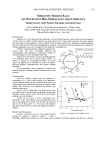
CATIONIC POLYMER DEPOSITION ON HAIR 125 we developed the model shampoo system shown in Table II. This shampoo formulation is comprised principally of a strong anionic surfactant, ammonium lauryl sulfate (ALS), a surfactant commonly used in the personal care industry. It closely mimics the TEALS surfacrant used in the model studies described previously. It is critical to keep in mind that the data presented below, strictly speaking, apply only to the deposition onto virgin blond hair of the labeled polymers present in a shampoo prepared according to the formulation presented in Table II. Any changes to the shampoo formulation, or changes in hair type, are likely to change the polymer deposition and adsorption behavior. Influence of cationic polymer viscosity (molecular weight) on ckposition. We investigated the effect of polymer viscosity on the cationic polysaccharide's deposition (Figure 3). For this study, we selected Polymers A and C, two polyquaternium-10 samples of similar cat- ionic substitution but different viscosities, and Polymers D and E, two commercial cationic guar derivatives of similar charge levels but different viscosities. As seen in Figure 3, the influence of polymer molecular weight on polymer deposition is signifi- cant. For both types of cationic polysaccharides, the deposition of the high-viscosity (high-molecular-weight) polymers is significantly higher than the deposition of the corresponding low-viscosity (low-molecular-weight) polymers. For polyquaternium- 10, this trend is the opposite of the sorption behavior reported by Goddard for the polymers when the same polymers were delivered to hair from aqueous solutions, in the absence of surfactant (5)! This result confirms the significant impact of the surfactant on the deposition and adsorption of cationic polymers onto keratin surfaces. This sorption behavior may be related, in part, to the rheology of the polymer/surfactant complexes formed during deposition. Higher-molecular-weight polymers form more viscous asso- ciative complexes, hindering the removal of the deposits from the hair during rinsing. Efjbct of cationic charge level. To assess the effect of charge on polymer deposition from shampoos, we selected Polymers A and B, which vary in their levels of cationic charge. Polymer A has twice the level of cationic charge, compared to Polymer B, but the two polymers have similar molecular weights. We did not detect a significant difference in the amount of polymer deposited from these two shampoos, at least within the range of 35O 0 (0.27) (1.36) (0.44) Polymer A (Ix) Polymer C (1){) Polymer D(1X) Cationic Polymer Type (0.33) .. Polymer E (lx) Figure 3. Deposition data (including relative standard deviations) for low-viscosity polymers A and D and high-viscosity polymers C and E after a single wash cycle.
Purchased for the exclusive use of nofirst nolast (unknown)
From: SCC Media Library & Resource Center (library.scconline.org)