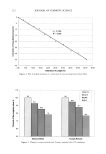
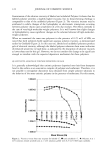
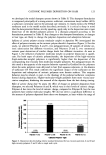
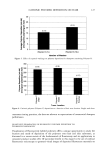
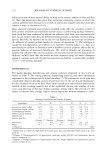
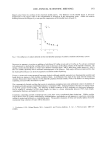
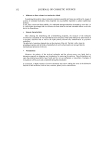
126 JOURNAL OF COSMETIC SCIENCE experimental error of the technique (Figure 4). Therefore, while it is important that the polymers carry positive charges for deposition to occur, the amount of charge does not affect deposition to the same extent as molecular weight. It should be pointed out that Goddard demonstrated also by radiolabeling studies that cationic charge was essential for polymer adsorption onto hair and skin (5). Efj•ct of multiple washings on polymer deposition. The effect of multiple washing cycles on polymer deposition is critical information that the formulator needs to know in order to understand the mechanism of polymer build-up. The perception of build-up of a prod- uct, such as a conditioning shampoo, as a result of its repetitive use is detrimental to its acceptability by consumers. The study of the effect of multiple washings on cationic polymer deposition was carried out with a low-viscosity polyquaternium-10 sample, Polymer B. In the case of the strong anionic surfactant platform used here, the sorption of polyquaternium-10 is relatively constant through the course of ten washing cycles (Figure 5). No significant build-up of polyquaternium-10 on the hair tress was detected, within the range of error for the measuring technique. Indeed, polymer build-up de- pends critically on the hair type and on the nature of the shampoo composition, in particular the choice of surfactants, the polymer concentration, and physical properties. Polymer deposition at difj•rent tress locations. It is well known that as hair ages, damage from various physical, environmental, and chemical factors gradually erodes the protective cuticle layers, eventually exposing the native proteins of the hair cortex. Virgin hair has not been exposed to the ravages of chemical dyeing and perming and is, therefore, relatively damage-free. We examined the amount of polymer deposited in three different locations on the virgin blond hair tresses using a shampoo made with high-viscosity polyquaternium-10, Polymer C. Deposition at the distal end and middle of the tress was similar, but there appeared to be slight reduction in deposition at the proximal end of the tress (Figure 6). This was not unexpected, as the proximal end of the tress is newer hair. We should point out also that during preparation, the tresses were rinsed in such a way that the rinse water flowed from the proximal to the distal end of the hair tress. Thus, it is not unreasonable to consider the possibility that rinsing moves the more weakly bonded polymers down the tress. As this rinsing pattern is typical of standard 3O 20 •E,15 •- 0 o & 5 (0.17) (1.36) Figure 4. Effect of cationic polymer charge level on polymer deposition. Single wash data. Polymer A (lx) Polymer B (lx) Polyq uate rn iu m -10 variant

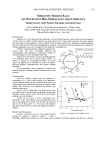
CATIONIC POLYMER DEPOSITION ON HAIR 127 30 25 • E• 20 E• 10 o• 5 ,• o (0.11) (0.17) Polymer B (lx) Polymer B (10x) Number of Washes Figure 5. Effect of repeated washings on polymer deposition fbr shampoos containing Polymer B. 350 300 '2oo-- E E100 •[ 50 Q. ß o (0.38) (0.28) (0.37) Tress Location Figure 6. Cationic polymer (Polymer C) deposition as a function of hair tress location. Single wash data. consumer rinsing practices, the data are relevant to expectations of commercial shampoo performance. QUALITATIVE EXAMINATION OF FLUORESCENT POLYMER DEPOSITION VIA FLUORESCENT MICROSCOPY Visualization of fluorescently labeled polymers offers a unique opportunity to study the location and mode of deposition of the polymers onto hair and skin substrates, as discussed in a recent review of the fundamentals of fluorimetry and its applications to consumer product studies (20). Of particular benefit in this regard is the use of confocal fluorescence microscopy to generate visual images of deposited fluorescent materials on
Purchased for the exclusive use of nofirst nolast (unknown)
From: SCC Media Library & Resource Center (library.scconline.org)