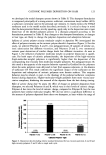
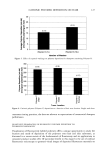
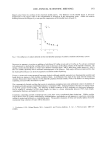
128 JOURNAL OF COSMETIC SCIENCE hair and skin. The principles of confocal microscopy and its use in personal care have recently been reviewed (21). We examined various polymer-treated hair fibers via confocal microscopy to gain further insight to the mode of deposition of the polymers onto the surface of hair fibers. The photomicrograph presented in Figure 7a shows an untreated virgin blond hair fiber under typical fluorescent viewing conditions. Note that hair has a natural fluorescence. Images presented in Figures 7b and 7c display individual fibers taken from tresses treated with shampoos containing Polymer A and Polymer C, respectively. The fluo- rescently labeled polymer deposited on the hair is easily detected. Qualitatively, the fluorescence intensity of a hair sample treated with a shampoo containing the high- viscosity polymer is much stronger than that of a hair sample treated with the low- viscosity polymer shampoo formulation, in agreement with the quantitative data dis- cussed above. The appearance of patches of strong fluorescence and areas of weak fluorescence intensity (Figures 7b and 7c) suggests that the polymer is not deposited uniformly on the tress. The highly fluorescent clusters may be regions of stronger deposition of polymer/ surfactant complexes, although this cannot be proven by the use of this technique. Interestingly, recent fluorescent images of hair treated with an SLES surfactant system containing a protein labeled with a comparable dye show similar patchiness (9). The authors of the study propose that the images reflect the preferred deposition of the protein on sites of damage on the hair. Our results suggest that this phenomenon may not be limited to proteins, but that cationic cellulose ethers may also show preferential adsorption to specific hair sites. A corollary to this observation is that caution should be placed in attempting to quantify polymer deposition by single-fiber analysis. Measure- ments using fluorescence imaging alone are prone to significant sources of error and artifact. The bulk hair digestion protocol and the quantitative fluorescence spectroscopic analysis of the digest described in this article circumvent some of these uncertainties. It offers an easy and reproducible means of comparing the adsorption properties of a wide range of synthetic and natural polymers in "real" situations. ACKNOWLEDGMENTS The authors would like to recognize the help provided in these studies by Carmella ,:. 4• .• .... .• :?:i._•--• • " -3A / 06:04:98 / 20x / 40 •:•0•.3C / 0•:27:•S / 10x / a0 -•. Figure 7. Confocal laser fluorescent photomicrographs of (a) normal virgin blond hair, (b) virgin blond hair treated with a single wash with Polymer A, and (c) virgin blond hair treated with a single wash with Polymer C.

CATIONIC POLYMER DEPOSITION ON HAIR 129 Barbeito, Luis Moral, Don Firstenberg, Ray Rigoletto, Sudarshi Regismond, and Yew- Meng Heng. REFERENCES (1) E. D. Goddard, "Measuring and Interpreting Polycation Adsorption," in Principles of Polymer Science and Technology in Cosmetics and Personal Care, E. D. Goddard and J. V. Gruber, Eds. (Marcel Dekker, New York, 1999), pp. 465-508. (2) E. D. Goddard, R.B. Hannah, and J. A. Faucher, "The Adsorptivity of Charged and Uncharged Cellulose Ethers," in Principles of Polymer Science and Technology in Cosmetics and Personal Care, E. D. Goddard and J. V. Gruber, Eds. (Marcel Dekker, New York, 1999), pp. 509-523. (3) A. R. Sykes and P. A. Hammes, The use of merquat polymers in cosmetics, Drug Cosmet. Ind., 126, 62 (1980). (4) E. D. Goddard, J. A. Faucher, R. J. Scott, and M. E. Turney, Adsorption of polymer JR on keratinous surfaces. Part II,.J. Soc. Cosmet. Chem., 26, 539 (1975). (5) J. A. Faucher and E. D. Goddard, Influence of surfactants on the sorption of a cationic polymer by keratinous substrates, J. Colloid Interface Sci., 55, 313 (1976). (6) P. Hossel, Investigations of conditioning polymers for hair styling, J. Cosmet. Sd., 50, 59 (1999). (7) H. D. Weigmann and Y. Kamath, "Evaluation Methods for Conditioned Hair," in Principles of Polymer Science and Technology in Cosmetics and Personal Care, E. D. Goddard and J. v. Gruber, Eds. (Marcel Dekker, New York, 1999), pp. 525-570. (8) J. A. Swift and A. K. Allen, Swelling of human hair by water (abstract), 8 th International Hair Science Symposium, Deutsches Wolforschungs Institute, Kiel, Germany, 1992. (9) J. Vollhardt, Native hydrophobic wheat proteins with intelligent hair care properties, SOWF-J., 124, 2 (1999). (10) R. B. Qaqish and M. M. Amiji, Synthesis of a fluorescent chitosan derivative and its application for the study of chitosan-mucin interactions, Carbohyd. Polym., 38, 99 (1999). (11) A. N. De Bilder and K. Granath, Preparation and properties offluorescein-labeled alextrans, Carbohydr. Res., 30, 375 (1973). (12) L. Chan, The clear solution for conditioning needs, PCIA Conference Proceedings, Intex, Shanghai, 32 (April 1999). (13) M. Carvell, I.D. Robb, and P. W. Small, The influence of labeling mechanisms on the fluorescence behavior of polymers bearing fluorescein labels, Polymer, 39, 393 (1998). (14) S. T. A. Regismortal, Y. M. Heng, E. D. Goddard, and F. M. Winnik, Fluorescence microscopy ob- servation of the adsorption onto hair of a fluorescently labeled cationic cellulose ether, Langmuir, 15, 3007 (1999). (15) S. T. A. Regismortal, Y. M. Heng, E. D. Goddard, and F. M. Winnik, Fluorescence microscopy study of the sorption of cationic polymers on hair, ACS Symposium Series, 737, 276 (1999). (16) J. V. Gruber, F. M. Winnik, A. Lapierre, N. D. Khaloo, N. Joshi, A. Lawrence, and P. N. Konish, Quantitative and qualitative measurement of the adsorption of cationic hydroxyethyl cellulose onto keratin surfaces via direct polymer fluorescent labeling (abstract), Annual Meeting of the Society of Cosmetic Chemists, New York, December 9-10, 1999. (17) N. D. Khaloo, F. M. Winnik, A. Lapierre, and J. V. Gruber, A study of the adsorption of cationic cellulose ethers on hair substrates, 82 "d CSC Conference, Toronto, Canada, May 1999. (18) E. D. Goddard, P.S. Leung, and K. P. Anathapadmanabhan, Novel gelling structures based on poly- mer/surfactant systems,./. Soc. Cosmet. Chem., 42, 19 (1991). (19) M. Goldraich, J. R. Schwartz, J. L. Burns, and Y. Talmon, Microstructures formed in a mixed system of a cationic polymer and an anionic surfactant, Colloid Surf A., 125, 231 (1997). (20) E. D. Goddard and F. M. Winnik, Fluorimetry: A useful tool is cosmetics research, Cosmet. Toilerr., 114, 63 (1999). (21) J. L. Leveque, Confocal microscopy, Cosmet. Toiletr., 111, 35 (1996).
Purchased for the exclusive use of nofirst nolast (unknown)
From: SCC Media Library & Resource Center (library.scconline.org)