j. Cosmet. sci., 52, 131-136 (March/April 2001) The use of x-ray fluorescent spectroscopy to study the influence of cationic polymers on silicone oil deposition from shampoo JAMES V. GRUBER, BURTON R. LAMOUREUX, NIRAJ JOSHI, and LUIS MORAL, Amerchol Corporation, 136 Talmadge Rd., Edison, NJ 08818-4051 (J. V.G., N.J., L.M. [retired]), and Union Carbide Corporation, 1 River Rd,, Bound Brook, NJ 08876 (B,R.L.). Accepted for pz•blication February 28, 2001. Synopsis In this study, x-ray fluorescent spectroscopy was employed, in a non-destructive way, to analyze the influence that water-soluble, cationic hydroxyethylcellulose (i.e., polyquaternium-10) has on the deposition of silicone oil (dimethicone) onto hair. Virgin brown hair tresses were washed with various model shampoos that contained emulsified dimethicone. The shampoos were modified only by the addition or absence of polyquaternium-10. The results indicate that the cationic polymers do influence silicone oil deposition onto hair during the shampooing process. In the absence of cationic polymer, the silicone oils deposit readily, but appear to show "build-up" phenomena upon repeated washings. When a cationic polymer is present in the continuous phase of the shampoo, the build-up phenomena is significantly diminished, and silicone oil deposition remains relatively constant in repeated washings. In addition, we have noted that the molecular weight of the cationic polymer can have a strong effect on silicone oil deposition. It appears that the higher the molecular weight of the polyquaternium-10, the greater the amount of silicone deposition onto the surface of the hair. To demonstrate that the analysis technique has potential applications in commercial shampoos, we examined a commercial "2-in-l" shampoo that contains dimethicone and polyquaternium-10 and found that the data for our simple model shampoos and the commercial shampoo correlated closely. INTRODUCTION The use of silicone polymers, especially non-ionic silicone polymers such as dimethicone, is prevalent in personal care (1). These unique oleaginous materials, because of their very low surface tension, have a remarkable ability to spread over both hydrophobic and hydrophilic surfaces. When applied to hair or skin they offer significant beneficial improvements in the sensory properties of skin and hair in both the wet and dry state. Cationic polymers likewise have enjoyed a healthy relationship with the personal care James V. Gruber's present address is Arch Personal Care, 70 Tyler Place, South Plainfield, NJ 07080. 131

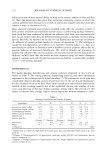
132 JOURNAL OF COSMETIC SCIENCE industry because of their natural ability to bind to the anionic surfaces of hair and skin (2). How this deposition takes place from surfactant-containing systems in which the cationic polymers find themselves in a broth of anionically charged surfactant molecules remains a topic of discussion (3-6). Many shampoo and body wash products available today offer the consumer a blend of both cationic polymers and emulsified silicone oils as a conditioning package. However, little work has been conducted to address the influence that these two macromolecules have on one another when they are delivered simultaneously to the body via the washing process. Recently, we reported on the use of x-ray fluorescence spectroscopy to examine the influence of cationic polysaccharides on silicone oil deposition (7). The technique is unique for this application, as it allows us to examine a keratin surface, i.e., hair, in a non-destructive fashion to determine how a dissolved cationic polymer affects the de- position behavior of dispersed dimethicone. We wish to broaden our discussion to examine the influence that cationic polymer concentration has on silicone deposition. In addition, we will show that the results we have obtained using our model shampoos appear to correlate well with the silicone deposition we find for a commercially available "2-in-l" conditioning shampoo. EXPERIMENTAL The model shampoo formulations and cationic polymers employed in this study are shown in Table I. The testing protocol, shampooing protocol, and other information important to the technique can be found elsewhere (7). This referenced article goes into considerable detail to describe sources of potential error in the use of x-ray fluorescence for direct analysis of silicon on hair. These errors include such experimental details as the method of hair washing, particle size of the emulsified silicone oils, number of x-ray scans, and direction of the hair during scanning, among others. We elected, for this reason, to discuss only average relative silicon deposition without reference to error. Table I Shampoo Formulation and Cationic Polymers Ingredients A B C D E F G Ammonium lauryl sulfate 14.0 14.0 14.0 14.0 14.0 14.0 Ammonium laureth sulfate 3.9 3.9 3.9 3.9 3.9 3.9 Cocamidopropyl-betaine 3.0 3.0 3.0 3.0 3.0 3.0 Ethylene glycol distearate 2.0 2.0 2.0 2.0 2.0 2.0 Dimethicone • 1.5 1.5 1.5 1.5 1.5 -- Cationic polymer 0.5 0.3 0.1 0.5 -- -- Polymer 12 Polymer 1 Polymer 1 Polymer 23 Preservative 0.4 0.4 0.4 0.4 0.4 0.4 Water 74.7 74.9 75.1 74.7 75.2 76.7 15-Pareth-9 100.0 • Dimethicone is a blend of a high-molecular-weight gum, and a low-molecular-weight fluid in the ratio of 60:40. 2 Polymer 1:Polyquaternium-10 of approximate molecular weight 400,000 and approximate percent cationic nitrogen of 1.0. • Polymer 2:Polyquaternium-10 of approximate molecular weight 900,000 and approximate percent cationic nitrogen of 1.0.
Purchased for the exclusive use of nofirst nolast (unknown)
From: SCC Media Library & Resource Center (library.scconline.org)