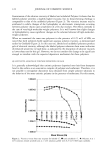
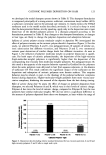
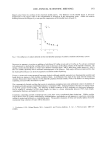
94 JOURNAL OF COSMETIC SCIENCE (Figure 2a). The cytoplasm exhibited varying bright features corresponding to cytoplas.rn organelles and/or melanin granules. The plasma membrane was clearly defined. Near the dertoo-epidermal junction, a monolayer of bright basal cells (Figure 2b) surrounded the derreal papillae in clusters arranged in the shape of bouquets at the top. At deeper levels these clusters appeared as crowns. In the center of the derreal papillae, dark rounded areas (not shown) indicated the presence of capillary loops where the flow of red blood cells and leukocytes could be watched in movement as a series of time frames. The 3D reconstruction of a volume of living skin permitted an observation of the relationships between the various segmented features: the keratinocytes identified by their nuclei (Figure 3a), the stratum corneum as an overlay (Figure 3b), and the derreal tissue on the ground. This mode of representation demonstrates that thickness mea- surements can be automatically extracted from the whole field of exploration, thus ensuring good accuracy of the results. The 3D reconstruction of the bright features in the basal cells layering a derreal papilla is shown in Figure 4a. By zooming and rotating one of the segmented features (Figure 4b), its lower side clearly revealed a non-convex hull that could be easily associated with the imprint of the nucleus. Thus, the shape and size of this non-convex volume could be attributed to the melanin cap covering the apical pole of the nucleus. SUN EXPOSURE The evolution of the stratum corneum thickness followed the same pattern for the two subjects even though individual variations could be recorded (Figure 5). There was a 25% increase at T12 for each subject, which was confirmed at T20. A decrease at T40 was more pronounced for subject B, which recovered almost its initial value. Unusual histologic changes occurred within the whole epidermis after exposure. First, bright inclusions inside numerous nuclei of granular and spinous keratinocytes (Figure Figure 2. Horizontal optical sections of epidermal layers. (a) A section 36 t•m below the skin surface of a Caucasian skin sample. Each keratinocyte contains a dark nucleus, bright features, in the cytoplasm enclosed in the plasma membrane 488-nm blue laser line. Image size: 180 x 168 i•m. (b) A section 48 lam below the skin surface of a Negroid skin sample showing three dermal papillae delineated with bright basal cells forming bouquets and crown 488-nm blue laser line. Image size: 180 x 168 tma.

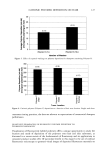
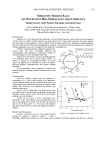
IN VIVO CONFOCAL MICROSCOPY 95 Figure 3. 3D reconstruction of the epidermis from a stack of 66 optical sections, l-Fro steps. The segmented features correspond to: (a) The dermo-epidermal junction in grey tone and the nuclei of spinous and granular keratinocytes in white. The basal epidermal layer is not represented. (b) The stratum corneum represented as a semitransparent light-grey overlay. 6a) persisted up to T20 while almost disappearing at T40. The zoomed image (Figure 6b) clearly shows the shape and size of four inclusions within a dark nucleus. Second, brightly spotted filaments running between keratinocytes were observed at T12 and T20. They had a preferential vertical orientation within the epidermis and seemed to follow the intercellular route (Figures 7a and 7b). Third, melanin caps observed at TO (Figure 8a) were no longer detected at the site of the usual bright basal monolayer (Figure 8b). This lack of melanin persisted until T20. They could still be observed at T40. DISCUSSION This new prototype of CLSM dedicated to in vivo skin exploration brought substantial improvements compared with previous systems (6-8). Sharper images of the epidermal keratinocytes could be recorded with the blue laser line (Figure 2a). This could be ..• . , . ._ . .,.•.: .... • • ... . . . ..... "5' - ß, ..... '• " •--• ß •j:• •' .","i•' .... '. ..... ' '•-. ..... 7- " ""• "• :'• a b Figure 4. 3D reconstruction of the segmented bright features into the basal keratinocytes. (a) Overview of the bouquet overlaying a dermal papilla. (b) Detail of one feature zoomed and rotated in order to reveal the spherical imprint of the nucleus.
Purchased for the exclusive use of nofirst nolast (unknown)
From: SCC Media Library & Resource Center (library.scconline.org)