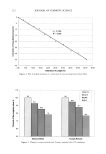
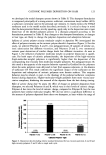
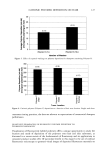
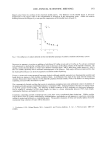
SILICONE OIL DEPOSITION ON HAIR 135 these experiments, the juxtaposed influence of the silicone oil on the cationic polymer deposition is not, and this aspect is currently a topic of investigation in our laboratories. The effect of cationic polymer molecular weight can also be seen from the data in Figure 2. It appears that as the molecular weight of the cationic polymer increases (compare Formulation A with Formulation D), the amount of silicone oil that deposits on the hair increases as well. We note that in a single washing experiment, the higher-molecular- weight polyquaternium-10 polymer deposits nearly 60% more silicone than the com- parable lower-molecular-weight polymer of equal charge. This further suggests to us that perhaps factors such as the rheology of the shampoo during application and rinsing, or the hydrodynamic volume of the cationic polymer, can also play an important role in modulating the oil deposition. Looking at the effect of cationic polymer concentration, we note that for the medium- molecular-weight cationic polymer (Polymer 1) there is little change in the amount of silicone depositing on the hair even after repeated washings down to a concentration of 0.3 wt% (compare Formulations A and B) (Figure 3). However, when the cationic polymer concentration drops to O. 1% (Formulation C), the effect on silicone oil depo- sition is quite dramatic and the shampoo behaves more like a formulation that does not contain cationic polymer, i.e., the silicone build-up phenomena is noted again. It appears that when the cationic polymer concentration falls below a certain level, its ability to interact with the silicone emulsion and influence the silicone deposition diminishes. We were curious as to whether or not our analysis technique was providing results that might have significance to the behavior of commercial shampoos. For this reason, we elected to examine a commercial shampoo that we knew to contain a surfactant platform similar to our own model platform containing polyquaternium-10. However, we do not ,',' 15.0 • 10.0 • 5.0 0.0 Figure 3. Effect of oationic polymer concentration (0.5, 0.3, and 0.1 wt%) on relative silicon XRF intensities for hair tresses treated with cationic Polymer 1 and data for a commercially available "2-in-l" shampoo containing dimethicone and polyquaternium-10 (1 and 10 washes).

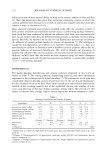
136 JOURNAL OF COSMETIC SCIENCE know the exact composition of the shampoo or the concentrations of the ingredients in the commercial shampoo. The commercial shampoo also contains other ancillary ingre- dients that we have excluded in our simple model formula. The data for the commercial shampoo is provided in Figure 3. From this data, we note that the relative amount of silicone deposited from the shampoo and the amount of deposition we noted from our model shampoo containing 0.3% cationic polymer are essentially identical, even after multiple washing steps (compare Formulation B and the labeled "2-in-1" shampoo). We feel comfortable, therefore, in suggesting that the use of x-ray fluorescence in the fashion we have described can be predictive of real-world shampoo use. CONCLUSIONS We have demonstrated that x-ray fluorescent spectroscopy can be a useful tool for analyzing the behavior of ingredients delivered from emulsified surfactant systems. While we have focused in this study on the deposition of silicone oil onto hair, and have examined the role dissolved cationic polymers can play in potentiating the deposition, it seems very likely that this technique can be expanded to a wide variety of colloidal systems including, perhaps, the study of antidandruff agents (e.g., pyrithione zinc) and physical sun screens such as TiO 2. Likewise, while we conducted our studies on hair tresses that are readily available, there does not appear to be any reason why this technique could not work on other types of fibers, or membranes such as skin. REFERENCES (8) (9) (10) (1) M.D. Berthiaume, "Silicones in Cosmetics," in Principles of Polymer Science and Technology in Cosmetics and Personal Care, E.D. Goddard and J. V. Gruber, Eds. (Marcel Dekker, New York, 1999), pp. 275-324. (2) E. D. Goddard, "Measuring and Interpreting Polycation Adsorption," in Principles of Polymer Science and Technology in Cosmetics and Personal Care, E. D. Goddard and J. V. Gruber, Eds. (Marcel Dekker, New York, 1999), pp. 465-508. (3) E. D. Goddard, "Polymer-Surfactant Interaction. Part II. Polymer and Surfactant of Opposite Charge," in Interactions of Surfactants with Polymers and Proteins, E. D. Goddard and K. P. Anathaphadmanabhan, Eds. (CRC Press, Boca Raton, Florida), pp. 171-201. (4) B. Jonsson, B. Lindman, K. Holmberg, and B. Kronberg, in Surfactants and Polymers in Aqueous Solution (John Wiley & Sons, New York, 1998), pp. 219-244. (5) K. Shirahama, "The Nature of Polymer-Surfactant Interactions," in Polymer-Surfactant Systems, J. C. T. Kwak, Ed. (Marcel Dekker, New York, 1998), pp. 143-191. (6) D. Myers, in Surfaces, Interfaces, and Colloids: Principles and Applications, 2"d ed. (Wiley-VCH, New York, 1999), pp. 344-357. (7) J. V. Gruber, B. R. Lamoureux, N. Joshi, and L. Moral, Influence of cationic polysaccharides on polydimethylsiloxane (PDMS) deposition onto keratin surfaces from a surfactant emulsified system, Colloid Surf B: Biointerfaces, 19, 127-135 (2000). S. B. Torok, J. Labar, M. Schmeling, and R. E. Van Grieken, X-ray spectrometry, Anal. Chem., 70, 495R-517R (1998). A. De Smedt, I. Van Reeth, S. Marchioretto, D. A. Glover, and J. Naud, Measurement of silicone deposited on hair, Cosmet. Toiletr., 112, 39-44 (1997). H. M. Klimisch, "Personal Care Applications," in The Analytical Chemistry of Silicones, A. L. Smith, Ed. (John Wiley & Sons, New York, 1991), pp. 117-132.
Purchased for the exclusive use of nofirst nolast (unknown)
From: SCC Media Library & Resource Center (library.scconline.org)