j. Cosmet. Sci., 52, 137-154 (March/April 2001) Papers Presented at the 2000 Annual Scientific Meeting (Friday's Program) December 7-8, 2000 New York Hilton New York, NY 137

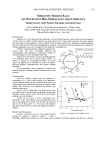
138 JOURNAL OF COSMETIC SCIENCE ADVANCES IN EMULSION SCIENCE FOR PERSONAL CARE APPLICATIONS Tharwat Tadros, Ph.D. 89 Nash Grove Lane, Wokingham,, Berkshire RG404HE, U.K. SUMMARY This overview starts with an introduction summarizing the stabilization mechanisms for macroemulsions (those that are currently used in most personal care applications). These systems are thermodynamically unstable since the energy required for their formation exceeds the much smaller entropy of dispersion of the droplets in the medium. To stabilize the emulsions against flocculafion and coalescence, one needs to create an energy barrier between the droplets to prevent their close approach (where the van der Waals attraction is very strong). This can be achieved by electrostatic stabilization, e.g. by the use of ionic surfactants, where the double layers prevent the close approach of the droplets. This stabilization mechanism is not ideal since the double layer repulsion is significantly reduced in the presence of electrolytes. An alternative mechanism is that of steric stabilization, whereby nonionic surfactants or polymeric surfactants may be used. These molecules consist orb chains that are strongly adsorbed (or soluble in oil) and A chains which are soluble in the medium and strongly solvated by the its molecules. Examples are given of the types of A-'B, A-B-A block copolymers that can be used for stabilization of oil-in-water (O/W) or water-in-oil (W/O) emulsions. The stabilization mechanism by these polymeric surfactants is described in terms of the unfavourable mixing of the A chains, when these are in good solvent conditions, and the loss in configurational entropy on overlap of the chains. The second part of the overview deals with the subject of microemulsions, which are thermodynamically stable systems that can be transparent or translucent (with drop sizes in the range 5- 50 nm). These systems are produced spontaneously by mixing oil, water, surfactant and cosurfactant. The driving force for their for their spontaneous formation is the ultralow interfacial tension, in which the surface energy in expanding the interface is overcompensated by the negative entropy of dispersion of the droplets. The reason in using two surfactant molecules for reduction of interfacial tension can
Purchased for the exclusive use of nofirst nolast (unknown)
From: SCC Media Library & Resource Center (library.scconline.org)