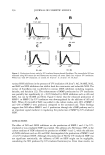
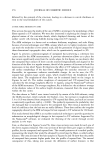
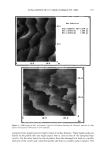
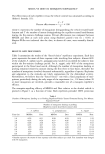
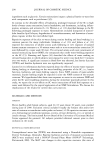
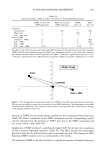
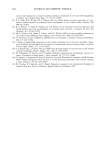
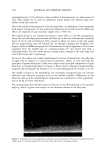
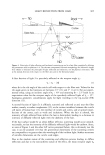
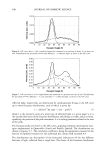
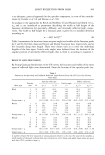
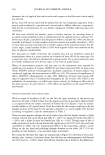
244 JOURNAL OF COSMETIC SCIENCE A B Figure 1. Chromatograms of a standard mixture (A) of methyl-, ethyl- and propylparabens aqueous solution or (B) extracted from an oil-in-water emulsion (see Experimental section). Table II Percentages of Recovery of Parabens Recovery average + RSD • (%)2 Preservative A B C D Methylparaben 97.8 +_ 1.3 97.1 +- 1.9 97.5 + 1.4 99.2 +_ 1.8 Ethylparaben 98.2 + 1.5 99.1 -+ 2.1 98.2 +_ 1.2 98.8 _+ 1.6 Propylparaben 97.2 +_ 1.7 97.3 -+ 1.6 97.4 -+ 2.2 97.4 +_ 2.0 Relative standard deviations. Percentage w/w with respect to total amount of preservative used in the formulation. A: W/O emulsion. B: O/W emulsion. C: Pemulen gel. D: Carbopol gel. percutaneous absorption glass cell (Franz diffusion cell) (19,20), assembled with single or multiple synthetic membranes (see Experimental section). For the calculation of the permeability coefficients, in all cases the following procedure was used: the amount of paraben penetrated through the membrane(s) per unit area was plotted against time, and the slopes, which represent the steady-state fluxes, were calculated by linear regression. The calculated regression coefficients were never less than 0.97. The slopes were then substituted into the following equation for the determination Of Jn (permeability coef- ficient): Jn = Jo/C. Diffusion of parabens from topical formulations. Figure 2 reports the diffusion kinetics of parabens from the aqueous solution and from the produced topical formulations. The

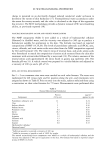
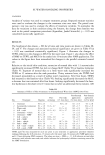
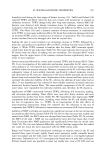
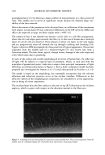
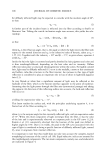
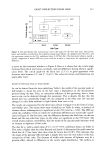
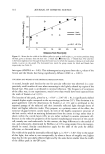
DIFFUSION OF PRESERVATIVES 245 140 12o 80 6o 40 20 0 A 2 4 6 8 diffusion time (hours) , 70 • 60 ß • 40 •3o 0c 0 B 2 4 6 8 diffusion time (hours) 70 "$ 60 • 50 '• 40 • 30 • 20 .• 1o c 2 4 6 8 10 diffusion time (hours) 70 •50 -=• 40 • 3o $2o o 10 0• 0 D 2 4 6 8 diffusion time (hours) , i 0 2 4 6 8 10 diffusion time (hours) Figure 2. "In vitro" diffusion kinetics of methyl- (O), ethyl- ([•) and propyl- (O)-parabens incorporated in the reported topical dosage forms. A bimembrane system was employed: a silicone-based membrane (250- pm thickness) in contact with the donor phase, and a nylon-based membrane (150-pm thickness), 0.22-pm pore size) in contact with the receptor phase. The results reported represent the mean values + SD of six independent experiments. A: Aqueous solution. B: Water-in-oil emulsion. C: Oil-in-water emulsion. D: Pemulen gel. E: Carbopol gel. calculated diffusion coefficients for parabens incorporated into the different topical forms are reported in Table III. Figure 3 shows a comparison between the diffusion coefficients of the different parabens from topical formulations.
Purchased for the exclusive use of nofirst nolast (unknown)
From: SCC Media Library & Resource Center (library.scconline.org)