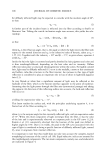
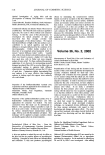
248 JOURNAL OF COSMETIC SCIENCE emulsion, capric/caprilic triglyceride can dissolve EP and PP better than petrolatum present in the oil phase of the W/O emulsion. The EP and PP attraction to the oil phase of the O/W emulsion can justify their lower diffusion coefficients with respect to the W/O emulsion. These last considerations suggest that the lipophilic components of the matrix could represent a mean to hold on to parabens, promoting their preservative action in the formulation. As an appendix to Table III, Table IIIa reports the results of a statistical analysis based on a paired t-test performed to compare the Jn of parabens for the different formulations. The results obtained with different formulations were significantly different (being Table IIIa Statistical Analysis (paired t-test) of the J,• Values of Parabens Incorporated in the Different Formulations Reported in Table III Aqueous W/O O/W Carbopol Pemulen Methylparaben solution emulsion emulsion gel gel Aqueous solution -- t = 45.42 t = 43.92 t = 39.3 p 0.0001 p 0.0001 p 0.0001 W/O emulsion t = 45.40 -- t = 9.55 t = 3.37 p 0.0001 p = 0.0002 p = 0.0198 O/W emulsion t = 43.90 t = 9.55 t = 13.11 p 0.0001 p = 0.0002 p 0.0001 Carbopol gel t = 39.30 t = 3.37 t = 13.11 -- p 0.0001 p = 0.0198 p 0.0001 Pemulen gel t = 54.58 t = 22.5 t = 73.55 t = 60.16 p 0.0001 p 0.0001 p 0.0001 p 0.0001 54.58 0.0001 22.50 0.0001 73.55 0.0001 60.16 0.0001 Ethylparaben Aqueous W/O O/W Carbopol Pemulen solution emulsion emulsion gel gel Aqueous solution -- t = 2.46.57 t = 119.30 t = 271.68 p 0.0001 p 0.0001 p 0.0001 W/O emulsion t = 246.57 -- t = 26.93 t = 297.87 p 0.0001 p 0.0001 p 0.0001 O/W emulsion t = 119.30 t = 26.93 t = 1.78 p 0.0001 p 0.0001 n.s. Carbopol gel t = 271.68 t = 297.87 t = 1.78 p 0.0001 p 0.0001 n.s. Pemulen gel t = 51.53 t = 66.15 t = 142.91 t = 101.46 p 0.0001 p = 0.0001 p 0.0001 p 0.0001 51.53 0.0001 66.15 0.0001 142.91 0.0001 101.46 0.0001 -- Propylparaben Aqueous W/O O/W Carbopol Pemulen solution emulsion emulsion gel gel Aqueous solution -- t = 8.81 t = 104.67 t = 13.24 p 0.0001 p 0.0001 p 0.0001 W/O emulsion t = 8,81 -- t = 7.37 t = 47.27 p 0.0001 p 0.0001 p 0.0001 O/W emulsion t = 104.67 t = 7.37 -- t = 50.76 p 0.0001 p 0.0001 p 0.0001 Carbopol gel t = 13.24 t = 47.27 t = 50.76 -- p 0.0001 p 0.0001 p 0.0001 Pemulen gel t = 105.61 t = 2.83 t = 10.23 t = 50.88 p 0.0001 p = 0.0178 p 0.0001 p 0.0001 105.61 0.0001 2.83 0.0001 10.23 0.0001 50.88 0.0001 --

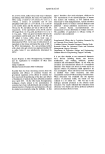
DIFFUSION OF PRESERVATIVES 249 mostly p 0.0001), apart from EP included in the Carbopol gel versus the O/W emulsion. Parabens, analogously to most of other preservatives, can induce sensitizing effects such as allergic contact dermatitis, especially when they are included in particular topical formulations such as eyedrops, or contour eyes (8,9,16). In this respect, the method here described is proposed to control the extent of paraben diffusion from topical prepara- tions, with the aim of minimizing percutaneous absorption. CONCLUSIONS In conclusion, the results of this study show that the experimental methods presented here could be proposed (a) in preformulatory studies aiming to determine the extent of paraben diffusion from topical formulations, (b) to control the availability of parabens to microbes, (c) to perform premarketing quality controls for dermatological and cosmetic products (e.g. creams, gels, and ointments), and (d) to assure batch-to-batch uniformity. ACKNOWLEDGMENTS This work was supported by the National Research Council of Italy (target-oriented project "Biotecnologie"). REFERENCES (1) S. R. Marouchoc, Cosmetic preservation, Cosmet. TechnoL, 2, 38-44 (1980). (2) T. E. Haag and D. F. Loncrini, "Esters of Para-Hydroxybenzoic Acid," in Cosmetic and Drug Preservation, J.J. Kabara, Eds. (Marcel Dekker, New York, 1984), pp. 63-77. (3) R. L. Decker and J. A. Wenninger, Frequency of preservative use in cosmetic formulas as disclosed to FDA-1987, Cosmet. Toilerr.,102, 21-24 (1987). (4) D. Steinberg, Z. Hirschfeld, I. Tayeb, S. Ben-Yosef, A. David, and M. Friedman, The effect of parabens in a mouthwash and incorporated into a sustained release varnish on salivary bacteria, J. Dentistry, 27, 101-106 (1999). (5) A. H. Kibbe, Ed., Handbook of Pharmaceutical Excipient, 3rd ed. (2000). (6) T. R. Aalto, M. C. Firman, and N. E. Rigler, p-hydroxybenzoic acid esters as preservatives. I. Uses, antibacterial and antifungal studies, properties and determination, J. Am. Pharm. Assoc. (Sci.), 42, 449-457 (1953). (7) L. K. Golightly, S.S. Smolinske, M. L. Bennett, E. W. Sutherland, and B. H. Rumack, Pharmaceutical excipients: Adverse aspects associated with active ingredients in drug products. Part I, Med. ToxicoL, 3, 128-165 (1988). (8) J. Vilaplana and C. Romaguera, Contact dermatitis from parabens used as preservatives in eyedrops, Contact Dermatitis, 43, 248-258 (2000). (9) S.M. Cooper and S. Shaw, Allergic contact-dermatitis from parabens in a tar shampoo, Contact Dermatitis, 39, 140 (1998). (10) P. Bonnevie, Overfolsomhed for aetylparaoxybenzoat, Mycoten Nordisk Medicin, 6, 684-685, (1940). (11) L. Sarkany, Contact dermatitis from paraben, Br. J. Dermatol, 72, 345-347 (1960). (12) J. E. Nagel, J. T. Fuscaldo, and P. Fireman, Paraben allergy, JAMA, 237, 1594-1595, (1978). (13) C. H. John and H. T. Eduardo, Contact uricaria to parabens, Arch. Dermatol., 115, 1231-1232 (1979). (14) S. Carradori, A.M. Peluso, and M. Faccioli, Systemic contact dermatitis due to parabens, Contact Dermatitis, 22, 238-239 (1990).
Purchased for the exclusive use of nofirst nolast (unknown)
From: SCC Media Library & Resource Center (library.scconline.org)