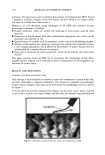
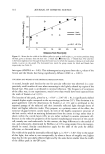
314 JOURNAL OF COSMETIC SCIENCE 55 50 45 4O 0 black 0 blonde o o y= 45,1 +0.31x 5 10 15 20 25 30 35 Distance from Root [cm] Figure 11. Means for the width of the diffuse reflection peak at half height, wd, at various positions along the hair, given as distance from the hair root. O black hair, ß brown hair, 0 blonde hair. The solid line is the linear regression line through the data for brown hair, for which the equation, relating to all individual results, is given on the graph. The horizontal lines mark the group means for black and blonde hair, respectively (see Table I). hair types (ANOVA: o• = 0.03). This inhomogeneity originates from the w d values of the brown and the blonde hair being significantly different (LSD: o• = 0.011). LOCATION AND WIDTH OF THE INTERNAL REFLECTION PEAK A second, broader peak besides the one for specular reflection was observed ih a com- paratively small number of cases when measuring in the lightly colored tip region of the blonde hair. This peak is attributed to internal reflection. The frequency of occurrence of the effect was, in our experiments, much lower than would have been expected from the work of Stamm et al. (2,11). The location of this peak, given by % = 64.0 ø + 2.96 ø (N = 8), is significantly shifted towards higher angles compared to the ray-tracing prediction (55ø). This deviation is in good agreement with the observations by Stamm et al. (11) and is attributed to the repeated passage of the refracted and then internally reflected light through sheets of lower and higher refractive index. They propose, as a primary source of the effect, the existence of gaps between cuticle layers. In view of the highly cooperative structure of the hair cuticle, which on straining delaminates from the cortex in rings rather than in sheets within the cuticle layers (20), we are rather inclined to assume systematic dif- ferences in the refractive properties of the layered morphological structure of the cuticle cell, namely exo- and endocuticle. In this context, the large differences in the moduli of exo- and endocuticle, determined by Parbhu et al. (21), using atomic force microscopy, should be noted. Similar considerations apply for the shift of the peak for diffuse reflection, as discussed above. The width of the peak for internally reflected light w i is 24.9 ø + 3.02 ø. Due to the nature of this light, this value is, not unexpectedly, by about a factor of roughly two, higher than that for the specularly reflected light and by the same factor smaller than the width of the diffuse peak in the GP curve.

LIGHT REFLECTION FROM HAIR 315 CONCLUSION The high-resolution, optical probing of the surface and interior of a hair fiber is enabled by fast data acquisition through simultaneous multi-angle goniophotometry, which gives quick access to the light reflection curve of a single hair at any given position along its length. By fitting up to three Gaussian peaks to the GP curve, the different types of reflected light are determined with respect to their receptor angles and intensity distributions. From the data, detailed insight into the reflection of light from hair and its changes along the hair length are gained. Specific changes of the parameters are observed for the three hair types and along the hair length that can be attributed to the antagonistic effects of hair damage and grooming as well as to other phenomena that are currently not well understood. The next, immediate step of these investigations is to derive a measure of luster for human hair from the observations on light reflection (22). REFERENCES (1) (2) (3) (4) (5) (6) (7) (8) (9) (lO) (11) (12) (13) (14) (15) (16) (17) H. K. Bustard and R. W. Smith, Studies of factors affecting light scattering by individual human hair fibres, Int. J. Cosmet. Sci., 12, 121-133 (1990). R. F. Stamm, L. M. Garcia, and J. J. Fuchs, The optical properties of human hair. II. The luster of hair fibers, J. Soc. Cosmet. Chem., 28, 601-609 (1977). M. Hailer, H. Schmidt, and G. Sendelbach, Measurement of the optical paths of light in hair, Poster 42, Proc 21 't IFSCC Int. Congress, Berlin, 2000. A. Guiolet, J. C. Garson, and J. L. Levecque, Study of the optical properties of human hair, Int. J. Cosmet. Sci., 9, 111-124 (1987). Y. Tango and K. Shimmoto, Development of a device to measure human hair lustre,J. Cosmet. Sci., 52, 237-250 (2001). C. Reich and C. Robbins, Light scattering and shine measurements of human hair: A sensitive probe of the hair surface, J. Soc. Cosmet. Chem., 44, 221-234 (1993). W. Haertl, R. Klemp, and H. Vetsmold, Crystallization and characterization of crystallites in charge stabilized suspensions, Phase Transitions, 21, 229-235 (1990). R. F. Schmidt and G. Thews, Eds., Physiologie des Menschen (Springer-Verlag, Berlin, 1995), Chapter 16. W. Czepluch, G. Hohm, and K. Tolkiehn, Gloss of hair surfaces: Problems of visual evaluation and possibilities for goniophotometric measurements of treated strands,J. Soc. Cosmet. Chem., 44, 299-318 (1993). J.A. Swift, Human hair cuticle: Biologically conspired to the owner's advantage, J. Cosmet. Sci., 50, 23-47 (1999). R.F. Stamm, M. L. Garcia, and J.J. Fuchs, The optical properties of human hair. I. Fundamental considerations and goniophotometer curves, J. Soc Cosmet. Chem., 28, 571-599 (1977). E. Schulze zur Wiesche, Untersuchungen zur haarpflegenden Wirkung yon Henna, MSc Thesis, Aachen University of Technology, 1995. S. Nagase, S. Shibuichi, K. Ando, E. Kariya, M. Okamoto, R. Yakawa, A. Mamada, and N. Satoh, Light scattering control at the medulla enhances human hair shine: Internal structures of hair fiber and its shine, Proc 21 st IFSCC Int. Congress, Berlin, 2000, pp. 153-159. J. H. S. Rennie, S. E. Bedford, and J. D. Hague, A model for the shine of hair arrays, Int. J. Cosmet. Sci., 19, 131-140 (1997). Statistica for Windows (computer program manual) (StatSoft Inc., Tulsa, OK, 1999). J. H. Zar, Biostatistical Analysis (Prentice Hall, NJ, 1996). M. L. Tate, Y. K. Kamath, S. B. Ruetsch, and H.-D. Weigmann, Quantification and prevention of hair damage, J. Soc. Cosmet. Chem., 44, 347-371 (1993).
Purchased for the exclusive use of nofirst nolast (unknown)
From: SCC Media Library & Resource Center (library.scconline.org)