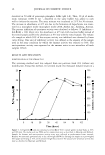
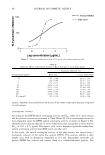
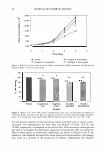
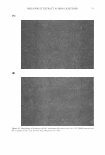
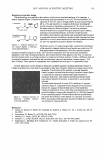
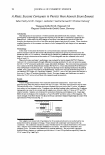
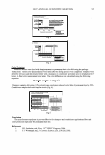
48 C 100 0 C iD a, lU 50 C "i 0 L. � � JOURNAL OF COSMETIC SCIENCE _ .. .. 0 +-------,,------r------,.-------, -1 0 1 2 Log concentration (µg/mL) 3 --A. incisus extract •• - • · Kojic acid Figure 3. Tyrosinase-inhibitory activity of A. incisus ether extract and kojic acid. Table II Inhibitory Effects on Tyrosinase Activity of Kojic Acid and A. incisus Ether Extract Concentration (µg/ml) 0.5 1 5 10 50 100 250 500 IC50 (µg/ml) Kojic acid 7.05 ± 0.08 7.02 ± 0.04 9.12 ± 0.11 26.54 ± 2.33 66.79 ± 0.53 81.94 ± 3.16 95.59 ± 0.55 96.08 ± 0.95 7.89 ± 0.18 Tyrosinase inhibition(%) A. incisus ether extract 20.13 ± 1.39 26.55 ± 1.13 42.76 ± 1.26 48.29 ± 0.93 67.44 ± 2.24 73.40 ± 1.42 81.25 ± 1.83 85.06 ± 4.24 10.26 ± 3.04 extract, therefore, may result from the action of the other compounds that are composed of such extract. ANTIOXIDANT ACTIVITY According to the DPPH radical scavenging activity, the EC 50 values of A. incisus extract and the positive controls are presented in Table III and IV. Each tested sample shows the dose-dependent curve for DPPH radical scavenging activity, as shown in Figure 4. The obtained results indicate that the A. incisus ether extract has antioxidant activity with an EC 50 of 169 ± 9.73 µg/ml. The extract of A. incisus heartwood provides weaker free radical scavenging activity than BHT and 1-ascorbic acid. In this study, the radical scavenging activity of the ether extract was tested using a methanolic solution of the stable free redical, DPPH. This solution exhibits a deep purple color with an absorption maximum at 515 nm. Antioxidant molecules can quench DPPH free radicals and convert them to a colorless/bleached product. The

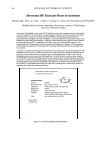
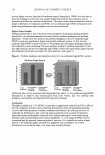
BREADFRUIT EXTRACT AS SKIN LIGHTENER 49 Table III Percentage of Free-Radical Scavenging of A. incisus Ether Extract Concentration of A. incisus ether extract (µg/ml) 0.5 1 5 10 25 50 100 250 500 2000 Free radical scavenging (%) 3.64 ± 0.29 7.70 ± 0.30 10.58 ± 0.43 13.09 ± 0.33 15.35 ± 0.22 20.30 ± 1.27 41.67 ± 1.81 62.71 ± 1.34 77.89 ± 1.23 94.08 ± 0.92 Table IV EC50 (µg/ml) 169.53 ± 9.73 Percentage of Free-Radical Scavenging of 1-Ascorbic Acid and Butylated Hydroxytoluene Concentration (µg/ml) 0.25 0.5 2.5 5 25 50 125 250 1000 2500 EC50 (µg/ml) 1-ascorbic acid 7.83 ± 1.72 15.81 ± 0.53 41.02 ± 3.97 69.03 ± 0.16 88.10 ± 0.33 93.89 ± 0.12 94.01 ± 0.13 94.09 ± 0.15 93.94 ± 0.13 93.96 ± 0.38 3.16 ± 0.26 Free radical scavenging (%) Butylated hydroxytoluene 12.68 ± 0.76 15.17 ± 1.64 56.68 ± 0.91 80.51 ± 0.73 92.41 ± 1.41 94.88 ± 0.23 95.00 ± 0.08 97.02 ± 1.35 96.12 ± 0.11 94.93 ± 1.46 2.30 ± 0.03 DPPH test only recognizes free-radical scavenging effects and not pro-oxidant activity (8). Therefore, other antioxidant properties, such as reducing o-quinones or other inter mediates in melanin biosynthesis of the ether extract, should be taken into consideration and further clarified in the future. MELANOGENESIS-INHIBITORY ACTIVITY In this study, the activity of melanocyte B16Fl cells was investigated by determination of the melanin content of cells treated with A. incisus ether extract, purified artocarpin, or lightening agents including kojic acid and hydroquinone. The A. incisus extract showed the dose-dependent inhibition of melanin production of B16Fl cells, as shown in Figure 5. The percentages of melanin reduction in the extract-treated cells compared to that of the control (DMSO-treated) cells at concentrations of 2, 10, 15, and 25 µg/ml of A. incisus extract were 5.34%, 8.76%, 16.73%, and 26.65%, respectively. The final concentration of DMSO in the cultured medium was not more than 0.1 % v/v. To provide more evidence that the extract of A. incisus potentially inhibits melanogen esis, we determined its effects on melanin production in comparison to well-known
Purchased for the exclusive use of nofirst nolast (unknown)
From: SCC Media Library & Resource Center (library.scconline.org)