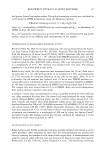
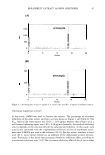
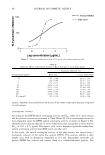
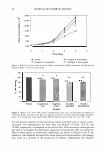
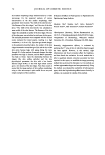
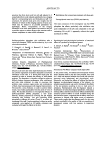
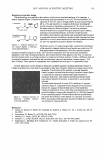
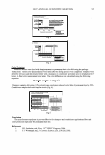
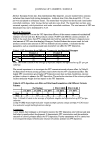
2007 ANNUAL SCIENTIFIC MEETING 83 Examples of molecular design Toe methodology was applied to the synthesis of a bioactive structural analogue of L-carnosine, a natural dipeptide (figure 2) capable of preventing lipid peroxydation in vitro [3]. The bioavailability of L L-Carnosine O COCH N H 2 N'''-,)lNH::t::.Jt:) B alanine moiety Decarboxy-carnoslne i-, ru � J NH ..l..\) carnosine is very low, due to its high polarity (Log D at physiological pH is -5,8), and sensitivity to cutaneous hydrolases including the specific ubiquitous dipeptidase carnosinase [ 4]. We chose to remove the alpha-carboxylic function (figure 2, in red) as a minimum structural modification ( original biological properties must remain), resulting in increased lipophilicity, molecular weight decrease (favorable to percutaneous adsorption), and anticipated high resistance to proteolytic enzymes. In addition, decarboxylated carnosine has been identified in vivo as a minor metabolite of carnosine (named carcinine) [5] this was regarded as a positive feature for tolerance. Figure 2 : chemical structures of the natural peptide L-carnosine, Predicted Log D (-3,3 at physiological pH), outlined that withdrawal and its peptidomimetics of the negatively charged carboxylic acid moiety may result in a 100 fold improvement of the penetration. Still, the compound remains strongly hydrophilic (negative Log D). Toe "substrate competition test" has shown that unmodified dipeptides, even with a B-aminoacid moiety, have a short half-life when applied to the skin. As expected, decarboxylation results in a strong resistance to cutaneous hydrolytic enzymes. Finally, a diffusion study on reconstituted epidermis indicated that the peptidomimetic can cross the stratum comeum (approx. 35% after 24 hours). These predictive experiments were confinned later with an ex vivo permeation study. Another application was the design of chemically modified arginine-containing dipeptides (Figure 3). Chemical modifications were made in an attempt to limit their enzymatic hydrolysis in upper layers of the epidermis. N-acetylation of the naturally occurring dipeptide citrullyl-arginine isolated from the red alga chondrus crispus (figure 3, compound A) resulted in unexpectedly high resistance to enzymatic hydrolysis. This chemical modification has provided some limited benefits for polarity, as predicted by our modeling software. Toe antioxidant dipeptide N-acetyl-(O,L)-methionyl-L-arginine ethylester (figure 3, compound B) was designed for the sustained release of L-arginine within the deep layers of the epidermis. Chemical modification of two of the three ionizable functions of the molecule enables to improve the lipophilicity by 100 fold compared to the unmodified peptide. We have shown that the modifications Figure 3 : chemical structures of also delay the hydrolysis of the peptide via a mixture of enzymes. chemically modified arginine- HPLC monitoring of the enzymatic mixture revealed that L-arginine containing dipeptides. was released at a measurable rate. References 1. Garcia, N., Doucet, 0., Bayer, M., Fouchard, D., Zastrow, L., Marty, J.P., Int. J. Cosmet. Sci., 24, 25- 34 (2002) 2. Lineweaver, H., Burke, D., JACS, 56, 658-666 (1934) 3. Decker, E.A., Faraji, JAOCS, 67, 650-652 (1990) 4. Boldyrev, A., Comp. Biochem. Physiol. B Biochem. Mo/. Biol., 127, 443-446 (2000) 5. Flancbaum, L., Brottnan, D.N., Fitzpatrick, J.C., Van Es, E Kasziba, T., Fisher, H., Life Sciences, 47, 1587-1593 (1990)

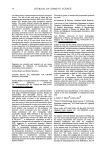
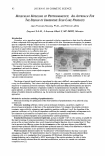
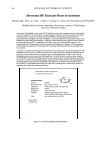
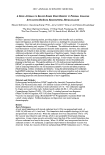
84 JOURNAL OF COSMETIC SCIENCE SUSTAINABLE UC/ STABILIZERS BASED ON ISOSORBIDE Michael Jaffe1, Ph.D., A.J. East1, Z. Ophir1, Y. Zhang1, G. Collins1, W. Hammond1 and P. Friedhoff2 1 Medical Device Concept Laboratory, New Jersey Institute of Technology 2 Iowa Corn Promotion Board A new class of sustainable resource derived UV stabilizers, based on the cinnamic acid esters of isosorbide is under investigation. This work is part of a larger program to identify commercially relevant com sugars based chemistries. The Iowa Com Promotion Board (ICPB) is the lead organization that has been supporting research designed to develop cost-effective com based chemistries and processes relevant to the commercial polymer and related industries. ICPB has licensed technology developed at Pacific Northwest National Laboratory (PNNL) to manufacture isosorbide. This research was funded by the Iowa Com Promotion Board, US Department of Agriculture and the US Department of Energy. ICPB has partnered with the New Jersey Institute of Technology (NJIT) to identify and assess potential polymer applications for isosorbide. The project is centered on defining the cost-performance of isosorbide derived compounds that improve the performance characteristics of commercial systems. The work will positively impact the feasibility of fuel production in an existing biomass processing facility by creating applications for high-value chemical building block derivatives co-produced with liquid fuels. The work builds on inventions and concepts of the ICPB-PNNL and ICPB-NJIT partnerships where several patents have been filed and more are pending. Isosorbide is a versatile, GRAS, dianhydrosugar compound, derived from sorbitol, with broad application as a building block for the polymer and pharmaceutical industries. Isosorbide currently sells for about $2.00/pound it is expected that the new process could lead to volume pricing ofless than $1/pound. The properties of isosorbide are summarized in Figure 1. J rbicl� .Ei:.1 �cl Ch�mbiri� : Ch:1mi lll ?wp:1rti:1 Characteristics: GAS No.: 652-67-5 a _x:.:;__�, ")� Molecular formula: Appearance: Melting point: Boiling point: Solubility: Other: C6H10O4 (Mw = 146.14) White crystalline powder, very hygroscopic 61-64°C 16o0c (10mm Hg) OH Soluble in water, alcohol, dioxane ketones. Almost insoluble in hydrocarbons, esters, ethers Very heat stable. Non-toxic, GRAS Figure 1 - Structure and Properties of Isosorbide
Purchased for the exclusive use of nofirst nolast (unknown)
From: SCC Media Library & Resource Center (library.scconline.org)