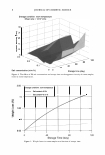
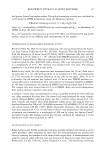
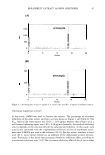
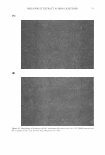
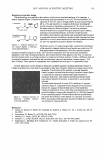
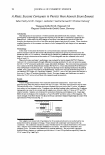
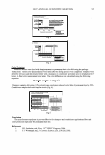
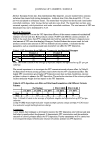
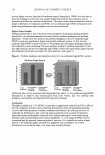
Color Protection 2007 ANNUAL SCIENTIFIC MEETING K&ratin Denaturation (DSC) Conlltlonor (Rin,.,.Qlf) 140 1415 115a Denaturation tempenllura('CI Keratin Oenaturatlon (DSC) Shampoo C ..... ( -""1 Fig. 2 1� 1.U 1• 141 1IO 1152 __ .., Fig. 3 tM Ietttn d·ebe 0-0%SodlumllllhthSUlfffli 3.otltCocamldapropylBetme 2""TM1Mlkliriill 11d 100.0IJli ...-. pH"' 5.1:lO 95 Bleached tresses were dyed with demipennanent or permanent hair color following the package instructions. Initial color measurements were taken after the dying process was completed. Samples were dried for 24 hours and then treated either with a shampoo or conditioner prototype prior to irradiation for 7 hours. A fmal color measurement was taken. The color difference was calculated using the following equation. Shampoo samples delivering 1.0% polysiloxane copolymer reduced color fade of permanent dye by 50%. Conditioner samples delivered similar results (Fig. 4). Conclusion Color• Protootion Against UV-Fading Stmrnpoo, Plrmanenl Oy,r Fig.4 The polysiloxane copolymer is proven effective for shampoo and conditioner applications fiber and color protection especially for permanent hair dye. References 1. 2. H.I. Leidreiter, etal, Proc. 23rd. IFSCC Congress, 2004. F.J. Wortmann, etal J. Cosmetic Science, (53), 219-228, 2002.

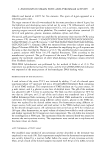
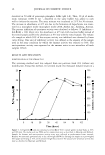
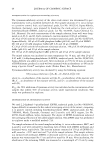
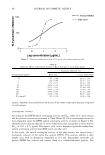
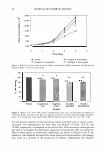
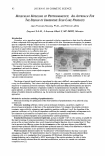
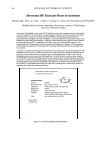
96 JOURNAL OF COSMETIC SCIENCE TOTAL PROTECTION FOR HAIR DURING THE USE OF COLORING PRODUCTS* Jennifer Marsh, Ph.D. *This paper is being presented by Dr. Graham McKelvey on behalf of Dr. Marsh who was unable to attend. The Procter & Gamble Company, Miami Valley Innovation Center, Cincinnati, OH 45252 Background: The use of permanent hair colorants products is widespread and allows the consumer to either change their natural hair color and/or cover gray. However, there are trade-offs that the consumer has to make if she is using these products on a regular basis. Typical trade-offs are the application time involved in the coloring event, typically 25-30 minutes to achieve the desired color, the unpleasant odor during application and the changes to the hair quality over multiple cycles. To try and reduce these trade-offs we have focused our research work to investigate alternative oxidants that can achieve the color result in a shorter time and ideally with an improved fiber damage and odor profile vs current products. The reason why our chosen focus was the oxidant system, i.e. ammonium hydroxide + hydrogen peroxide at pH 10, is because the long application time is controlled by the time it takes the oxidant to decolorize the melanin to achieve the required lightening. In addition, it is this same chemistry that causes the fiber damage and the poor odor profile. Previous products have been formulated that can deliver lightening and color formation in shorter application time ( 10-15 mins) but this has been achieved by significantly increasing the hydrogen peroxide and ammonia levels. This leads to negatives in terms of skin irritation from the higher levels of hydrogen peroxide and also even worse odor from the higher ammonia levels. The oxidant system we have investigated is the combination of an ammonium carbonate salt with hydrogen peroxide at a pH of9.0. We have demonstrated that with the addition of a radical scavenger such as glycine this system can achieve comparable lightening to current oxidants but at shorter application times and without significantly increased hydrogen peroxide levels. The lower pH also gives the system a lower ammonia odor and an improved fiber damage profile Lightening: The key species responsible for decolorizing the melanin in current colorants is the perhydroxyl anion (HOO-) formed as the pH of hydrogen peroxide is increased with ammonia as the alkalizer. A minimum pH of 10.0 is required for sufficient levels of this anion to be present in the product and for good lightening to occur. Lightening is of course crucial for the achievement of blonde shades but also for good grey coverage for the light/medium brown shades and also to produce vibrant tonal shades such as reds. (pKa = 11.6) For the ammonium carbonate/hydrogen peroxide/glycine oxidant, the proposed key species responsible for the lightening of the melanin is the peroxymonocarbonate ion which is formed in-situ as the carbonate and hydrogen peroxide are mixed. The pKa of this oxidant is 10.3 and the optimal pH for the system to give lightening is pH 9.0. + HOOH II ,........- c -........._ -o o-OH Peroxymonocarbonate ion Data will be shared that compares the lightening of selected ammonium hydroxide/hydrogen/pH 10 systems to ammonium carbonate/hydrogen peroxide/glycine systems at pH 9 at both 10 minutes and 30 minutes. The data illustrates that the ammonium carbonate/hydrogen peroxide/glycine system at 10 minutes can match current lightening levels at 30 mins. Odor: The optimum pH of the ammonium carbonate/hydrogen peroxide/glycine system is 9.0 vs 10.0 for the current ammonium hydroxide/hydrogen peroxide oxidant. As the pKa of ammonia is 9.3 a drop of one pH unit will significantly reduce the level ofNH3 in the system NH3 is the species responsible for the ammonia odor. Calculations have been done to predict the speciation of the different equilibria in two matched lightening oxidant systems and the relative concentration of the NH 3 formed (see table 1) Concentration ofNH3 (mol/1) 1.35% ammonium hydroxide/3% h drogen peroxide 0.67 4.5% ammonium carbonate/3% hydrogen peroxide/1.9% 1 cine 0.27
Purchased for the exclusive use of nofirst nolast (unknown)
From: SCC Media Library & Resource Center (library.scconline.org)