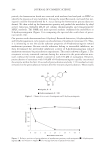
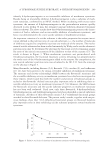
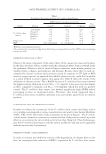
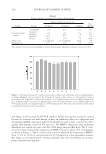
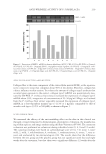
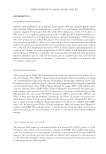
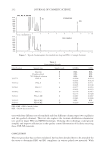
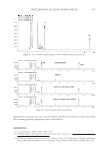
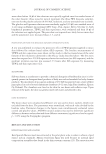
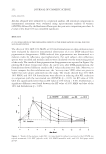
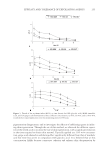
JOURNAL OF COSMETIC SCIENCE 218 and ellagic acid by using the RT-PCR method. EGCG was used as a positive control because its activities are well known to have an inhibitory effect on collagenase and stromelysin mRNA expression induced by IL-1β (21) and to have a protective effect against skin damage caused by UV rays (22). The MMP-1 expression assay on human fi broblasts was carried out with a Gel Doc 2000 image analyzer (Bio-Rad). The P. strobi- lacea fruit extract reduced the expression of MMP-1 (by up to about 76% at 50 μg/ml), as shown in Figure 2. The P. strobilacea fruit extract inhibited the expression of MMP-1 from 17.3% to 76.0% at concentrations of 25–50 μg/ml in a dose-dependent manner. But ellagic acid isolated from P. strobilacea showed only 15% of inhibition at its maxi- mum concentration (1μg/ml). Figure 1. Cytotoxicity assay of P. strobilacea fruit extract, ellagic acid, and ellagic acid 4-O-xylopyranoside in human fi broblast cells: (a) Control (b) 10 μg/ml P. strobilacea fruit extract (c) 20 μg/ml P. strobilacea fruit extract (d) 50 μg/ml P. strobilacea fruit extract (e) 0.25 μg/ml ellagic acid (f) 0.5 μg/ml ellagic acid (g) 1.0 μg/ml ellagic acid (h) 0.25 μg/ml ellagic acid 4-O-xylopyranoside (i) 0.5 μg/ml ellagic acid 4-O-xylopyranoside (j) 1.0 μg/ml ellagic acid 4-O-xylopyranoside. The data are expressed as mean values (± standard deviations) of fi ve experiments. Table II Elastase Inhibition Activity of P. strobilacea Fruit Extract Sample Fraction Elastase inhibition activity (%) IC50a (μg/ml) 100 μg/ml 50 μg/ml 10 μg/ml P. strobilacea fruit extract 70% EtOH 72.8 63.7 12.1 37.9 Hexane fr. — — — — EtOAc fr. 74.3 69.2 7.8 35.1 BuOH fr. 82.2 67.5 6.1 37.0 H2O fr. 56.2 27.6 4.6 89.2 Ellagic acid 6.2 (1 μg/ml) 57.3 (5 μg/ml) 80.6 4.6 Oleanolic acid 57.7 35.2 9.9 83.8 a IC50 indicates the concentration (μg/ml) at which the percentage inhibition of elastase activity was 50%.

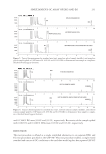
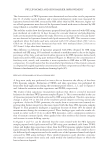
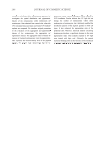
ANTI-WRINKLE ACTIVITY OF P. STROBILACEA 219 ASSAY OF COLLAGEN TYPE I mRNA BY RT-PCR Collagen fi ber is the main component of the extracellular matrix (ECM), as the represen- tative connective tissue that comprises about 90% of the dermis. Therefore, collagen has a direct infl uence on skin tension. To evaluate the amount of collagen type I synthesis that occurred upon exposure to the extract, collagen type I mRNA was quantitatively mea- sured by RT-PCR. P. strobilacea fruit extract increased the expression of collagen type I mRNA about 30%, irrespective of concentrations of 25–50 μg/ml. Ellagic acid isolated from the P. strobilacea fruit extract especially increased the expression of collagen type I mRNA in a dose-dependent manner (up to 41.3% at 1 μg/ml), comparable to that of ascorbic acid (up to 39.5% at 500 μM), as shown in Figure 3. IN VIVO CLINICAL TRIAL We measured the effi cacy of the anti-wrinkling effect on the skin in this clinical test through a visual evaluation by dermatologists, photometric evaluation, the manufactur- ing of skin replicas, and image analysis using the Skin-Visiometer SV 600. The cutaneous evaluation was performed on volunteers during scheduled visits (0, 4, 8 and 12 weeks). The cutaneous readings were based on a photodamage score of 0 to 7 (0, none 1, none/ mild 2, mild 3, mild/moderate 4, moderate 5, moderate/severe 6, severe 7, very se- vere) and evaluated by two dermatologists (18). The results show that the difference between the test group and the placebo group was not signifi cant until four and eight weeks after the treatment, but that there was a signifi cant difference 12 weeks after the Figure 2. Expression of MMP-1 mRNA in human fi broblasts (ATCC, CRL-2076) by RT-PCR: (a) Control (b) UVA 6J (c) UVA 6J + 10 μg/ml EGCG, (-)epigallocatechin-3-gallate (d) UVA 6J + 10 μg/ml P. strobi- lacea fruit extract (e) UVA 6J + 20 μg/ml P. strobilacea fruit extract (f) UVA 6J + 50 μg/ml P. strobilacea fruit extract (g) UVA 6J + 0.25 μg/ml ellagic acid (h) UVA 6J + 0.5 μg/ml ellagic acid (i) UVA 6J + 1.0 μg/ml ellagic acid.
Purchased for the exclusive use of nofirst nolast (unknown)
From: SCC Media Library & Resource Center (library.scconline.org)