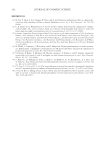
JOURNAL OF COSMETIC SCIENCE 310 (13) C. Mackay, T. Cox, G. Burrows, and T. Lazzerini, An inventory for the measurement of self-reported stress and arousal, Br. J. Soc. Clin. Psychol., 17, 283–284 (1978). (14) D. M. McNair and M. Lorr, An analysis of mood in neurotics. J. Abnorm. Psychol., 69, 620–627 (1964). (15) T. Hatta, J-SACL, Jodogo niyoru sutoresu sindan tesuto, manyuaru (Faburikku Joho Sisutemu, Osaka, Japan, 2010) (in Japanese). ( J-SACL, Stress diagnosis tests with emotion/behavior-related words: a manual a title translated by the present authors) (16) K. Yokoyama, S. Araki, N. Kawakami, and T. Takeshita, Production of the Japanese edition of Profi le of Mood States (POMS): Assessment of reliability and validity, Jpn. J. Pub. Health., 37, 913–918 (1990). (17) M. Itomura, S. Fujioka, K. Hamazaki, K. Kobayashi, T. Nagasawa, S. Sawazaki, Y. Kirihara, and T. Hamazaki, Factors infl uencing EPA+DHA levels in red blood cells in Japan, In Vivo, 22, 131–135 (2008). (18) M. Cabanac and M. Caputa, Natural selective cooling of the human brain: Evidence of its occurrence and magnitude, J. Physiol., 286, 255–264 (1979). (19) F. Corrard, Le froidissement sélectif du cerveau, Arch. Pédiatr., 6, 87–92 (1999). (The selective cooling of the brain a title translated by the present authors) (20) M. Caputa and M. Cabanac, Precedence of head homeothermia over trunk homeothermia in dehydrated men, Eur. J. Appl. Physiol. Occup. Physiol., 57, 611–615 (1988). (21) M. Kerscher, T. Reuther, J. Bayrhammer, and G. Schramm, Effects of an oral contraceptive containing chlormadinone and ethinylestradiol on acne-prone skin of women of different age groups: An open- label, single-centre, phase IV study, Clin. Drug. Investig., 28, 703–711 (2008). (22) A. H. Stark, M. A. Crawford, and R. Reifen, Update on alpha-linolenic acid. Nutr. Rev., 66, 326–332 (2008). (23) S. Suzuki, T. Akechi, M. Kobayashi, K. Taniguchi, K. Goto, S. Sasaki, S. Tsugane, Y. Nishiwaki, H. Miyaoka, and Y. Uchitomi, Daily omega-3 fatty acid intake and depression in Japanese patients with newly diagnosed lung cancer, Br. J. Cancer., 90, 787–793 (2004). (24) S. M. Conklin, J. I. Harris, S. B. Manuck, J. K. Yao, J. R. Hibbeln, and M. F. Muldoon, Serum omega-3 fatty acids are associated with variation in mood, personality and behavior in hypercholesterolemic com- munity volunteers. Psychiatry Res., 152, 1–10 (2007). (25) K. Joshi, S. Lad, M. Kale, B. Patwardhan, S. P. Mahadik, B. Patni, A. Chaudhary, S. Bhave, and A. Pandit, Supplementation with fl ax oil and vitamin C improves the outcome of Attention Defi cit Hyperactivity Disorder (ADHD), Prostaglandins Leukot. Essent. Fatty Acids, 74, 17–21 (2006). (26) S. Yoneyama, K. Miura, S. Sasaki, K. Yoshita, Y. Morikawa, M. Ishizaki, T. Kido, Y. Naruse, and H. Nakagawa, Dietary intake of fatty acids and serum C-reactive protein in Japanese, J. Epidemiol., 17, 86–92 (2007). (27) L. S. Rallidis, G. Paschos, G. K. Liakos, A. H. Velissaridou, G. Anastasiadis, and A. Zampelas, Dietary alpha-linolenic acid decreases C-reactive protein, serum amyloid A and interleukin-6 in dyslipidaemic patients, Atherosclerosis, 167, 237–242 (2003). (28) M. B. Howren, D. M. Lamkin, and J. Suls, Associations of depression with C-reactive protein, IL-1, and IL-6: A meta-analysis, Psychosom. Med., 71, 171–186 (2009). (29) H. Ando, A. Ryu, A. Hashimoto, M. Oka, and M. Ichihashi, Linoleic acid and α-linolenic acid lightens ultraviolet-induced hyperpigmentation of the skin, Arch. Dermatol. Res., 290, 357–381 (1998). (30) N. Antypa, A. J. Van der Does, A. H. Smelt, and R. D. Rogers, Omega-3 fatty acids (fi sh-oil) and depression-related cognition in healthy volunteers, J. Psychopharmacol., 23, 831–840 (2009). (31) G. Fontani, F. Corradeschi, A. Felici, F. Alfatti, S. Migliorini, and L. Lodi, Cognitive and physiological effects of omega-3 polyunsaturated fatty acid supplementation in healthy subjects, Eur. J. Clin. Invest., 35, 691–699 (2005).

J. Cosmet. Sci., 63, 311–320 (September/October 2012) 311 Skin-whitening effects of Mediterranean herbal extracts by in vitro and in vivo models LUISA RIZZA, CLAUDIA BONINA, GIUSEPPINA FRASCA, and CARMELO PUGLIA, Department of Pharmaceutical Science, School of Pharmacy, University of Catania, Viale A Doria 6, 95125 Catania, Italy. Accepted for publication February 13, 2012. Synopsis Several plant extracts are able to protect skin against ultraviolet-light-induced damage and hyperpigmenta- tion in a safe way. The anti-melanogenic effect of herbal extracts seems to be related to their antioxidant activ- ity and their polyphenolic content. In this study, the skin-whitening effect of some Mediterranean species, already known for their strong antioxidant and radical scavenger activity, has been evaluated by in vitro and in vivo models. The results obtained showed that herbal extracts possessed an inhibitory effect on tyrosinase enzyme. Each extract showed a similar inhibiting activity even though it was less intensive than kojic acid and hydroquinone. Otherwise, a signifi cant higher activity than kojic acid and hydroquinone was observed when the herbal extracts were combined. Furthermore, the anti-melanogenic activity and an evaluation of skin tolerance were affected by in vivo methods. INTRODUCTION Melanin is a physiological cutaneous “sunscreen” because it plays an essential role in the protection of skin from sunlight-induced damage. However, excessive production and accumulation of melanin can cause hyperpigmentation (melasma, freckles, age spot), and it can be associated with most serious skin disease such as melanoma (1–3). Melanin production can be inhibited by the reduction of ultraviolet (UV) exposure, by physical removal of corneal layer or inhibition of melanocyte biosynthesis and metabo- lism (4). Currently, topical application of melanin synthesis inhibitors is the less inva- sive procedure to avoid skin hyperpigmentation. Until now, traditional synthetic inhibitors of tyrosinase, such as hydroquinone and kojic acid, are considered the main active ingredients in cosmetic skin-whitening products (4–6). However, topical ap- plication of cosmetic and cosmeceutical products containing these active substances can raise several safety concerns especially for long-term treatments. Actually, some of their adverse effects, such as erythema, skin irritation, dermatitis, exogenous ochrono- sis, impaired wound healing, sclera and nail pigmentation, restricted their usage in the cosmetic industry (5,7,8).
Purchased for the exclusive use of nofirst nolast (unknown)
From: SCC Media Library & Resource Center (library.scconline.org)