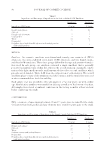
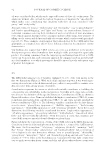
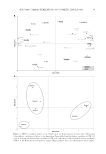
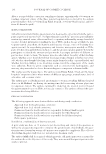
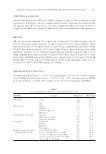
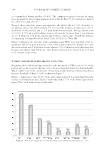
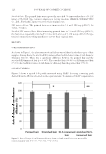
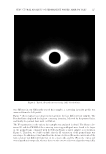
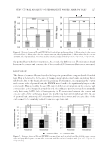
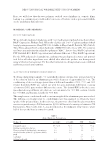
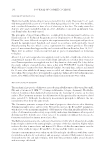
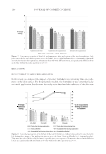
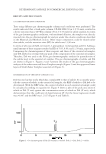
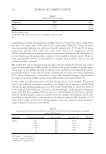
JOURNAL OF COSMETIC SCIENCE 124 Stretched hairs. The permed hairs were repeatedly stretched 50 times with a force of 0.1 N using a SV-201N type tension/compression testing machine (IMADA SEISAKUSHO Co., Ltd., Toyohashi, Japan) to restore their original state. SLS immersed hair. The permed hairs were immersed in 5.0 wt% SLS aq. (pH 8.5) for 3 min, 30 times. Stretched SLS immersed hair. After immersing permed hairs in 5.0 wt% SLS aq. (pH 8.5), the hairs were repeatedly stretched 50 times with a force of 0.1 N using a SV-201N type tension/compression testing machine to restore their original state. RESULTS CURL DIAMETER EFFICIENCY As shown in Figure 1, the phenomenon of curl fallout was validated in the three types of hair samples. Among them, the stretched SLS immersed hair had the lowest value of curl diameter effi ciency (82.6%). There was a signifi cant difference between the permed hair and the stretched SLS-immersed hair (p = 0.007). The stretched hair (90.8%) or SLS-immersed hair (95.3%) also had lower values of curl diameter effi ciency than the permed hair (97.1%). SAXS MEASUREMENTS Figure 2 shows a typical 2-D profi le measured using SAXS. A strong scattering peak derived from the IFs was observed on the equatorial axis. To examine if the IF’s organization Figure 1. Rate of change of curl diameter effi ciency because of each treated hair. t-test was used for statistical analysis with *p 0.05, **p 0.01, ***p 0.001.

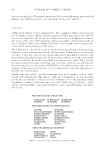
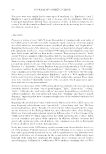
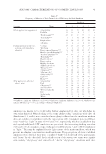
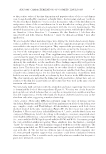
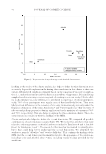
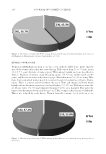
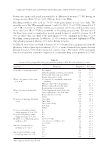
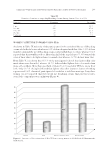
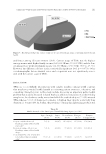
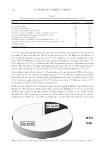
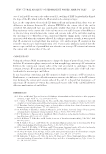
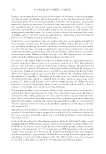
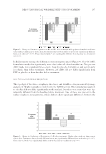
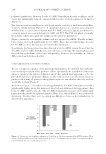
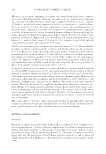
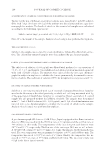
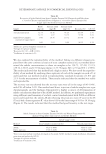
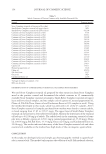
STRUCTURAL ANALYSIS OF PERMANENT WAVED HAIR BY SAXS 125 was different in our differently treated hair samples, a scattering intensity profi le was extracted from the 2-D profi le. Figure 3 shows typical scattering intensity profi les for four different hair samples. The bleached hairs displayed the highest scattering intensity, followed by the permed hairs, and fi nally the permed hairs with curl fallout. The IF organization in the various hair samples was analyzed in detail. The distance be- tween IFs and the FWHM of the scattering intensity profi le peak were found to be larger in the permed hairs compared with the bleached hairs (control sample) as is shown in Figure 4. Therefore, we could conclude that the IF orientation of the permed hairs was anisotropic. In addition, it was found that the distance between IFs on the convex side of the hair curvature was different from that on its concave side, and the IFs on the convex side were aligned anisotropically, whereas those on the concave side were aligned isotropically. Figure 2. Typical 2-D profi l e measured using SAXS (bleached hair).
Purchased for the exclusive use of nofirst nolast (unknown)
From: SCC Media Library & Resource Center (library.scconline.org)