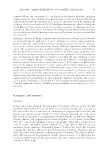
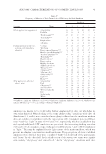
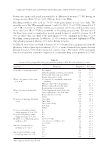
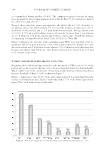
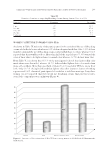
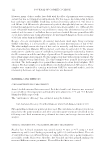
JOURNAL OF COSMETIC SCIENCE 90 Viscosities were very similar for the same types of emulsions (i.e., Emulsions 1 and 2, Emulsions 3 and 4, and Emulsions 5 and 6), because only the emollients, which were both liquid ingredients, differed. Thus, the presence of olive oil did not change the vis- cosity of the thickest emulsion (Emulsion 1), whereas modestly increasing the viscosity of the other two emulsion types. CATA SURVEY Frequency of mention of terms. Table V shows the number of consumers who used terms of the CATA survey to describe each of the evaluated cosmetic emulsions. As for the appear- ance of the emulsions, most emulsions were considered “glossy/shiny” and “bright white.” Regarding the viscosity of the emulsions, term selection depended on the particular sam- ples. Emulsions 1 and 2 (i.e., steric-stabilized O/W emulsions) had a high viscosity they were thick creams and did not fl ow in the container. They were perceived as “thick/ creamy” by most consumers, which was in line with the viscosity measurements discussed previously. Emulsions 3 and 4 (i.e., liquid crystal–stabilized O/W emulsions) had a me- dium viscosity, compared with the rest of the emulsions. Perception of their viscosity was not uniform unlike in the case of the other emulsions, most of the consumers considered Emulsion 3 as “thin/milky,” whereas Emulsion 4 was perceived primarily as “thick/creamy.” Consumers could not decide whether they should select “thick/creamy” or “thin/milky.” Some consumers noted that they perceived the viscosity to be “in between” the two terms. Notes were not used in the data analysis. Emulsions 5 and 6 (i.e., W/O emulsions) had a low viscosity they were lotions and were able to fl ow easily in the container. These emul- sions were considered “thin/milky” by most of the consumers, which again was in agree- ment with the viscosity measurements. As for the second section of the CATA survey, which was related to rub-out, pick-up, and immediate afterfeel, the terms “easy to spread/slippery,” “light,” “gluey/sticky,” “cooling,” “light,” “silky/smooth,” and “easy to rub in” were most frequently associated with the evaluated emulsions. The least mentioned terms were “warming” and “hard to spread/ dragging,” suggesting that most consumers thought none of the evaluated emulsions had these properties. Regarding the afterfeel after 3 min, which was the third section of the CATA survey, the most frequently selected terms were “smooth/soft,” “glossy/shiny” and “dry.” The least mentioned term was “white.” Results of Cochran’s Q test, which was performed to evalu- ate the robustness of the Skillings–Mack test, were identical to those of the Skillings– Mack test. Statistical analysis showed signifi cant differences for 15 of the 30 terms of the CATA survey (Table V), which suggests that the CATA survey was able to detect differ- ences in consumers’ perception of the emulsions. In addition, all three categories had statistically signifi cant terms, which indicate that consumers were able to distinguish between emulsions based on more than appearance. In the fi rst section of the CATA survey, signifi cant terms were those related to the viscos- ity of the products. Probable rationale includes the following: (i) viscosity is a property that can be qualitatively determined by eye, and (ii) signifi cant viscosity differences were present in the three sets of emulsions. In the second section of the CATA survey, more than half of the terms were signifi cant. For example, most consumers selected “hard to spread/dragging” for Emulsion 6, which was a W/O emulsion containing olive oil. W/O

SENSORY CHARACTERIZATION OF COSMETIC EMULSIONS 91 emulsions are known to be sticky/tacky, further emphasized by olive oil, which has its own tacky skin feel. When looking at the term “gluey/sticky,” emulsions with olive oil (Emulsions 2, 4, and 6) were considered more gluey/stickier than the emulsions without olive oil, which is in alignment with the expectations (28). Consumers perceived Emul- sions 3 and 4 as “light” at rates of 90% and 76%, respectively, which is usually how liq- uid crystal–stabilized O/W emulsions are perceived. An interesting fi nding was that 74% and 61% of consumers, respectively, perceived Emulsions 5 and 6 (W/O emulsions) as “light.” This may be explained by the light nature of the main emollient, which was present in a higher concentration in all emulsions. The perceptions of steric-stabilized emulsions were divided they were considered “light” by about half of the participants and “heavy” by the other half. In the third section of the survey, two terms were signifi - cant, namely “oily/greasy” and “smooth/soft.” As for “oily/greasy,” emulsions with olive Table V Frequency of Mention of Each Term of the CATA Survey for Each Emulsion Category Term Emulsion 1 2 3 4 5 6 Before application (appearance) Glossy/shiny 36 33 39 41 39 41 Dull/fl at 10 10 4 3 5 6 Thick/creamy*** 49 45 15 27 0 6 Thin/milky*** 1 1 31 18 49 43 Bright white 33 34 33 35 28 33 Off-white 11 8 6 8 14 10 During application (rub-out, pick-up, and immediate afterfeel) Cooling 23 25 27 27 33 28 Warming 2 2 0 1 1 1 Easy to spread/slippery*** 36 38 48 49 45 38 Hard to spread/dragging*** 7 7 0 0 4 13 Thick/creamy/fi rm*** 39 39 2 6 2 10 Thin/milky*** 7 3 39 35 40 31 Hard to rub in* 16 9 13 17 12 23 Easy to rub in 29 28 28 25 29 19 Highly absorbent 19 17 10 17 14 14 Slightly absorbent 18 18 20 22 22 18 Watery/wet*** 9 6 39 25 33 22 Oily/greasy*** 27 28 6 13 14 19 Silky/smooth* 32 24 38 32 24 29 Gluey/sticky*** 11 15 1 4 7 13 Light*** 18 19 45 38 37 31 Heavy*** 22 16 0 4 3 10 After application (afterfeel after 3 min) Glossy/shiny 25 24 23 29 29 27 Dull 14 10 15 11 10 14 Oily/greasy** 20 24 8 16 13 16 Smooth/soft** 36 27 44 34 29 32 Wet/not fully dry 16 19 10 14 19 15 Dry 21 16 20 21 18 20 Sticky/tacky 7 12 3 10 7 11 White 4 4 4 2 2 1 ***Indicates signifi cant differences ( p 0.001) **Indicates signifi cant differences ( p 0.01) *Indicates sig- nifi cant differences ( p 0.05), according to Skillings–Mack test.
Purchased for the exclusive use of nofirst nolast (unknown)
From: SCC Media Library & Resource Center (library.scconline.org)