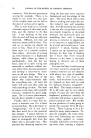
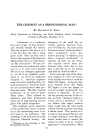
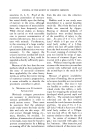
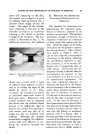
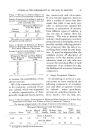
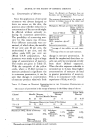
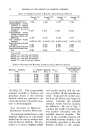
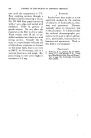
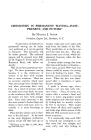
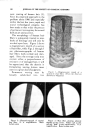
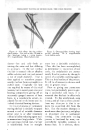
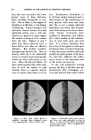
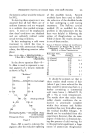
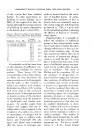
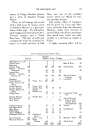
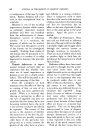
112 JOURNAL OF THE SOCIETY OF COSMETIC CHEMISTS fore, that any successful cold wave process must at least eliminate those variables susceptible to con- trol. One of these is the degree of cleanliness of the hair, or the degree of defatting. A good shampoo will obviously remove surface dirt and epidermal debris, and it will also remove to a greater or lesser degree the surface coating of oil or sebum from the hair. Figures 6 and 7 show hair fibers removed from a head before and after an efficient shampoo. But modern syr•thetic detergents go beyond this. Hair or keratin, after all, is not chemically inert it contains many polar groups which can react with anions or cat- 'ions. Thus, Neville and Harris (2) have demonstrated that when sam- ples of wool are soaked in soap solution there is a greater adsorp- tion of cations than there is'of an- ions. Furthermore, Steinhardt, et al. (3) have amply demonstrated in their'studies on the combination of wool protein with acid and base that this is not a simple physical adsorl•tion , but rather that keratins react q•ith anions and cations chem- ically. Similar conclusions x3ere reached by Speakman and Elliott (4) in their studies on the combina- tion of wool with acids and acid dyes. It is evident, therefore, that the action of detergents on hair goes far beyond that of surface cleansing, in that they may combine with and modify the polar groups of the kera- tin, and thus influence the subse- quent action of the chemicals used in the actual waving step. In the cold permanent waving process the hair is divided. into ap- proximately fifty rectangular sec- tions and the hair from each of these Figure &--Hair fiber taken before a shampoo, showing loose dandruff scales. 55 X magnification. Basic fuchsin stain Figure 7.--Hair fiber taken after a sham- poo from the same individual as that in Fig. 6. In this particular fiber the medulla is quite pronounced. 160 X magnification. Basic fuchsin stain

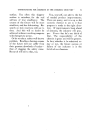
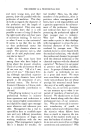
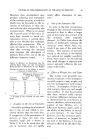
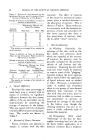
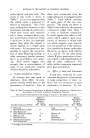
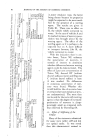
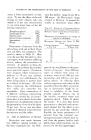
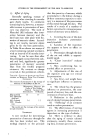
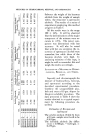
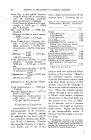
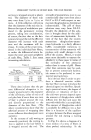
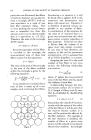
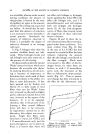
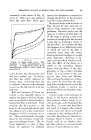
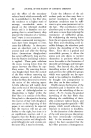
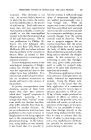
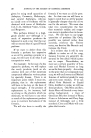
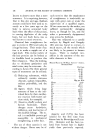
PERMANENT WAVING OF HUMAN HAIR: THE COLD PROCESS 113 sections is wrapped around a plastic rod. The diameter of these rods may vary from 1/8 in. to •/8 in. or more. A little reflection will prove that the diameter 0f the rod may in- fluence the type of undulations pro- duced in the permanent waving process, taking into consideration, of course, the fact that as the hair is wound around the rod the effective diameter will increase with each turn and the curvacure will de- crease. In terms of the strain intro- duced in .the individual hair fibers, or rather the differential strain be- tween the inner and outer periphery strength of preparations now in use commercially may vary from about 0.4 N to 0.9 N with respect to am- monium thioglycolate as determined iodimetrically. The pH of these solutions may vary from 9.0-9.5. Usually the alkalinity of the solu- tion is brought about by the addi- tion of ammonium hydroxide. In view of the fact that the system ammonium thioglycolate-ammo- nium hydroxide is a fairly efficient buffer, considerable variations in 'concentration of free ammonia will produce only small changes in the pH of the system. Hence,.it would p_f_ •a_ch__•b_e_r•, _Ta_b_l•__l__lj_s•s•_some seem more desirable to express the. interesting calculations. - the normality of free ammonia % Differential Diameter Extension (Inner Periphery Fiber Diameter Wrapped Fiber), In. 0.001 In. 0.005 In. 0.125 1 .ø60 8.00 0. 250 0.80 4.00 0.500 0.40 2.00 ß These data indicate that the per cent differential elongation is in- ver•ely p.roportional to the diameter of the curvature, either of rod or of rod plus hair if more than one turn of hair is placed around the rod, and directly proportional to the diameter of the hair fiber. (The above considerations show that the physical process of wrapping does or can influence the subsequent wave pattern.) In the systems of cold waving as currently practiced, the waving lo- tion is applied to the hair before it is wrapped around the rod. The rather than in terms of pH. Bases other than ammonia may be used, but at present ammonium hydrox- ide seems to be preferred in corn- mercia.1 waving lotions. It is obvious that ifi order to pro- duce a chemical reaction within the hair fiber we must introduce the chemical agent into the fiber. Speak- ing in practical terms, the degree of alteration or reduction of hair in the cold wave process depends upon the amount of thioglycolate which diffuses into the hair and upon the rate with which this is accomplished. The amount of thioglycolate which is available for diffusion into a hair fiber is a function of the capillary air space between the fibers wrapped around •he rod during a waving process. In Fig. 8 is shown a diagram of a cross section of a tress of fibers in close packed relationship. In the
Purchased for the exclusive use of nofirst nolast (unknown)
From: SCC Media Library & Resource Center (library.scconline.org)