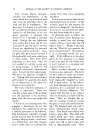
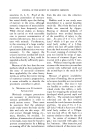
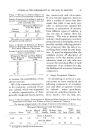
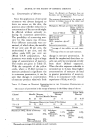
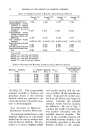
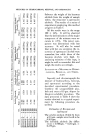
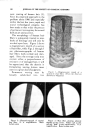
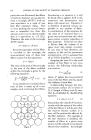
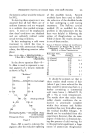
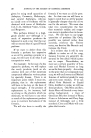
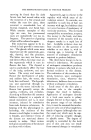
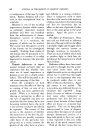
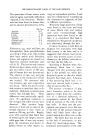
114 JOURNAL OF THE SOCIETY OF COSMETIC CHEMISTS particular case illustrated, hair fibers of uniform diameter are assumed to form a rectangle (RSTU) with one side equivalent to a total of two hair fiber diameters (2D,. Due to close packing the second dimen- sion is somewhat less than thik amount, and it can be shown readily that it is equivalent to x/• (D,. Therefore the area of the rectangle RSTUequals At = 2(D•) X x/• (D•) Since the equivalent of four fibers is inscribed in this rectangle the cross-sectional area of these hair fibers is given by the expression: At' = •r(D•) 2 The ratio of the area of the rectangle to the area of the fibers included within the rectangle is given by the following equation: At _ 2x/•(D•) '• 2x/õ = 1.i (1) At' •r(D_u) • •r It can readily be visualized that a tress of hair is made up of n rec- tar•gles, each containing four fibers.. 1 R $ Figure 8 Introducing n in equation 1, it will be found that it appears both in the numerator and denominator and hence will cancel out. Equation 1 is therefore of general nature, ap- plicable to any number of fibers. A consideration of the equation for the value of z/' indicates that in a given cross-sectional area this value must remain constant regardless of fiber diameter. If this be true then it follows th•tt the volume of air space must also remain constant. In any tress of hair therefore, the capacity of the curl for permanent wavihg lotion--if it is assumed that all air will be dispelled--is constant. Assigning the term N to the total number of hair fibers in any cross section, the following relationship is arrived at: At' N •r(D•/2) = (2) where z/' eqt•als the cross-sectional' area of the hair fibers and DH equals the diahaeter of each fiber. A relatiorlship between the reac- tive keratin surface ($) in terms of N, L (length of fibers) and DH may then be established by the.follov•ihg equation: 8= •rD•XLX N (3) ß Inasmuch as the value for Nvaries in- versely with the square of the radius of the hair fibers, it will be seen that the reactive keratin surface in a tress will be profoundly affected by the fiber diameter. For example, if the hair diameter is doubled, the number of fibers in a given cross section will be reduced to one-fourth the previous numbers. Accordingly

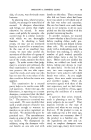
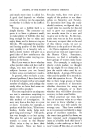
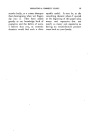
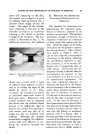
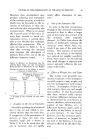
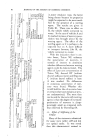
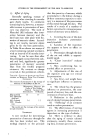
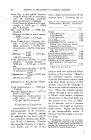
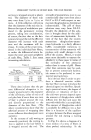
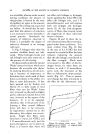
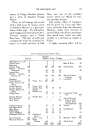
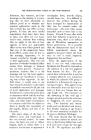
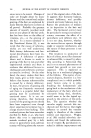
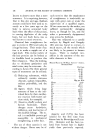
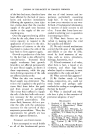
PERMANENT WAVING OF HUMAN HAIR: THE COL•) PROCESS 115 the keratin surface would be reduced by 50%. In deriving these equations it was assumed that all hair fibers are of uniform diameter and are 'wrapped in a uniform close packed arrange- ment. It need not be emphasized that these' conditions are idealized and are seldomly realized under actual waving conditions. In hair undergoing a cold wave treatment in which the tress is saturated with ammonium thiogly- colate, the following reaction takes place: Hair--S--' S--Hair 2 Hair-SH n t- NH4OOCCH•S--S-- CH2COONH• In the above equation Hair--S-- S--Hair is used to represent a nor- mal segment of a keratin molecule as shown in Fig. 9. "Backbone" NH CO I CHCH2S SCH•CH (CystineLinkage) CO NH NH CO R--CH CH--R CO NH NH . OC (Hydrogen Bond) / R--CH CH--R / CO NH / N/H CO / CHCH2CH2CH•NHa* -OOCCH•CH (Polar ß or Salt Linkage) Polypeptide Chain Polypeptide Chain Figure 9 Hair--SH is used to indicate this segment after the reductive splitting of the disulfide bonds. Several methods have been used. to follow the reduction of the disulfide bonds in hair undergoing a cold waving treatment. The Sullivan cystine method (5) as modified for this problem in this laboratory (6) has been very helpful in following the action of thioglycolates on hair. Table 2 shows the results obtained. in one of these studies. TASTE 2--EffECT or TIME o• THE DEOREE OF REDUCTION OF HUMAN HAIR USING A COMMERCIAL COLD WAVINO SOLUTION (DCR-3) AT ROOM TEMPERATURE Reduction Time, Cystine Min. Found,,% Av. 0•Con trol 17.0 O--Control 16.0 16.5 4 3.0 4 2.9 3.0 8 2.6 8 2.6 2.6 14 2.4 14 2.6 2.5 20 2.5 20 2.4 2.5 It should be pointed out that in these studies small tresses of hair (about 1 gm.) were reduced for the time stated by immersing them in a beaker containing a commercial cold wave lotion (--SH=0.72 N pH = 9.2, at room temperature). The results show that under these rather drastic conditions the re- duction is practically complete within four minutes and further treatment has very little effect upon the residual disulfide linkages. It should not be concluded from this experiment, however, that the same degree of reduction is obtained dur- ing the process of cold waving, for in this particular experimeni a huge excess of ammonium thioglycolate
Purchased for the exclusive use of nofirst nolast (unknown)
From: SCC Media Library & Resource Center (library.scconline.org)