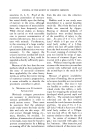
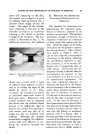
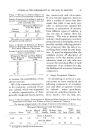
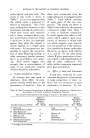
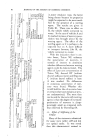
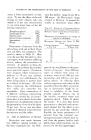
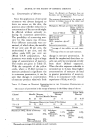
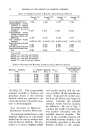
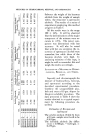
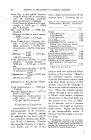
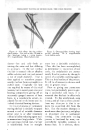
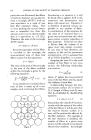
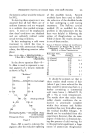
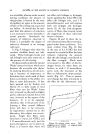
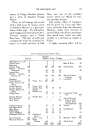
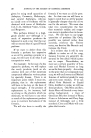
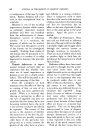
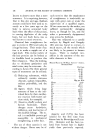
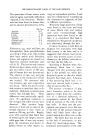
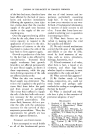
116 JOURI•AL OF THE SOCIETY OF COSMETIC CHEMISTS was available, whereas under normal waving conditions the amount of thioglycolate is limited by the ratio of capillary air space to the amount of hair on the curling rod, as pointed out before. It should also be real- ized that this amount of reduction is not necessary or even desirable in actual practice. One-fourth the amount of reduction observed in Table 2 is probably the degree of reduction obtained in an average cold wave. In Fig. 9 linkages other than the covalent disulfide bonds are indi- cated. These hydrogen bonds and salt linkages must play some role in the process of cold waving. To them must be added the van der Waals' attractive forces•which exist between the non-polar side chains. In studying the process of cold wav- ing it becomes of importance to determine how much each of these forces contribut6s to the ability of a fiber to resist deformation. It has been pointed out by Sookne and Harris (7) in their study of wool fibers that van der Waals' forces vary inversely as the sixth or higher power, whereas Coulomb forces will vary inversely as the square of the distance. It is to be expected, therefore, that in the process of de- forming a fiber several different forces will .have to be overcome. In exp.eriments carried out in this laboratory this subject was investi- gated. Single hair fibers were stretched in water, 0.1 h r HC1, and 5 N monochloracetic acid, and the load-elbnga•ion curve plotted. Since it is known that water will not. affect salt linkages or hydrogen bonds significantly, dilute HC1 will affect salt linkages only, and 5 N monochloroacetic acid will •:upture both salt linkages and hydrogen bonds (8, 4), the load-elongation curves of fibers thus treated reveal the magnitude of these 'individual forces in keratin. Figures 10 and 11 show the re- sults obtained when fibers were elon- gated under these conditions. 'It is quite evident from Fig. 10 that in the case of 0.1 N HC1 the load required to stretch thff fiber has been reduced, indicating the .amount that the salt linkages contributed to the fiber strength. Much more pronounced is the effect of the hy- drogen bonds, for when these are broken, as with 5 N monochloro- acetic acid, the resistance of the fiber to deformation drops precipi- tately (Fig. 11). That no perma- nent change has been introduced in the fiber by the chloroacetic acid A B ELONGATION Figure 10.--Stress strain curve. 20% elongation in 0.1 N HCI. ,,/--original water curve, B--in 0.1 N HC1

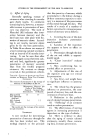
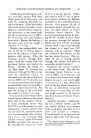
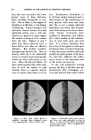
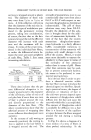
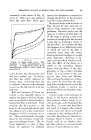
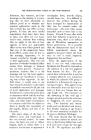
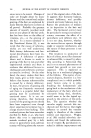
PERMANENT WAVING OF HUMAN HAIR: THE COLD PROCESS, 117 treatment is also shown in Fig. 11, curve C. This curve was obtained from the same fiber which gave ELONGATION Figure 11.--Stress strain curve, 20% elongation in 50% monochloracetic acid (wt./vol.). •/---original water curve, B--in monochloracetic acid, C--water curve 24 hours after B. curve B after the chloroacetic acid had been washed out. As shown, the fiber has nearly regained its former state, indicating that the co-ordinate valences were reformed as soon as the chloroacetic acid was removed. Bull and Gutmann (9) have ad- vanced a very plausible theory to explain the shape. of the load-elonga- tion curve which is obtained when a human hair fiber is deformed. They visualize the hair protein in the form of a thixotropic gel which under the influence of a stress induced by elongation will be converted into a sol. This transformatioh is brought about by the severance of salt link- ages and hydrogen bonds. The ob- vious implication is that if these bon'ds are ruptured by chemical means, less elongation is required to change the keratin to the sol state and thus induce plastic flow. Hysteresis loops such as shown in Figs. 10 and 11 may seem far re- moved from practical cold wave problems. However, such is not the case, for it will be recalled that one of the steps in giving a' cold wave consists of wrapping the hair around a rod, that is, inducing a strain in the hair fiber. It is immaterial that this hal•pens to be differential strain in which one side of the fiber is stretched more than the other. From a practical standpoint it would seem important, therefore, to de- sign a process which would co-ordi- nate the effect of the lotion as a whole on the secondary valence forces with the effect of the thio- glycolate on the covalent disulfide bonds. It is of interest in this con- nection that Jones and Mechan, (10) studying the dispersion of kera- tins, stress the view that the split- ting of the disulfide bonds and of the co-ordinate bonds in keratin are processes which can take place inde- p.endently. A direct result of the severance of bonds in the keratin molecule, be they primary valence bonds or co- ordinate bonds, is the swelling of the hair fiber. It is true that hair fibers will swell to a degree when placed in pure water, yet this is very small compared to the swelling which oc- curs when hair fibers are placed in a medium which is known to sever bonds, such as an alkaline thio- glycolate solution or a concentrate•l solution of monochloracetic acid.
Purchased for the exclusive use of nofirst nolast (unknown)
From: SCC Media Library & Resource Center (library.scconline.org)