106 JOURNAL OF THE SOCIETY OF COSMETIC CHEMISTS 3. Preliminary Consumer Test--If an experimental sample is found to be significantly different from some control or standard then there is a possibility that it also might be better liked than that control or standard. Of course, sometimes it may be desired to produce an experimental sample which is not different from a standard. This can occur in the case where some processing change is being considered to try to reduce production costs. If the experimental sample is equally as acceptable as the standard then the change in processing may be undertaken with no fear of loss of sales. In any event the samples are submitted to the consumer before any opin- ion is formed as to the relative acceptability of the experimental product. The consumer test may take the form of a conventional home use test such as is available from a large number of agencies who provide such services commercially. In our work we have developed a form of testing which is called a store test. The control sample and a variant are pre- pared in the laboratory ready for eating and are sent to one or another of several stores where facilities are maintained for this work. These facilities consist of counter space rented from a department store together with refrigerators, heating stoves, and all the utensils necessary for adequate serving of the samples. A staff of two to four trained interviewers invites customers of the store to participate in a "taste test." The respondents are asked to tell which of two samples they prefer and, if possible, the reason for their choice. The information thus obtained is used as a day-to-day or week-to-week source of guidance for the technologist attempting to improve old or de- velop new products. Principal advantages of this store test procedure lie in the relative speed with which results can be obtained and the com- paratively low cost. 4. Full-Scale Consumer Testing--If the new or improved product still shows promise after the above three steps of testing, it is ordinarily then subjected to this last step which is considered essential before chang- ing processing conditions or before putting a new product on the market. The full-scale consumer test is designed to determine, with as great a cer- tainty as possible, that the product really satisfies the needs and wants of the consumer. Decisions of this type require more assurance than can be given in any of the three previous steps. Therefore, the best avail- able type of consumer sampling is used, ordinarily on a nation-wide basis to determine the consumer acceptance of the new product. This type of test is ordinarily not carried out at the request of the tech- nologist but belongs more to the realm of the merchandising staff. The research man has done the best he can with the tools at his command after the third step above has been successfully completed. The preliminary consumer test phase of the program above is of primary

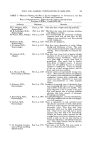
CONSUMER TESTING AS A GUIDE FOR TECHNICAL RESEARCH 107 importance to the technologist. In the first place, the use of a large group to express a preference for one of two products is obviously better by sheer weight of numbers than the opinion of any small panel. In the second place a consumer test gives the research man evidence directly from consumers which is more valuable than his own opinion or the opinion of a group of his technical co-workers when he reaches the all- important stage of recommending a development to his management. Third, when this kind of guidance is available early in the development program it can prevent a costly waste of research time. Without this kind of •guidance it is very possible to •ork long and hard perfecting a develop- ment only to find out later that certain 'features which seem technically desirable are undesirable from a consumer standpoint. One of the problems of the food technologist which is probably shared in common with the cosmetologist is that no one person or no small group is really qualified to predict consumer reaction to any new combination of taste, flavor, odor, texture, etc. There is no reason why any one person or any small group should be representative of the consumer group as a whole. The seriousness of this fact becomes apparent when we consider that, in a highly competitive field, manufacturers must be concerned with preference ratios of 1.5:1 and even less. Often a manufacturer may de- cide in favor of a product which shows only a 56 to 44 per cent preference margin over an alternative product. This corresponds to a preference ratio of 1.3:1. Consumer testing procedures are less precise than most people realize. It is axiomatic that safety lies in numbers. Obviously one can place greater reliance in a test in which 1000 people have expressed their preference than in a test of only 50 people. How much greater confidence, involves us in a consideration of statistical interpretation. The necessary statistics are clearly described in a number of texts on the subject (1, 3, 4) and are very useful for defining the degree of confidence which can be placed in any given test. The data in the following tables have been calculated to show the limitations and qualifications of various sizes of panels for paired preference consumer tests. TABLE 1--CA•'XBXLXT¾ Or PaSELS roe. Cossvu•v. T•sxxsG (Pv.•r•v. Esc• roe. Exx•v. or Two S•uvL•s) Panel Least Significant Panel Least Significant Size Pre•rence,% Size Pre•rence,% 15 75.3 75 61.3 25 69.6 150 58.0 50 63.9 300 55.7 Table 1 shows some of the obvious limitations of small panels with respect to their ability to evaluate small preferences between two samples.
Purchased for the exclusive use of nofirst nolast (unknown)
From: SCC Media Library & Resource Center (library.scconline.org)