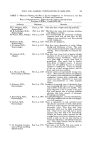
TOXIC AND ALLERGIC COMPLICATIONS OF HAIR DYES 123 TABLE 1--HEARINGS BEYORE THE HOUSE SoeLECT COMMITTEE TO INVESTIGATE THE Usv. o¾ CHEMICALS IN FOODS AND COSMETICS House of Representatives, Eighty-Second Congress, Second Session Pursuant to H.Res. 74 and H.Res. 447 Authority Reference Remarks H. V. Ailington, M.D., Part 2, p. 746 Para dyes have a high sensitizing potential. Dermatologist M. B. Sulzburger, M.D., Part 3, p. 1067 Hair dyes can cause skin eruptions, pruritus, Dermatologist and falling out of hair.. M. Walzer, M.D., Allergist Part 3, p. 1250 Tests recommended for prevention of allergic reactions from coal tar hair dyes by pre- liminary skin sensitivity tests have proved totally inadequate. H. Sharlit, M.D., Part 3, p. 1281 Para dyes are dangerous. Dermatologist I. I. Lubowe, M,D., Part 3, p. 1315 Hair dyes cause dermatitis of scalp, falling, Dermatologist drying and brittleness of hair. The reac- tions may be precipitated by cold permanent waving. Para compounds are frequent sen- sitizers. M. Grolnick, M.D., Part 3, p. 1324 Hair dyes may cause local or general allergic Allergist reactions in the skin and in the nasal and bronchial mucous membranes. These may vary from mild to severe, from local to generalized. May rarely lead to fatality from direct or indirect causes. A pre-use patch test self applied by user or cosmetic operator is inadequate. There are hazards in the use of para among workers and fur dyers and may cause asthma. R. L. Mayer, M.D., Part 3, p. 1338 Aromatic amines are particularly strong sensi- Dermatologist, Biologist tizers. Most powerful poisons and allergens are anilines, para-aminophenol, paraphenyl- enediamine, certain nitro compounds, and certain azo dyes. Sensitivity to para may cause cross-sensitivity to other aromatic amines. L. Schwartz, M.D., Part 3, p. 1798 Incidence of reported cases of dermatitis from Dermatologist para containing hffir dyes is about 1:80,000, and in 1930's of the order of 1:10,000. This great reduction is due to purity of the para now used, greater care in making oxidizing solutions and lower content of ammonia. Pre-•dyeing test helpful. A. Rostenberg, M.D., Part 3, p. 1801 Paraphenylenediamine, paratoluylenediamine, Dermatologist and minor modifications are the most danger- ous of all cosmetics. S. M. Peck, M.D., Part 3, p. 1242 There is apparently no real statistical proof Dermatologist that the pre-use patch test with a hair dye by the beauty parlor operator has had practical preventive value. Para dyes may cause dermatitis which may be slight or general- ized. Some of my cases had such a severe eruption that they had to be hospitalized. Neither the beauty parlor operator nor the average home user in most instances is com- petent to pick up the one plus reaction of sensitivity following a self-administered skin test. This slight reaction may be the first evidence of sensitivity. C. W. Crawford, Commis- Part 3, p. 1719 There were a few deaths that were traced to ioner of Food and Drug the use of hair dyes and eyelash dyes. Administration

124 JOURNAL OF THE SOCIETY OF COSMETIC CHEMISTS Table 1 is a summary of the opinions concerning toxicity of para dyes ex- pressed before the Committee. It is seen that with one exception (Schwartz) it was the opinion of all of the experts that para containing dyes are hazardous, that the method of patch testing and the whole idea of a preliminary patch test has not served the purpose of preventing allergic dermatitis due to these dyes. It is of interest, therefore, and it is necessary for us to closely ex- amine the authoritative paper of Schwartz and Barban (28) which recently appeared in the Archives of Dermatology, concerning their opin- ion about the dangers of paraphenylenediamine as a hair dye. These authors claim that thinking concerning the dangers of the para dyes is colored by the statistics, most of which were published before 1930. At that time, and in the textbook which the author published with Dr. Schwartz, we considered that the estimated cases of dermatitis reported were approximately one in ten thousand packages sold. Schwartz and Barban state that a recent study places the number of cases of alleged skin irritation in the ratio of one case to forty thousand to sixty thousand packages distributed. He and his collaborator believe that this reported drop. in incidence is undoubtedly due to the increased use of preliminary patch tests which manufacturers are now required by law to prescribe as an integral part of the instructions for use in which cosmetologists are required to perform by local laws in many jurisdictions. The high incidence of positive reactions to patch tests previous to 1930, according to Schwartz and Barban, was influenced by the use of impure para. This impure para contained residual amounts of irritating para- nitraniline from which it was then exclusively made. Now it is also produced from the cqmparatively innocuous paradichlorobenzene and pure para is used in hair coloring. The author discussed with the technical staff of the Calco Chemical Company, one of the largest producers of paraphenylenediamine in this country, their method of manufacturing para. They stated that para- chlorobenzene was used only briefly during the war and had not been used as a base for para either before the war or since then. They were not familiar with the use of paranitraniline as the initiating point of para. Certainly, they had not used this compound. It seems to me that as far as dermatitis is concerned we are concerned with para as a sensitizer and not as a primary irritant. Schwartz and Barban further state that in suits for damages against manufacturers of para hair dyes there have been no recoveries since pre- liminary patch testing became an important part of the directions for use. Recoveries have been obtained against beauty shop owners when it was established that the alleged injuries resulted from the negligence of the beautician in failing to make the preliminary patch test which would
Purchased for the exclusive use of nofirst nolast (unknown)
From: SCC Media Library & Resource Center (library.scconline.org)