118 JOURNAL OF THE SOCIETY OF COSMETIC CHEMISTS patch testing or should be given a drug with a similar reaction but a dif- ferent chemical structure (25). Paratoluenediamine, para-aminophenol, metol (paramethylaminophenol sulfate), and rodinol (pa-ra•aminopheva314vydrochloride) can be used instead of the para dyes. They are less toxic but not as effective as the latter. Amidol (2,4-di-aminophenol hydrochloride) can be used as a one solution dye. When used for fur dyeing para dyes will impart different shades from yellow to black depending on the type of dye and mordant used. Cases of dermatitis due to fur dyes are comparable to those encountered in dye- ing hair. The question of the toxicity of the coal tar derivative dyes, especially para and allied compounds, has become a serious problem because of the home hair dyeing kits. It is estimated that there are over fifty-five million applications of para dyes per year in this country alone. The hair dyes now being sold to the public for home use are put out as the so-called two-bottle package. One of the bottles contains a'solution of para, ammonia, and other ingredients, depending on the tint which is eventually to be produced, and the other bottle contains the oxidizing agent which is usually hydrogen peroxide. In carrying out the dyeing the con- tents of the two bottles are poured into a shallow dish and allowed to stand for about five minutes and then applied to the hair. It is usual in most well-prepared dye kits that the ammonia content of the final dyeing mixture should not exceed 11/2per cent, but surely should not be more than 2 per cent. The pH should not be higher than 10. Some of the preparations on the market tested by us had a higher pH. There must always be careful control by the laboratory to avoid an excess of free alkali. Pre-shampooing is not required with the home used hair dye. After the dye has been pre- pared as described above it is applied to the hair. It takes from one half to one hour for the desired color to appear. All of the excess dye, the am- monia and hydrogen peroxide are rinsed or shampooed off. Certain types of para dyes are now being sold as color shampoos. This is obviously quite dangerous to the eyes. It is the thinking of many workers in this field that the oxidation of the para should be allowed to go quickly because it is thought it becomes less of a potential irritant. The reasoning behind this will become evident when the question of themechanism of irritation of the para dyes is discussed. ß The Course of Paraphenylenediamine Oxidation The paraphenylenediamine is oxidized to quinonedi-imine and then a condensation takes place to what is known as Bandrowsky's base. Ac- cording to Cox (26), Bandrowsky's base is not the final compound obtained

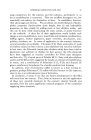
TOXIC AND ALLERGIC COMPLICATIONS OF HAIR DYES 119 NH• NH N---C•I'-Ia (NH•): C C C HC CH oxidation HC CH condensation HC CH HC CH HC CH HC H C C C N•C•Ha(NH:): p-Phenylenediamine •inonedi-imine Bandrowsky's b•e in the dyeing of furs. The actual principal coloring matter is an azine compound with the protein of the fiber. Previously it had been considered that it was Bandrowsky's base which was responsible for the deleterious effects of the para dyes. Gordon (27), as long ago as 1929, applied this substance to scarified human skin and concluded from his experiments that it was neither poisonous nor irritating. He believed that sensitivity was due to the para itself and not to any intermediate product. Quinonedi-imine which is the first step in the oxidation of para is con- sidered by some to be the actual irritant. For this reason it was suggested that oxidation of para should proceed rapidly beyond this stage to lessen potential irritation. This compound has a sharp, penetrating odor (ac- cording to Schwartz, et aL) (28) and produces local irritation wherever it contacts the mucous membranes. It is unstable and decomposes and combines with itself in a short time to form Bandrowsky's base, which is a more stable compound. Oxidation proceeds beyond this until the final compound is produced which is insoluble and inert. O'Donoval (quoted by Harry) has pointed out that normal persons may fail to react to a 10 per cent solution of Ursol (containing para) whereas susceptible individuals react to a concentration as low as 0.005 per cent. Rostenberg and Sulzberger (29) tested 411 subjects with 2 per cent para in petroleum jelly and obtained 6.3 per cent positive reactors. Cross-sensitization to related chemical compounds may develop in those sensitized to para. Many instances of so-called polyvalent sensitivity after reactions to para are due to the fact that the sensitizing agent from an immuno-chemical point of view is unknown and, therefore, these cases which are assumed to be due to sensitization to polyvalent unrelated chemicals, are actually examples of cross-sensitization. The term cross-sensitization will be employed in the same way in which Baer (30) and Sulzberger (31) used the term: A given sensitization may cross among several compounds because, (a) they can contain identical allergenic principles (b) that there is produced a sensitization not only to the primary sensitizing chemical, but also to one or more immuno- chemically related allergens which these authors call secondary allergens
Purchased for the exclusive use of nofirst nolast (unknown)
From: SCC Media Library & Resource Center (library.scconline.org)