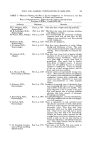
124 JOURNAL OF THE SOCIETY OF COSMETIC CHEMISTS Table 1 is a summary of the opinions concerning toxicity of para dyes ex- pressed before the Committee. It is seen that with one exception (Schwartz) it was the opinion of all of the experts that para containing dyes are hazardous, that the method of patch testing and the whole idea of a preliminary patch test has not served the purpose of preventing allergic dermatitis due to these dyes. It is of interest, therefore, and it is necessary for us to closely ex- amine the authoritative paper of Schwartz and Barban (28) which recently appeared in the Archives of Dermatology, concerning their opin- ion about the dangers of paraphenylenediamine as a hair dye. These authors claim that thinking concerning the dangers of the para dyes is colored by the statistics, most of which were published before 1930. At that time, and in the textbook which the author published with Dr. Schwartz, we considered that the estimated cases of dermatitis reported were approximately one in ten thousand packages sold. Schwartz and Barban state that a recent study places the number of cases of alleged skin irritation in the ratio of one case to forty thousand to sixty thousand packages distributed. He and his collaborator believe that this reported drop. in incidence is undoubtedly due to the increased use of preliminary patch tests which manufacturers are now required by law to prescribe as an integral part of the instructions for use in which cosmetologists are required to perform by local laws in many jurisdictions. The high incidence of positive reactions to patch tests previous to 1930, according to Schwartz and Barban, was influenced by the use of impure para. This impure para contained residual amounts of irritating para- nitraniline from which it was then exclusively made. Now it is also produced from the cqmparatively innocuous paradichlorobenzene and pure para is used in hair coloring. The author discussed with the technical staff of the Calco Chemical Company, one of the largest producers of paraphenylenediamine in this country, their method of manufacturing para. They stated that para- chlorobenzene was used only briefly during the war and had not been used as a base for para either before the war or since then. They were not familiar with the use of paranitraniline as the initiating point of para. Certainly, they had not used this compound. It seems to me that as far as dermatitis is concerned we are concerned with para as a sensitizer and not as a primary irritant. Schwartz and Barban further state that in suits for damages against manufacturers of para hair dyes there have been no recoveries since pre- liminary patch testing became an important part of the directions for use. Recoveries have been obtained against beauty shop owners when it was established that the alleged injuries resulted from the negligence of the beautician in failing to make the preliminary patch test which would

TOXIC AND ALLERGIC COMPLICATIONS OF HAIR DYES 125 have disclosed the presence of hypersensitivity to the hair coloring, and thus could have prevented the resulting skin involvement. He makes the rather strong statement that neither he nor his collaborator are aware of any single instance in which a claim of systemic effects was substan- tiated. In view of this rather wide divergence of opinion of Schwartz and Barban as against all other experts in the field it is important for us to go a little further into the methods which they used and the reasons they gave for this apparent decrease in the sensitizing properties of modern hair dye solutions. Schwartz and Barban carried out more than five thousand patch tests upon one thousand subjects without eliciting any reactions. In addition, uncovered patch tests were performed by two other der- matologists on 234 women with the dyes that were to be used on their hair and there were no reactions. Therefore, they seem to have records of open patch tests in about 1234 subjects without reactions. They make the claim that a home hair dye which has now become commercially avail- able for about one year and had about ten million packages sold is rela- tively safe. They base this on the fact that the company has received less than one hundred and twenty-five letters from users stating that there has been skin irritation. That is one complaint to eighty thousand packages sold. They conclude, therefore, that the use of modern para hair dyes as now regulated by law is not unduly hazardous. It is not quite valid to use the number of complaints received as a basis for determining the incidence of hair dye dermatitis. Many of the cases I have seen have not taken the trouble to report irritation to the manufac- turer. This was especially true of the mild cases. When an authority such as Schwartz takes such a strong stand for the relative non-toxicity of the modern para dyes it cannot be dismissed lightly. However, it is not the consensus of opinion of nearly all other authorities that have been heard, both in print and at the hearing mentioned pre- viously. The author sees a great many cases of para dye sensitivities among users of para dyes. In every instance at some time or other these users have gone through a beauty parlor patch test routine or have carried out a patch test themselves for whatever it is worth. The users are very anxious to continue to use a hair dye which will not give them any toxic symptoms. The directions for proper patch testing which come with the hair dye solution are as follows: Five drops of the solution from Bottle 1 are mixed in a small glass with the proper proportional amount from Bottle 2 and the mixture allowed to stand for five minutes. The site to be used should be washed with soap and water and dried. Then with a cotton ap- plicator the mixture should be painted on the skin at the bend of the
Purchased for the exclusive use of nofirst nolast (unknown)
From: SCC Media Library & Resource Center (library.scconline.org)