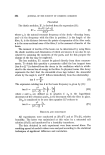
422 JOURNAL OF THE SOCIETY OF COSMETIC CHEMISTS the addition of an oil is specified (3) to reduce stickiness. Simple prepara- tions of this type including well-known proprietary products have been marketed for many years. A German trade mark of 1904 refers to a "lanolin toilet cream" (4). DEFINITION AND SIGNIFICANCE OF "WATER ABSORPTION" The amount of water which a given quantity of lanolin will emulsify or "absorb" is known to have an upper limit which varies from sample to sample. The maximum amount capable of being absorbed as a smooth emulsion without visible excess is sometimes used as a criterion of quality for lanolin, an absorption of 200%, i.e. twice the weight of the anhydrous substance, being usually regarded as an acceptable minimum. A test for maximum water absorption, sometimes referred to as "water number" or "water index", is of limited significance, since it is rarely that lanolin emulsions containing anywhere near the maximum possible water content are contemplated commercially. Stability of emulsions at more practical water contents is of greater importance, but there appears to be no fixed relationship between emulsion stability and maximum water absorp- tion. METHODS OF TEST FOR WATER ABSORPTION The first method published was that of Casparis and Meyer (5) who added cold water to molten lanolin in stages, with constant stirring, using a pestle and mortar, until no more water could be emulsified and the emulsion began to slip around the mortar. The mass was then spread out on a glass sheet at 0øC and turned over at intervals of several hours by a spatula, any separated water being removed by soaking up with filter paper. When separation of water ceased, the water remaining emulsified was determined by azeotropic distillation from an aliquot sample. Casparis et al (5) recognized that the water absorption was dependent on temperature, but offered no experimental evidence. The effect of temper- ature on a different test method is shown in Table I, but small vari- ations in ambient temperature are indicated to be of little practical signi- ficance. The method of Casparis et al (5) is inconvenient as regards time, large weight of sample and type of apparatus, since emulsion builds up around the pestle and frequent scraping is necessary. The method also has an

THE WATER ABSORPTION PROPERTIES OF LANOLIN 423 Table I Effect of temperature on maximum water absorption* Temperature, øC water absorption, % 20 280 30 290 40 440 48 550 55 620 (after difficult start) 63 no emulsification *Mixmaster method, 50 g sample. inherent source of inaccuracy, occasioned by the deliberate addition of excess water which can break down part of the emulsion already formed. This is similar to the effect of adding too much water at any one time during the emulsification, an effect common to the preparation of w/o emulsions in general, whether experimental or commercial. As illustration, two emulsions were made by the Casparis and Meyer technique, incorporating respectively less than, and more than, the maxi- mum water absorbable without excess. After removing separated water from the glass plate (none separated from the first emulsion) final water absorptions were determined by azeotropic distillation as shown in Table Table II Effect of adding excess water to a lanolin emulsion (2 different samples) Water originally added, Water finally present, 200, 200 195, 195 300, 300 150, 160 (•aximumpossibleabsorptionwithout excess=280%) This inaccuracy in their first method was apparently recognized but not demonstrated by Cusparis and Meyer, who proposed a second method in- volring the preparation of successive emulsions with increasing water con- tents to establish the maximum water absorption without exceeding it. If one accepts this principle, however, the method may be simplified by carrying out step-wise emulsification only, just to the end point, and sub- tracting from the total water added that which was added as the last portion. The remainder is the "water absorption". Simplified procedures of
Purchased for the exclusive use of nofirst nolast (unknown)
From: SCC Media Library & Resource Center (library.scconline.org)