424 JOURNAL OF THE SOCIETY OF COSMETIC CHEMISTS this type have been proposed by Truter (6), and also by Aguiar and Huyck (7), and it is the method preferred by myself, using a 10 g sample in a porcelain dish about 75 mm diameter and stirring with a round-ended glass rod 125 mm long by 8 mm diameter. Water is added from a burette 0.5 ml at a time, or less if emulsification is difficult. The materials of construction of the apparatus are of some importance. For example, it is almost impossible to work with a glass pestle and mortar, due to premature slippage of emulsion around the walls. Different materials were compared by Velon and Picot (8) who recommended a stainless steel dish and a horn spatula. A special, hand-operated kneading machine was described and used by Jencic (9), whilst other workers (10) have passed the lanolin emulsion through a roll-mill as a means of expressing excess water. The use of a mechanical mixer has been proposed by Conrad (11), and I too have used this method with success, as have others, although makes of machine differed. As pointed out by Conrad (11) the results from different machines cannot necessarily be equated, and, as results presented here show, mechanical mixing tends to give higher results than hand mixing. The DAB (12) specifies a pestle and mortar method and a minimum absorption of 200%, whilst the OAB (13) stipulates a method similar to the first method of ( asparis and Meyer involving excess water, materials not being named. Even this list of test methods is not exhaustive, and rarely, if ever, can the results from one method be equated with those from another thus is the complexity of the present situation. FACTORS INHERENT IN LANOLIN WHICH AFFECT WATER ABSORPTION Free alcohols The percentage of free fatty alcohols in wool grease is already known to vary naturally, but it can also be affected by certain methods of processing. Lifschiitz (14) reported natural variation between 2% and 8% in wool grease and showed, as did Tiedt and Truter (15) later in more detail, that the pure esters were devoid of emulsifying power whereas the free alcohols were powerful emulsifiers. The natural free alcohol content of lanolin is altered during the commer- cial production of lanolin oil, wherein the liquid lanolin esters are separated from the hard, waxy esters by refrigerated fractional crystallization from

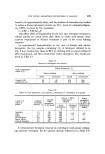
THE WATER ABSORPTION PROPERTIES OF LANOLIN 425 an organic solvent system (16). Distribution of the free alcohols between the two phases occurs, with the partition coefficient biased strongly to the liquid phase. This effect has been demonstrated by fractionating Anhydrous Lanolin B.P. using the method of Cording and Shaines (17). The oil and wax fractions were analysed and tested for water absorption as shown in Table III. The higher water absorption of the oil fraction is in conformity with the higher free alcohol content as indicated by the unsaponifiables, free cholesterol content [determined by the refluxing technique (18)] and hydroxyl value. A difference in hydroxyl value between oil and wax fractions has also been reported by Eisner, Noble and Scanlan (19), without mention of water absorption. Table III Effect of fractionating lanolin on water absorption Free fatty acids (as oleic), •o Unsaponifiables, •o Total fatty acids, •o Combined fatty acids (by diff.), •o Free cholesterol (by digitonin), •o Total cholesterol (by digitonin), •o Hydroxyl value Water absorption (10g in dish, by hand), Water absorption (50g in Midmaster), •o Original Oil Wax lanolin fraction fraction 0.3 51.6 50.0 49.7 2.5 20.6 27.9 310.0 350.0 0.5 54.8 46.9 46.4 4.6 19.6 33.7 380.0 500.0 0.22 47.7 53.5 53.3 1.2 20.4 25.3 155.0 190.0 As additional confirmation of the relationship between water absorption and free alcohols, the free alcohol content of the wax fraction referred to in Table III was restored by adding different percentages of various alcohols, as shown in Table IV. Mixed lanolin alcohols, and also cetyl Table IV Water absorption of lanolin wax fraction after adding free alcohols Type of alcohols added Mixed lanolin alcohols Cetyl alcohol Oleyl alcohol C 12 -014 alcohols Water absorption (•o)* at percentage of additive 0 1•o 2•o 3•o 155 220 290 310 155 260 330 350 155 130 100 140 155 150 120 100 *10g in dish, by hand
Purchased for the exclusive use of nofirst nolast (unknown)
From: SCC Media Library & Resource Center (library.scconline.org)