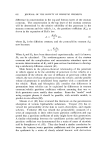
622 JOURNAL OF THE SOCIETY OF COSMETIC CHEMISTS difference in concentration in the top and bottom layers of the stratum comeurn. The concentration in the top layer of the stratum comeurn will be determined by the relative solubility of the penerrant in the stratum corneum and the vehicle, i.e., the partition coefficient (Kin), as shown in the expansion of Fick's law: - (2) where D,• is the diffusion constant, and the permeability constant now becomes: Kmf)m (3) k•- When kp and K• have been determined experimentally, and 3 is known, D,• can be calculated. The nonhomogeneous nature of the stratum comeurn and the complications and uncertainties attendant upon an accurate determination of Km and • pose serious limitations in develop- ing a satisfactory diffusion constant (61). Main factors in the physico-chemical relationship of the penerrant to vehicle appear to be the solubility of penetrant in the vehicles or a constituent of the vehicle, the rate of diffusion of penetrant within the vehicle, the rate of release of penerrant from the vehicle, and the possible release of penetrant in solubilized form together with a constituent of the vehicle. Blank and Scheuplein (25) consider that differences in penetration from vehicles can be explained by differences in stratum corneum/vehicle partition coefficient without assuming that one ve- hicle penetrates more readily than another. From the "model" work using receptor phases, it should be possible, with suitable models, to predict in vivo effects (62). Minato et al. (63) have reviewed the literature on the percutaneous absorption of various lipid-soluble substances. Tregear (16) has re- viewed the permeability of the skin to water, electrolytes, and organic solvents. Treherne (64) has related the permeability constants of a series of compounds to their ether/water partition coefficients and sug- gested that a partition coefficient of unity might favor skin penetration. A similar relationship between the vasodilator activity and lipid/water partition coefficient was demonstrated for a series of esters of nicotinic acid by Stoughton et al. (65). They also found a similar correlation be- tween the benzene/water partition coefficients and the penetration of the epidermis by a series of closely related boronic acid derivatives.

SKIN PENETRATION 623 Cronin and Stoughton (66), studying the penetration of nicotinic acid and ethyl nicotinate, were able to show a very dramatic difference (37,000-fold) between the penetration rates of the two materials. They postulated that the differing ether/water partition coefficients of the two com?ounds were at least in part responsible for the difference. Aprotic molecules such as dimethyl sulfoxide (DMSO), dimethylformamide (DMF), and dimethylacetamide (DMA), with high lipid and water solubility and the capacity to form strong hydrogen bonds, penetrate skin themselves and aid in the penetration of other agents. The positive permeation effects of solubility and partition coefficient characteristics are perhaps best illustrated with the corticosteroids. Triamcinolone possesses five times the systemic activity of hydrocortisone but only one-tenth its topical activity. Conversion of triamcinolone to its acetonide yields a more favorable lipid/water partition coefficient and enhances the topical activity one-thousandfold (67). Similarly, betamethasone has 30 times the systemic activity of hydrocortisone, but only ten times its topical activity. Conversion to betamethasone-17- valerate, with a more balanced lipid/water coefficient, increased topical activi_ty over tenfold (68). The effects of steroid solubility are also major factors in penetration from varied vehicles (60, 69-71). Molecular Characteristics of Penetrant An inverse relationship appears to exist between absorption rate and molecular weight (16, 25, 65, 72-74). Small molecules penetrate more rapidly than large molecules, but within a narrow range of mo- lecular size there is little correlation between size and penetration rate. Diffusion constants through hydrated stratum corneum for many low molecular weight compounds appear approximately the same (75). Yet, when Feldmann and Maibach (19) determined the human urinary ex- cretion of a series of topically applied molecules of relatively similar molecular weight (ca. 200), there was a large difference in penetration of the compounds tested. The specific effect on penetration rate of the size and shape of the penetrating molecules can be determined only if the effect of size and shape can be separated from the effect of solubility characteristics. Blank and Scheuplein (25), in studies of homologous alcohols from methanol to octanol, noted that water solubility decreases and lipid solubility in- creases with increasing molecular weight, and the rate of penetration in- creases as the molecular weight increases.
Purchased for the exclusive use of nofirst nolast (unknown)
From: SCC Media Library & Resource Center (library.scconline.org)