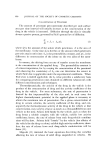
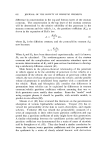
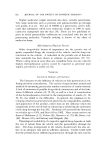
620 JOURNAL OF THE SOCIETY OF COSMETIC CHEMISTS Concentration of Penetrant The amount of penetrant percutaneously absorbed per unit surface area per time interval wild usually increase as the concentration of the drug in the vehicle is increased. Diffusion through the skin is virtually always a passive process, governed by Fick's general law of diffusion: e At where Q is the amount of the solute which penetrates A is the area of the membrane t is the time ]8 is the flux or the amount which penetrates per unit area in unit time k• is the permeability constant, and zxC8 is the difference in concentration of the solute on the two sides of the mem- brane. In essence, the driving force or rate of transfer across the membrane is the concentration of the applied drug. The permeability constant is of utmost importance, for by varying the concentration of the penetrant and observing the consistency of /%, one can determine the extent to which Fick's law is applicable under the experimental conditions. When Fick's law is indeed applicable, the k• value provides a satisfactory basis for comparing penetration rates obtained in different laboratories with different concentrations and techniques. Thermodynamically, the activity of the drug in the vehicle is the product of the concentration of drug and the activity coefficient of the drug in the vehicle. For most substances, the rate of penetration is limited by the irapermeability of the skin and, in such cases, the highest thermodynamic potential in the applied phase is necessary to obtain the maximum rate of penetration. For a given concentration of drug in certain vehicles, the activity coefficient of the drug, and con- sequently the thermodynamic activity of the drug in the vehicle at that concentration, may vary by a factor as much as a thousandfold from one vehicle to the next. Solutes held firmly by the vehicle, such as when the drug forms a soluble complex with the vehicle, exhibit low activity coefficients hence, the rate of release from such drug-vehicle combina- tions will be slow. Solutes held "loosely" by the vehicle (less affinity of the vehicle for the drug or solute) exhibit high activity coefficients there- fore, the rate of release from such drug-vehicle combinations will be faster (11). Higuchi (11) initiated the basic equations describing the variables affecting the rate of release of solid drugs suspended in vehicles. He

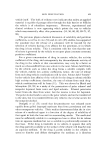
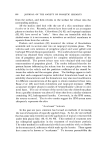
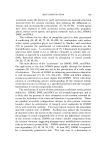
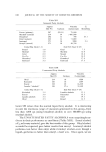
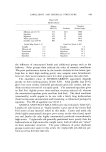
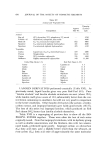
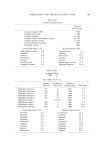
SKIN PENETRATION 621 pointed out that the driving force behind the drug movement is the difference in the thermodynamic potential between the vehicle and the deeper tissues, and the direction of flow for systems is always from higher thermodynamic potential to lower thermodynamic potential. Wagner (53) has reviewed the thermodynamic considerations involved in vehicle-drug relationships. The positive penetrative effects of increased concentration have been particularly demonstrated using varied steroids (53-56). Skog and Wahlberg (57) have shown a definite increase in the absorption of various compounds with increasing concentration in guinea pigs. They noted increasing penetration up to a certain point at which a plateau was reached. This may indicate that the barrier layer may not be primarily influenced by diffusion gradients, but act by limiting the total amount of any substance passing through in unit time. When true steady-state diffusion is reached, the permeability constants are independent of con- centration. Dimethyl sulfoxide (DMSO) has an unusual concentration depen- dence. Low concentrations are virtually without effect. As the concen- tration is increased, there is a rapid enhancement of percutaneous pene- tration (58). A direct relationship was obtained between the concentra- ' tion of dimethyl sulfoxide and the rate of penetration of potassium methylsulfate (59). Solubility Characteristics of the Penetrant The aqueous solubility of a drug determines the concentration pre- sented to the absorption site, and the partition coefficient strongly in- fluences the rate of transport across the absorption site. Katz and Shaikh (60) indicate that the efficiency of percutaneous absorption may be a function of the product of the partition coefficient and the square root of the aqueous solubility, in agreement with theoretical considera- tions developed by Higuchi (11). The lipid/water partition coefficient per se is not as significant as the stratum corneum/vehicle partition coefficient (11, 28). If a substance is much more soluble in the stratum corneum than in the vehicle in which it is dissolved, the concentration in the first layers of the stratum corneum at equilibrium may be much higher than the concentration in the pre- senting solvent. The concentration in the lower layers of the stratum corneum will remain near zero, since these layers are in contact with a fluid which is being continuously replaced, or through which diffusion is relatively rapid. The flux, therefore, is more accurately related to the
Purchased for the exclusive use of nofirst nolast (unknown)
From: SCC Media Library & Resource Center (library.scconline.org)