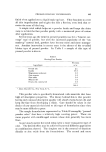
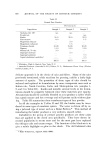
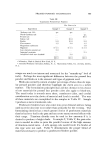
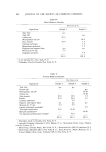
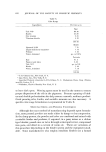
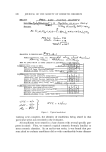
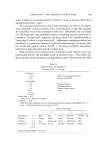
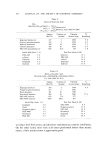
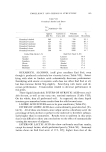
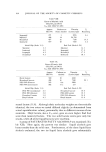
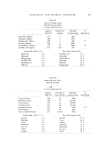
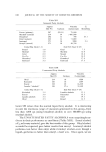
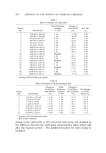
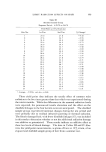
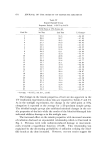
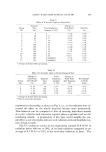
652 JOURNAL OF THE SOCIETY OF COSMETIC CHEMISTS weight. On the other hand, the fact that both of these are diesters did not help them as much, apparently, as increasing the length of the fatty chain (isostearate, myristate, and palmkate isopropyl esters). Finally, note that the "best of the best" was diisopropyl adipate, with an End Feel score of 18.8. It is striking that the isopropyl ester giving the poorest End Feel (isopropyl ricinoleate) was the best in terms of Initial Slip, a pattern which was observed repeatedly throughout this study. SUMMARY AND CONCLUSIONS It is possible to quantitate skin feel of cosmetics, and to do so reason- ably reproducibly--whether the same investigator repeats his own work at various time intervals or the work of another investigator. From the work to date, we can draw a few "intuitive" conclusions, not yet backed by rigorous graphic or statistical analysis. Such analyses must await evaluation of further samples, not available at the time of this initial study. The intuitive conclusions include our belief that molecular weight per se is not relevant to final skin feel, but that "oiliness" (HLB?) is. This is evidenced by the fact that the presence of polar groups gen- erally gives very negative effects. Some degree of unsaturation and/or chain branching was usually helpful, perhaps due to the "liquefying ef- fect" such structural changes produced, lowering the melting point of the residual oil phase left on the skin. Viscosity of the final test product had to be at certain minimum levels, otherwise results were poor. Physical factors of this type may "mask" the more purely chemical effects, obtained by systematically varying the struc- ture of cosmetic emollients. Finally (and we are really not quite sure why), isopropyl alcohol esters of most fatty acids were outstanding as a group. They were invariably at or near the top of each series in which they were tested. Many of the trends demonstrated in this study have been known through practical experience in the past, or known "intuitively" by ex- perienced cosmetic formulators. Now, however, being able to assign numerical values to skin feel makes it possible to study the subject sys- tematically, and to estimate the additive skin feel effect of a series of ingredients proposed for a cosmetic formula. Also, we can now begin to choose emulsifiers and other cosmetic components on a known skin feel basis, considering their SFI index as well as HLB, solubility, etc. With this approach, it may be possible to custom-design molecules for certain

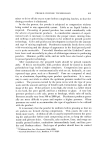
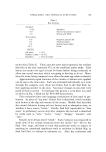
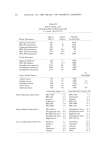
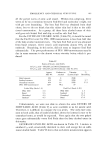
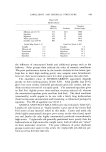
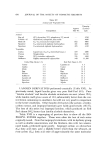
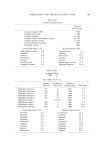
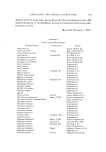
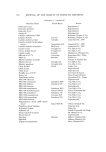
EMOLLIENCY AND CHEMICAL STRUCTURE 653 desired skin feel properties, just as drug and dye manufacturers now add desired antiseptic or chromophoric groups to molecules which have other functions as well. (Received February 1, 1971) APPENDIX I Source of Emollients Tested Chemical Namc Trade Name Source Butyl stearate Castor oil, USP Crystal CeW1 alcohol (natural) Cetyl lactate Ceraphyl 28 Decaglyceryl decaoleate Decaglyceryl octaoleate Decaglyceryl tetraoleate Decyl isostearate Decyl laurate Decyl linoleate Decyl oleate Ceraphyl 140 Dibutyl adipate Diethyl hexyl adipate Diglyceryl dioleate Diisopropyl adipate Ceraphyl 230 Diisopropyl azelate Diisopropyl sebacate Dimethyl adipate Di-PEG 350 adipate Dipropyl adipate Egg oil Erucyl alcohol Adol 22 Glyceryl monoisostearate Emery 3771D Hexadecyl alcohol (Cosmetic Grade) Hexadecyl laurate Hexadecyl linoleate Hexadecyl myristate Hexadecyl oleate Hexadecyl stearate Isodecyl isostearate Isodecyl oleate Ceraphyl 140-A Isodecyl stearate Isopropyl isostearate Emery 3770D Isopropyl lanolate Amerlate P Isopropyl linoleate Ceraphyl IPL Isopropyl myristate Isopropyl palmitate Propal Isopropyl ricinoleate Isostearyl alcohol Adol 66 Stoney Mueller Inc. Baker Castor Oil Co. M. Michel & Co. Van Dyk & Co. Drew Chemical Co. Drew Chemical Co. Drew Chemical Co. Experimental Experimental Experimental Van Dyk & Co. Experimental Experimental Experimental Van Dyk & Co. Experimental Experimental Experimental Experimental Experimental Viobin Corporation Archer Daniels & Co. Emery Industries Inc. Enjay Chemical Co. Experimental Experimental Experimental Experimental Experimental Experimental Van Dyk & Co. Experimental Emery Industries Inc. Amerchol Div., CPC Van Dyk & Co. Ruger Chemical Co. Robinson Wagner & Co. Experimental Ashland Chemical Co.
Purchased for the exclusive use of nofirst nolast (unknown)
From: SCC Media Library & Resource Center (library.scconline.org)