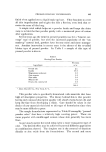
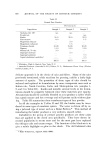
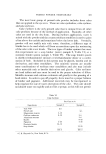
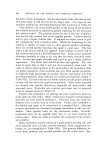
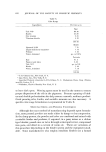
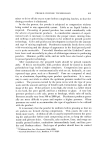
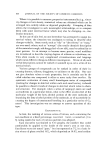
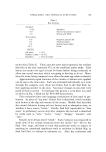
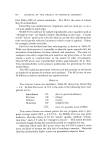
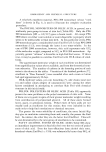
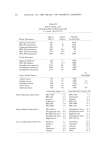
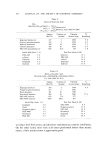
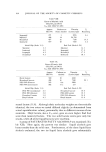
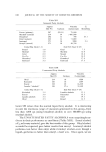
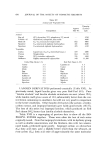
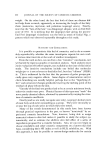
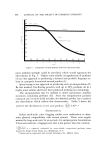
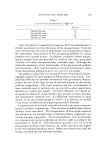
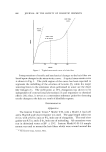
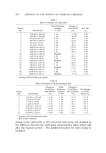
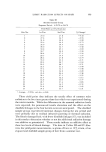
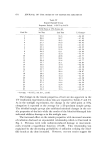
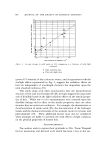
674 JOURNAL OF THE SOCIETY OF COSMETIC CHEMISTS Table IV Exposed Sample Group Exposure Period: 6-29-70 to 9-8-70 Yield Point at 15% Strain (g) Hair No. 1st Test 2nd Test % Change s l 2 3 4 5 6 7 8 9 l0 ll 12 13 14 15 16 17 18 19 20 21 22 23 24 25 30.8 28.0 35.0 27.7 32.6 25.1 22.2 24.2 29.6 38.5 31.7 28.4 35 7 30 0 34 0 29 7 33 7 28 6 28 2 31 6 25 1 27 5 25 1 31 2 34 2 16.5 14.7 20.5 14.0 19.2 12.4 12.0 12.1 16.0 22.8 18.4 15.4 21.1 17.4 20,2 16.5 20.6 15.6 15.2 18.3 11.6 14.6 12.4 16.6 19.6 --46 42 --47 50 -- 41 42 -- 49 45 --41 10 --50 59 --45 94 --50 00 --45 94 --40 77 --41 95 -- 45 77 --40 89 --42 00 --40.58 -- 44.44 -- 38.87 --45.45 -- 46.09 -- 42.08 --53.78 --46.90 --50.59 --46.79 --42.69 Average, --45.13% std. dev., -4-3.85. The changes in the tensile properties of hair are also apparent in the UV irradiation experiments whose data are reported in Tables V and VI. As in the sunlight experiments, the change in the yield point at 15% elongation is reported as the average for a 25-specimen sample group. The shielded sample groups also exhibited minimal changes in the ten- sile properties of the hair while the results of the bleached-damaged hair indicated additive damage as in the sunlight tests. The increased effect on the tensile properties with increased amounts of radiation disclosed an exponential relationship which is illustrated in Fig. 4. Previous work with radiation-induced damage to macromole- cules revealed a logarithmic function (18-20). This relationship was explained by the decreasing probability of radiation striking the disul- fide bonds as the dose increased. However, our test results suggest the

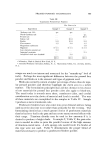
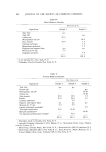
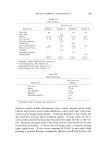
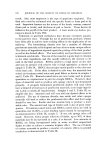
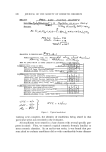
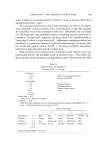
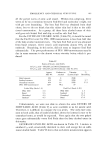
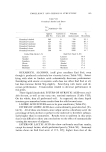
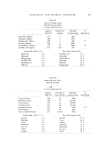
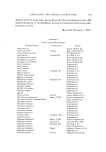
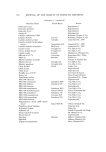
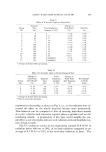
LIGHT RADIATION EFFECTS ON HAIR 675 Table V Effect of Ultraviolet Light on Virgin Hair Exposure Group Time No. (hr) Change in Total Radiation Yield Point a (langleys X 104) (%) Std. Dev. (+) 1 0 2 50 3 50 4 75 5 75 6 100 7 100 8 125 9 125 10 150 11 150 12 150 13 150 0 - 1.42 0.77 -4.03 0.77 -4.35 1.16 -5.47 1.16 -4.70 1.55 -7.16 1.55 -6.82 1.93 -7.64 1.93 -7.97 2.32 -10.2 2.32 -12.0 0 (shielded) -- 1.55 0 (shielded) -- 1.30 1.49 1.40 0.69 2.41 1.62 1.24 1.34 0.81 1.75 1.69 1.29 0.99 0.74 Average of 25 hair fibers per group. Table VI Effect of Ultraviolet Light on Bleach-Damaged Hair Change in Total Change in Yield Point Exposure Radiation Yield Point Net Changeb Group After Bleach" Time (langleys After Exposure in Yield No. (%) (hr) ( 104) (%) Point 1 --9.50 50 0.77 --13.8 --4.3 2 --9.05 100 1.55 --14.2 --5.2 3 --7.65 150 2.32 --18.4 --10.8 4 --8.88 150 2.32 --19.4 --10.5 Average of 25 hair fibers per group. Due to ultraviolet radiation. exponential relationship as shown in Fig. 4, i.e., as the radiation dose in- creased the effect on the tensile property became more pronounced. This behavior can be compared to that of severing individual strands ot: a yarn, wherein each successive rupture places a greater load on the remaining strands. A progression of this type would amplify the ten- sile effect as our test results indicate with radiation-induced disulfide rup- ture o[ hair keratin. The UV carbon-arc source in this experiment emitted 33.9 W/ft 2 of radiation below 400 nm or 20% of its total radiation compared to an average ot• 6.1 W/ft 2 or 5.9% ot• the total solar radiation in June. The
Purchased for the exclusive use of nofirst nolast (unknown)
From: SCC Media Library & Resource Center (library.scconline.org)