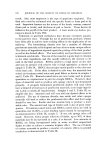
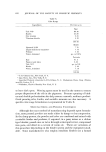
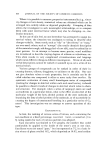
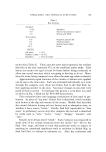
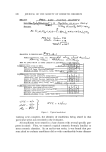
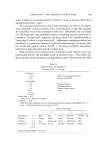
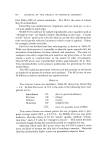
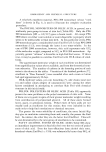
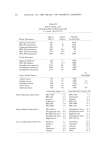
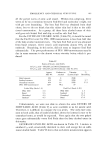
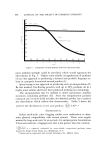
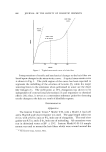
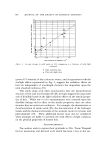
676 JOURNAL OF THE SOCIETY OF COSMETIC CHEMISTS lOO •o 7o •o •o 1 .o 2.o 3.o Lo TOTAL RADIATION IN LANGLEYS, x10 -• Figure 4. Average change in yield point at 15% elongation as a function of total light radiation 4• Solar radiation data [] Ultraviolet light data greater UV intensity of the carbon-arc source, and its agTeements with the sunlight effects represented in Fig. 4, suggests the radiation effects on hair are independent of wavelength character but dependent upon the total absorbed radiation (19). This study along with other examinations into the photochemical reaction of hair and wool keratin (21-24) strongly suggests the important role of disulfide bonds in the light radiation effects on the tensile proper- ties of hair. While our in vitro measurements were centered upon the disulfide linkage and its effect on the tensile properties, there are other moleties that are sensitive to radiation. For example, the deamination or decarboxylation of amino acids (25), the disorientation of the hydrogen bonds, and the chemical alteration of the aromatic nuclei in tyrosine and phenylalanine (19). These additional factors must also be considered when attempts are made to ascertain the total effects of light radiation on the physical properties of human hair. ACKNOWLEDGMENT The authors wish to express their gratitude to Mrs. Tessie Wiegand for her meticulous and devoted work which has been a key to the suc-

LIGHT RADIATION EFFECTS ON HAIR 677 cess of this program. The authors would also like to thank the Meteor- ology Department of the Argonne National Laboratory, Lemont, Ill., for the solar radiation data. (Received March 22, 1971) REFERENCES (1) Speakman, J. B., Mechano-chemical methods for use with animal fibers, J. Text. Inst., Trans., •8, 102-26 (1947). (2) Feughelman, M., and Reis, P. J., The longitudinal mechanical properties of wool fibers and their relationship to the low sulfur keratin fraction, Text. Res. J., •7, 884-6 (1967). (3) Collins, J. D., and Chaikin, M., The stress-strain behavior of dimensionally and struc- rurally, non-uniform wool fibers in water, Ibid., •5, 777-87 (1965). (4) Rebenfeld, L., Weigrnann, H. D., and Dansizer, C., Temperature dependence of the mechanical properties of human hair in relation to structure, J. Soc. Cosmet. Chem., 17, 525-38 (1966). (5) Bogaty, H., Torsional properties ,of hair in relation to permanent waving and setting, Ibid., 18, 575-89 (1967). (6) O'Connell, R. A., and Walden, M. K., Influence of ionizing radiations on wool fiber properties, Text. Res. J., 27, 516-18 (1957). (7) Berth, P., and Reese, G., Alteration of hair keratin by cosmetic processing and natural environmental influences, J. Soc. Cosmet. Chem., 15, 659-66 0964). (8) Zahn, H., Stein, W., and Blankenburg, G., Influence of surfactants on the physical prop- erties of keratin fibers, Fette, Seifen, Antrichm., 70, 756-60 (1968). (9) Deem, D. E., and Rieger, M. M., Mechanical hysteresis of chemically modified hair, J. Soc. Cosmet. Chem., 19, 395410 (1968). (10) Korostoff, E., Rawnsley, H. M., and Shelley, W. B., Normalized stress-strain relationship in human hair perturbation by hypothyroidism, Brit. J. Dermatol., 8•, 27-36 (1970). (l l) Swanbeck, G., Nyren, J., and Juhlin, L., Mechanical properties of hairs from patients with different types of hair diseases, J. Invest. Dermatol., 54, 248-51 (1970). (12) Price, V. H., and Menefee, E., On the effect of dimethyl sulfoxide on hair keratin, Ibid., 49, 297-301 (1967). (13) Speakman, J. B., and McMahon, P. R., The action of light on wool and related fibers, N. Z. J. Sci. Technol., 20, 248B-264B (1939). (14) Beyak, R., Meyer, C. F., and Kass, G. S., Elasticity and tensile properties of human hair. I. Single fiber test method, ]. Soc. Cosmet. Chem., 20, 615-26 (1969). (15) Book o[ ASTM Standards, Part 30, ASTM designation E187-63T, "Conducting natural light (sunlight and daylight) exposures under glass," Philadelphia, 1964, p. 526. (16) Climatological Data, National Summary, U.S. Department of Commerce, Environmen- tal Data Service, Asheville, N. C., 1970. (17) Wolfram, L. J., Hall, K., and Hui, ,•., The mechanism of hair bleaching, jr. Soc. Cosmet. Chem., 21,875-900 (1970). (18) Setlow, J. K., The Effects of Ultraviolet Radiation and Photoreactivation, in Florkin, M., and Slotz, E. H., Comprehensive Biochemistry, Vol. 27, Photobiology, Ionizing Ra- diation, American Elsevier, New York, N.Y., 1967, pp. 157-209. (19) Alexander, P., and Lett, J. T., Effects of Ionizing Radiations on Biological Macromole- cules, Ibid., pp. 267-356. (20) Marzona, M., and Dimodica, G., Effects of ionizing radiations on wool. Part 1: Solu- bility in alkalis, acids, urea, and urea-bisulfite solutions, Text. Res. jr., •8, 974-76 (1968).
Purchased for the exclusive use of nofirst nolast (unknown)
From: SCC Media Library & Resource Center (library.scconline.org)