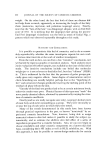
678 JOURNAL OF THE SOCIETY OF COSMETIC CHEMISTS (21) Joubert, F. J., Botes, D. P., and Haylett, T., The action of ultraviolet light on wool, J. Afr. Chem. Inst., 17, 44-54 (1964). (22) Dunlop, J. I., and Nicholls, C. H., Electron spin resonance studies of UV irradiated keratin and related proteins, Photochem. Photobiol., 4, 891-90 (1965). (23) Shatkay, A., and Michaeli, I., Electron paramagnetic resonance study of wool irradiated by ultra-violet and visible light, Radiat. Res., 43, 485-98 (1970). (24) Bhan, M. M., and Sule, A.D., The effect of sunlight on canary-stained wools, J. Text. Inst., Trans., 58, 46-8 (1967). (25) Luse, R. A., and McLaren, A.D., Mechanism of enzyme inactivation by ultraviolet light and the photochcmistry of amino acids (at 2537 •), Photochem. Photobiol., 2, 343-60 0963).

Book Reviews DIMETHYL SULFOXIDE, VOL. I: BASXC CONCEPTS or DMSO, Edited by Stan- ley W. Jacob, Edward E. Rosen- baum, and Donald C. Wood. Mar- cel Dekker, Inc., New York, N. Y. 10016, 1970. 477 pages. This volume represents the first of two which will form a basic source book for all scientific disciplines on the potential properties and uses of DMSO. Until relatively recently, DMSO was a laboratory curiosity used primarily as a tissue preserva- tive. It is startling to note how rap- idly the literature concerned wi,th DMSO has grown, and this book represents a superb introduction to this complex subject. This volume includes 13 chapters from an impressive list of contribu- tors and an additional section sum- marizing the individual bibliogra- phies. The predominant tbeme in most chapters dealing wi,th the physi- ological properties of DMSO is its ability to penetrate membranes and to facilitate membrane transport. DMSO evidently has bacteriostatic properties, but its primary effect on microbiological systems is again its ability to facilitate access of the anti- 679 microbial moiety to the microorga- nism. The fact the DMS0 even per- mits penetration of low molecular weight polypeptides through the skin holds great potential for im- munization with inactivated bac- teria, as through the mucosa. With regard to the utility of DMS0 in dermatology, this reviewer must agree with Dr. Cortese, who in- dicates that DMS0 in itself does not possess remedial properties but that it appears to be a vehicle for the transport of dermatological medica- tions into and through intact skin. As is the case with most books made up of chapters by various au- thors, some repetition does occur. The book is surprisingly free of typo- graphical errors, and chapters are well organized. This book is not for leisurely reading but is primarily a reference volume which should prove valuable to those interested in DMSO. Even the most casual reader will be impressed by the many pharma- cological activities which DMSO is reported to exhibit. Evidently, ve.ry few human clinical studies utilizing DMSO or combinations of DMSO
Purchased for the exclusive use of nofirst nolast (unknown)
From: SCC Media Library & Resource Center (library.scconline.org)