EXAMINATION OF PARTICULATE INCLUSIONS IN TOOTHPASTE 479 have been obtained previously with improvised equipment added to the conventional work chamber of the El2 E4 coating unit. The toothpaste under examination is formed into beads 3 to 5 mm in diameter on the specimen mounts supplied with the freeze-etch module up to six samples can be prepared at one time. Freezing of the toothpaste depends upon the nature of the major component. Aqueous formulations are quenched in liquid Freon 12 held at its freezing point (c. --158 ø) in liquid nitrogen excess Freon is shaken from the mount as it is transferred into liquid nitrogen prior to mounting on the specimen saddle under liquid nitrogen. Glycerin-based formulations are solidified either by cooling the specimen mounts on solid carbon dioxide or by cooling mounts and saddle directly on the freezing-stage. Glycerin-based formulations required slower and less extreme (c. --130 ø max.) cooling than water-based formulations to prevent spontaneous fracturing. The solidified specimen/mount/saddle assembly is transferred to the freezing stage of the freeze-etch module. The temperature is held at between --80 ø and --100 ø to defrost the stage assembly, as the vacuum chamber is evacuated to better than 10 4 torr. The freezing-stage is then cooled to the minimum temperature attainable with the specimen under examination. The specimens are fractured by a microtome which is cooled by liquid nitrogen. The fresh fracture surfaces are immediately shadowed with plati- num/carbon at a nominal grazing angle of 30 ø, and backed by carbon evaporated normal to the specimen surface. The vacuum chamber is brought to atmospheric pressure by admitting dry air. The specimen-mounts are quickly removed from the stage and saddle, and the replicas stripped from the fracture surfaces. Three tech- niques have been adopted for stripping the replicas from the toothpastes: (a) on to ammonia solution (Specific Gravity 0.88, freezing point --84 ø cooled in a solid carbon dioxide/alcohol bath to --72ø (b) on to distilled water at room temperature (c) on to tap water at room temperature. The cooled ammonium hydroxide bath was employed so that the toothpastes remained solid during stripping the surface tension and freezing point of ammonia solution make it suitable for the process. Stripping on to distilled water is a normal practice during replication, but since water-based tooth- pastes are made up in tap-water, the effect of the reduced salt concentration on the particulate inclusions was examined by stripping on to tap water. The free replicas are cleaned on fresh baths of the appropriate stripping agent and recovered on bare nickel grids. The dry replicas are examined.

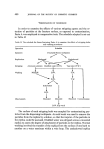
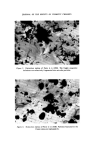
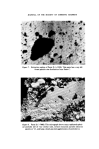
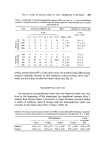
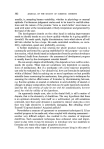
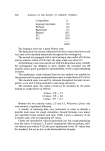
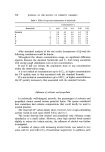
480 JOURNAL OF THE SOCIETY OF COSMETIC CHEMISTS VERIFICATION OF TECHNIQUE In order to examine the effects of various stripping agents and the re- tention of particles at the fracture surface, as opposed to contamination, Paste A was employed in comparative tests. The schedule adopted is set out in Table II. Table II. The schedule for freeze-fracturing Paste A to examine the effects of stripping baths and washing procedures Operation Specimen Schedule Fractured frozen toothpaste Replication Shadowed Unshadowed Stripping Washing Observations Ammonia solution Distilled water (D.W.) NH!OH D!W. 0.01N HCI D.W. Mo nted Mou Tap water (T.W.) T.Wo •ted Mou •ted Contal tination D.W. drip wash The surface of each stripping bath was sampled for contaminating par- tides from the dispersing toothpaste. An acid wash was used to remove the particles from the replica by solution, so that the imprint of the particles in the replica could be assessed. Distilled water was dripped across a mounted replica to assess the degree of attachment of particles to the replica. Normal washing involved the transfer of the replica from the surface of one bath to another on a water meniscus within a wire loop. The unshadowed replica
Purchased for the exclusive use of nofirst nolast (unknown)
From: SCC Media Library & Resource Center (library.scconline.org)