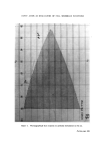
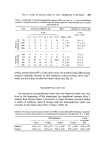
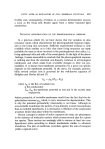
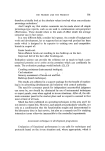
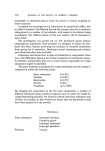
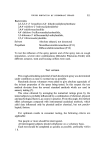
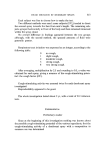
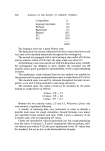
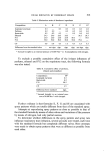
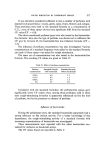
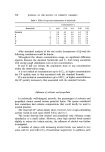
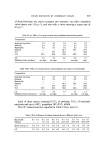
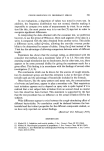
COUGH IRRITATION BY DEODORANT SPRAYS Table I. Elimination series of deodorant ingredients 515 Composition: A B C D E F G* Isopropyl myristate 0.3 -- 0.3 0.3 0.3 0.3 0.3 Perfume 0.2 0.2 -- 0.2 0.2 0.2 0.2 Bactericide 0.2 0.2 0.2 -- 0.2 0.2 0.2 Ethanol 24.3 24.6 24.5 24.5 -- 24.3 24.3 F11 25.0 25.0 25.0 25.0 49.3 -- 75.0 F12 50.0 50.0 50.0 50.0 50.0 75.0 -- CF 6.0 6.0 4.5 1.5 4.5 6.5 4.5 Difference from the standard value -- not sign. sign. sign. sign. not sign. sign. * Aerosol brought to an internal pressure of 0.009 Nm -• (= 8 atmospheres) with nitrogen. To exclude a possible cumulative effect of the irritant influences of perfume, ethanol and F12 on the respiratory tract, the following formula was also tested. Table 1I. Cumulative effect of perfume, ethanol and propellant Composition: H* Isopropyl myristate 0.3 Bactericide 0.2 Fll 99.5 CF 4.5 Difference from standard sign. * Aerosol brought to an internal pres- sure of 0.009 Nm -• with nitrogen. Further evidence is that formulae E, F, G and H are associated with spray patterns which are totally different from that of the standard spray. Attempts at reproducing spray patterns as close as possible to that of the standard formula by means of other valves and variations of the pressure by means of nitrogen, had only partial success. To determine whether differences in the spray pattern and spray rate influence respiratory tract irritation, several aerosols were tested, each time with the standard formula but completely different valves. Here attempts were made to obtain spray patterns that were as different as possible from each other.

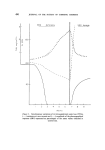
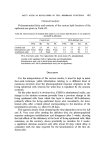
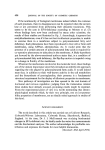
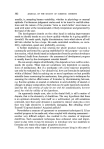
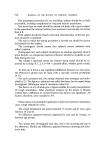
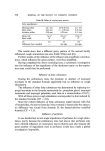
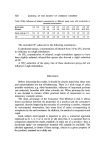
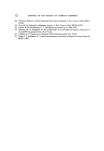
516 JOURNAL OF THE SOCIETY OF COSMETIC CHEMISTS Table III. Effect of varying spray pattern Valve specification: Housing orifice 2.0 mm 2.0-0.50 mm 2.0 mm Stem orifice 0.45 mm 2 x 0.50 mm 0.45 mm Actuator orifice 0.50 mm 0.50 mm 0.33 mm Spray rate 1 g s 4 0.6 g s -x 0.4 g s 4 Spray angle 16 ø 10 ø 12 ø CF 6.0 5.5 6.0 Difference from standard -- not sign. not sign. The results show that a different spray pattern of the aerosol hardly influenced cough stimulation (see also Table VII(a) and (b)). Further studies of the influence of the ethanol and propellant concentra- tions, which influence the spray pattern, were thus simplified. Having completed the above screening tests, a systematic investigation into the influence of the ingredients of the deodorant spray on the respira- tory tract could then be performed. Influence of fatty substances During the preliminary tests, the presence or absence of isopropyl myristate in the standard formula apparently had no influence on cough stimulation. The influence of other fatty substances was determined by replacing iso- propyl myristate in the formula successively by: propylene glycol, isopropyl isostearate and isopropyl palmitate, each time at a concentration of 0.3•. With all these sprays cough stimulation corresponded to that induced by the standard formula (CF = 6.0). Since the irritant influence of fatty substances might interact with that of bactericides, the above formulae were re-tested in bactericide-free sprays no difference was found from formula D, the bactericide-free modified formula (CF = 1.5). Influence of perfumes It was decided not to test single ingredients of perfumes for cough stimu- lation, partly because the preliminary tests had shown that perfumes only had a limited influence on respiratory tract irritation and also because the great number of ingredients used in perfumes would have made a global investigation impossible.
Purchased for the exclusive use of nofirst nolast (unknown)
From: SCC Media Library & Resource Center (library.scconline.org)