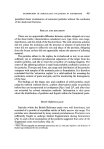
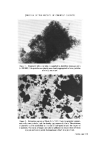
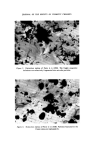
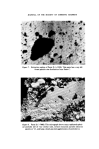
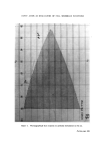
EXAMINATION OF PARTICULATE INCLUSIONS IN TOOTHPASTE 481 permitted closer examination of extracted particles without the confusion of the shadowed fractures. RESULTS AND DISCUSSION There was no appreciable difference between replicas stripped on to any of the three baths characteristics considered were type, form, size range, distribution, and the detail of the fracture faces. The cold ammonia solution did not attack the inclusions and the presence or absence of salts from the water did not appear to affect the size and shape of the particles. Stripping from the frozen surface did not appreciably reduce the amount of adhering material. The particles adhere to the replica, be it shadowed or not, to an extent sufficient: (a) to withstand gravitational separation of the larger from the smaller particles, and (b) to resist the cross-flow of washing reagents. The extent of the adhering surfaces is small and probably confined to points on the particles. The type and form, size range and distribution of the particles compares with samples of the materials prior to formulation. It is therefore concluded that the 'extraction replica' is a valid method for assessing the particulate content of gums and gels, and for monitoring the homogeneity of the base. The findings on the shape, size, and condition of solid particles, made using the method outlined above, confirm observations made on particles before they are incorporated in toothpastes (Figs I and 2)*, and after they are extracted by solvent extraction methods. Information is also given about the distribution of particles and liquids within the formulated paste. British Reference paste Particles within the British Reference paste were well distributed, and consisted of a powder of crystalline calcite of fairly narrow size range. The particles were characterized by many conical protuberances. The latter were sufficiently fragile to undergo limited fragmentation during formulation (Fig. 3), and a close examination of the particles suggested that some of the fragmented cones were hollow (Fig. 4). * Note: All micrographs are presented unreversed, that is, with pale shadows the direction of shadowing is indicated by the arrowheads.

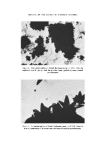
482 JOURNAL OF THE SOCIETY OF COSMETIC CHEMISTS Chalk-containing paste (A) This paste contained more fragile particles than the British Standards reference paste. The particles were well distributed and characterized by many acicular crystals growing from a solid core. Fragmentation of the particles was extensive in this paste (Fig. 5). Silica-containing pastes (B, C, D) Extruded strips of the clear silica-containing pastes were visually very similar. Micrographs of the freeze fracture extraction replicas confirmed this similarity at the microscopic level. Paste B contained two types of amorphous, expanded silica particles (Fig. 2), one type being relatively fine and fluffy, the other being coarser and more continuous in outline and morphology. Pastes C and D (Figs. 6 and 7) were similar to each other and differed only slightly from Paste B in the size-range and morphology of the particles. Polymer sphere-containing paste (E) In contrast to the well distributed, inorganic particles observed in most pastes this paste contained poorly distributed polymer spheres. The polymer spheres were frequently observed aggregated into close-packed arrays (Fig. 8). Toothpaste performance The performance of a toothpaste can be summarized mainly in terms of its 'cleaning' and abrasive properties. The cleaning power or cosmetic value, of dentifrices is thought to be directly proportional to their dentine abrasi- vity (1, 2) while the clinical acceptability has been related to the reciprocal of the dentine abrasivity. The reason for this may be twofold: (a)fear of excessive abrasivity may have caused over-reaction against the more abrasive pastes, or (b) abrasivity with respect to dentine is the most easily
Purchased for the exclusive use of nofirst nolast (unknown)
From: SCC Media Library & Resource Center (library.scconline.org)