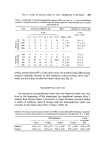
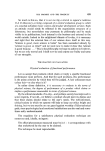
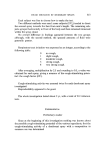
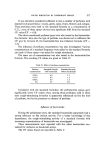
COUGH IRRITATION BY DEODORANT SPRAYS 517 It was therefore considered sufficient to test a number of perfumes with distinctive characteristics' woody, green, spicy, fruity, flowery and cologne. These perfumes were used in the standard formula at a concentration of 0.2%' none of these sprays showed any significant shift from the standard CF value (CF = 6.0). The above-mentioned perfume types were also tested in the bactericide- fi'ee formula' here also the type of perfume was shown not to influence the CF give by formula D, the bactericide-free low-irritation formula (CF -- 1.5). The influence of perfume concentration was also investigated. Various concentrations of a standard fragrance were added to the standard formula and each of these sprays was tested for cough stimulation. The same set of concentrations was also tested in the bactericide-free formula. The resulting CF values are given in Table IV. Table IV. Effect of perfume concentration Perfume Standard formula Standard formula concentration with bactericide without bactericide O.2O% 6.O 1.5 0.13% 6.5 1.5 O.O6% 6.O 1.5 O% 4.5 O.5 Compared with the standard formulae, the perfume-free sprays gave significantly lower CF values thus, among those perfumes used in these tests cough-stimulating irritation is apparently influenced not by the kind of perfume, but by the presence or absence of perfume. Influence of bactericides During the preliminary tests, the standard bactericide apparently had a strong influence on the irritant activity. For a better knowledge of this dependence, the cough-stimulating activity of a standard formula with increasing concentrations of bactericide was investigated. These measurements were repeated with five other bactericides con- sidered for inclusion in deodorant sprays. The CF values found are reported in Table V.

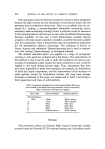
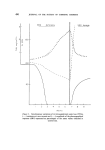
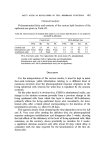
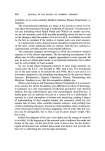
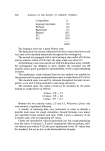
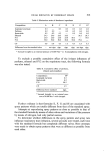
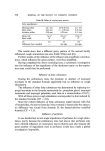
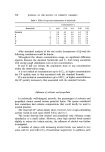
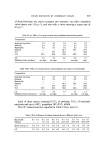
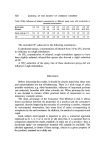
JOURNAL OF THE SOCIETY OF COSMETIC CHEMISTS Table V. Effect of type and concentration of bactericide Concentration % Bactericide 0 0.05 0.10 0.15 0.20 0.25 Standard • 3.0 4.5 6.0 6.5 7.0 A I 2.0 2.5 4.0 6.5 7.5 B 1.5 1.0 1.5 2.0 2.0 1.5 C 1.5 1.5 1.5 2.5 2.5 D I 1.5 4.0 5.0 7.0 7.0 E • 3.5 4.5 5.5 7.5 7.5 After statistical analysis of the test results (comparison of Q-test) the following conclusions could be drawn: Throughout the chosen concentration range, no significant difference appears between the standard bactericide and E, both being associated with strong cough stimulation even at low concentration, B and C did not irritate the respiratory tract at any concentration within the observation range, A is not irritant at concentrations up to 0.1 •o at higher concentrations the CF quickly rises to that associated with the standard formula, D is not irritant at concentrations up to 0.05• at higher concentrations the CF quickly increases to that associated with the standard formula. Influence of solvents and propellant In technically well-designed aerosols, the percentages of solvents and propellant cannot exceed certain practical limits. The sprays considered here sometimes had extreme compositions that could hardly be used in normal practice. The observed CF values clearly show, however, how cough-stimulating activity varied in such cases (Table Vl(a) and (b)). The results showed that ethanol and propellant only influence cough stimulation to a small extent. However, since high alcohol levels seemed slightly to reduce the irritant activity, the influence of alcohol was further investigated. A number of sprays with increasing alcohol levels was tested in two series with 0.1 and with 0.2• of bactericide respectively. In addition, each
Purchased for the exclusive use of nofirst nolast (unknown)
From: SCC Media Library & Resource Center (library.scconline.org)