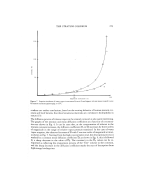
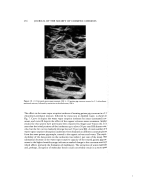
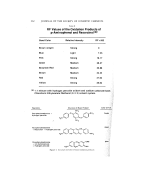
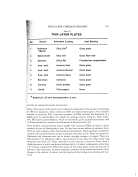
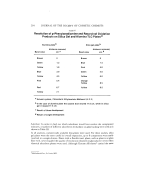
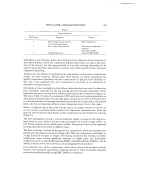
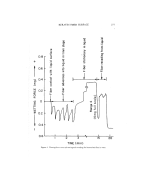
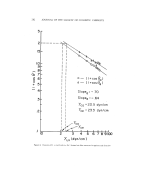
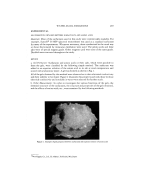
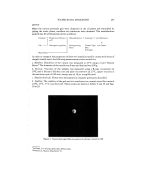
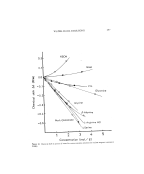
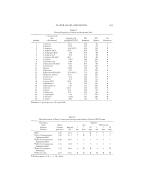
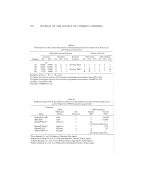
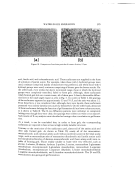
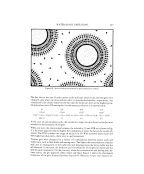
WATER-IN-OIL EMULSIONS 305 ß _. ' (a) , (b) Figure 18. Comparison of emulsion particles of creams: division, 2.5rtm acid, linolic acid, and isohexadecanoic acid. These suroeactants are supplied in the form of a mixture of partial esters. For example, when those with 3 hydroxyl groups were used, a mixture comprised mainly of monoester was preferred, and when those with 4 hydroxyl groups were used, a mixture comprising ofdiester gave the better results. On the other hand, even within the above mentioned range, those in which the hydroxyl groups were completely esterified, failed to form gels. Although, those surfactants which formed gels did not contain water, all of them gave 2 clearly discernible diffrac- tion lines in the small angle region as seen in Fig. 3. As is seen in Table I, the spacings of the surfactants appeared at approximately 33 and 70 •, and the ratio was about 1:2. From these facts, it was considered that, although, they were liquids, these surfactants possessed very orderly lameliar structures by themselves. On the other hand, almost all of those surfactants lacking the function of gel formation did not have a clear structure, as is shown in Table II. The X-ray diffraction patterns were indistinct or completely lacking even though they were clear the spacings were either too wide or too narrow. Such results of X-ray analysis were identified as having a close correlation to gel forma- tion. As a result, it can be concluded that, in. order to form gels, the corresponding surfactants are required to have at least a high orderly lameliar structure. Contrary to the restriction of the surfactants used, almost all of the amino acids and their salts formed gels. As shown in Table III, nearly all of the monoamino- rnonocarboxylic acids (neutral amino acid) with an. isoelectric point in the. weak acidic range, such as monosodium salts of monoamino-dicarboxylic acid (acidic amino acid) and monohydrochlorides of diamino-monocarboxylic acid (basic amino acid) were ca- pable of forming gels. Those readily soluble in. water were very effective, such as glycine, L-alanine, B-alanine, hydroxy L-proline, L-serine, monosodium Dglutamate rnonohydrate, monopotassium L-glutamate monohydrate, monosodium L-aspartate monohydrate, monopotassium Daspartate dihydrate, L-lysine monohydrochlo/-ide L-arginine monohydrochloride, and L-histidine monohydrochloride. The D- and DL stereoisomers also gave good gel formations.

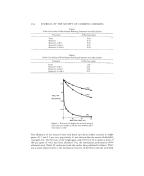
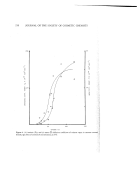
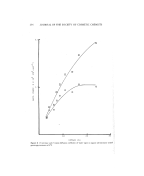
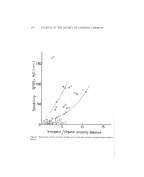
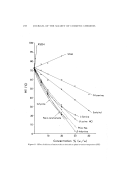
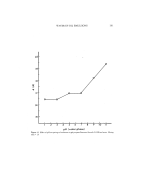
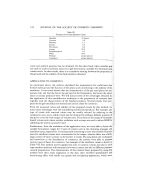
306 JOURNAL OF THE SOCIETY OF COSMETIC CHEMISTS x 1041 10 Of , • Squalane 1 O0 br-C8 -Trigly 0 5O 0 50 100 Component of Oil phase % (w/w) Figure 19. Influence of a component in oil phase on stability ofo/w emulsions
Purchased for the exclusive use of nofirst nolast (unknown)
From: SCC Media Library & Resource Center (library.scconline.org)